



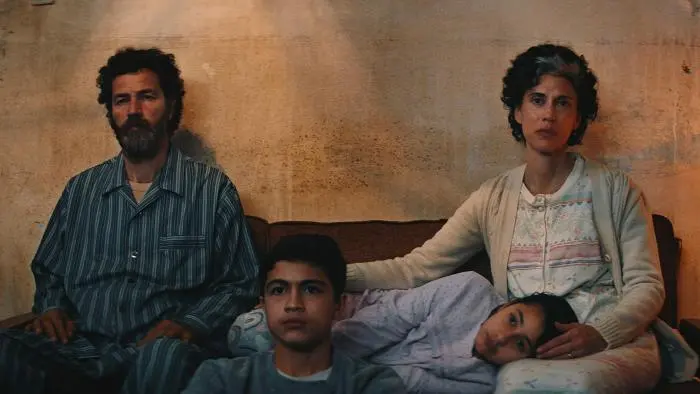
All That’s Left of You, written and directed by Cherien Dabis, was one of the notable films screened in the “Broken Olive Branch” section at the 43rd Fajr International Film Festival, where it won the award for Best Film in that category. The film is a powerful and thought-provoking melodrama that follows the story of three generations of a Palestinian family against the historical backdrop of the Israeli–Palestinian conflict. It is an honest and painful portrayal of the fate of a people who have lived for decades under occupation, discrimination, and humiliation, yet who retain an unending desire for freedom—even in the darkest of times. All That’s Left of You is a chronicle of the suffering and the long, enduring resistance of an occupied nation. Dabis initially intended to shoot the film in Palestine, but following Hamas’s October 7 attack on Israel and the subsequent bombardment of Gaza, she was forced to change the filming location.
The film opens in 1988 with a gripping sequence depicting a clash between Palestinian fighters and Israeli occupying forces in the West Bank. Here, a spirited Palestinian teenager named Noor comes face to face with Israeli soldiers, embodying the spirit of the Intifada—the Palestinian uprising against Israeli occupation. Noor’s fate is left uncertain as the windshield of the car in which he has taken refuge shatters. The film then cuts to a long flashback to 1948, taking us deep into the past to discover who this young man is, where he comes from, what family he belongs to, and what led him to this confrontation.
Using a Brechtian device, Hanan—Noor’s mother—addresses the camera directly, telling us that to understand what has happened to her son, we must first understand what happened to his grandfather, Sharif. In fact, Hanan serves as the film’s implicit narrator, portrayed by the filmmaker herself, Cherien Dabis, in a restrained yet powerful performance. Although her character remains largely in the background, the story revolves around her son, her husband, and her father-in-law, and how these men and boys relate to one another and struggle to endure over the years and decades as an authentic Palestinian family.
The film then flashes back to 1948—the year of the Nakba, the forced displacement of Palestinians from their homes and lands in what is now called Israel. Sharif and his family live in the beautiful city of Jaffa. As Israeli forces advance, the city’s residents are compelled to flee, but Sharif refuses to abandon his home and land. His refusal carries grave consequences, leading to his arrest and imprisonment. The film shows how the traumas and psychological and physical wounds inflicted by the Nakba and the occupation are not confined to a single moment in time, but can persist for years. Sharif’s suffering, through the complexities of family bonds, the weight of generational trauma, and the constant presence of occupation, is deeply felt in Noor’s life and plays a decisive role in his transformation from a fearful child into a determined teenager who actively participates in protests.
One of the film’s most powerful aspects is its depiction of how occupation shapes the everyday lives of Palestinians—how aggression, occupation, violence, and humiliation destroy dreams, sow the seeds of hatred, and intensify the desire for resistance. Cherien Dabis demonstrates that occupation is not merely a political or territorial issue; it is profoundly intertwined with the individual and historical identity of the Palestinian people.
What makes the film especially impactful—particularly in its first half—is its subtle yet forceful portrayal of the idea of resistance to aggression, occupation, and humiliation. The film raises essential questions: when everything is taken from you, what is left? How can one remain hopeful amid constant darkness, suffering, and loss? Through Noor’s life story and his family’s past, the filmmaker attempts to answer these questions. As the narrative progresses, we follow the fate of the family between 1978 and 1988. Sharif has become an old, bitter, broken man who still dreams of his orange groves. Salim, once lively and joyful, has grown up and now faces harassment and humiliation at the hands of Israeli soldiers himself.
Noor, who as a child witnessed his father being humiliated by Israeli soldiers and saw how Salim endured that humiliation to save his own life and his son’s, grows resentful toward his father, viewing him as a coward. One particularly striking scene illustrates the endless cycle of humiliation endured by Palestinians: Israeli soldiers stop Salim and his young son Noor on the street and, at gunpoint, force Salim to confess in front of his child that he is a donkey.
After a long flashback and an extended journey through time and the painful history of Palestine, the film returns to the present. We learn that Noor has been shot in the head and declared brain-dead. His parents, Salim and Hanan, are forced to take him to a hospital in Israel for treatment. The suffocating bureaucracy involved in transferring a wounded Palestinian child to an Israeli hospital for urgent surgery constitutes yet another form of humiliation—one whose consequences are no less damaging than the soldiers’ direct violence. Noor’s parents must now confront their son’s tragic fate and accept his painful death. When the hospital suggests donating Noor’s organs, they find themselves in a deeply dramatic dilemma. Salim wonders what it would mean if his son’s heart were transplanted into the body of an Israeli soldier—an enemy of Noor and other Palestinian youths. Yet, as a Palestinian sheikh suggests, “Perhaps God will use this act to create a spirit within them that brings us together—Muslims and Jews alike.” This becomes the film’s conciliatory message, one that many who think only in terms of struggle and revenge in Palestine may find difficult to accept.
Nevertheless, the second half of the film lacks the dramatic power of the first, turning the work into a more emotional and lighter melodrama. For this reason, the film ultimately approaches the Palestinian issue from a pacifist perspective. In its ending, the filmmaker cleverly distances herself from the idea of resistance, preventing the film from becoming radicalized.
Still, All That’s Left of You is a film that offers us the chance to understand not only the political dimensions, but also the profound human costs of the struggle between the Palestinian people and Israeli occupiers. In a world that often seeks to forget or ignore these struggles, Cherien Dabis’s film compels us to listen, to reflect, and to never forget.
© 2020-2026. Phoenix Review