



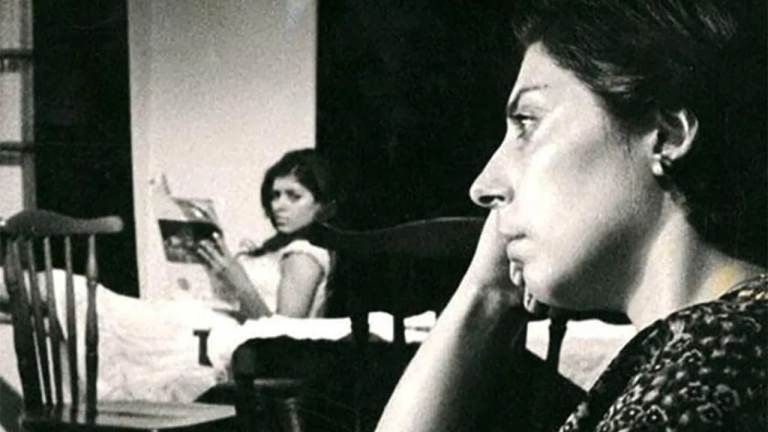
The film Tranquility in the Presence of Others is a psychological drama about a society in transition — centered on a family caught between tradition and modernity, a family that has lost its identity and stands with one foot in the past and one in the present, without any visible horizon of light or hope for the future.
Nasser Taghvai, an auteur and stylistically distinctive Iranian filmmaker — whose list of unproduced screenplays and unrealized projects is impressively long — is among those rare directors for whom literary adaptation has always been a creative preoccupation. Throughout the pre- and post-1979 periods, he sought to keep the dim light of adaptation burning in Iranian cinema.
Taghvai, one of the pioneers of the Iranian New Wave in the 1960s, entered filmmaking through documentary work and created seminal short documentaries such as Bad-e Jen (The Genie’s Wind), Arba’in, and Tamrine Akhar (The Last Rehearsal), the latter centered on the ritual performance of ta‘ziyeh.
His landmark television series My Uncle Napoleon (1976), adapted from Iraj Pezeshkzad’s bestselling novel of 1969, remains one of the most enduring works of Iranian popular culture — a series that, even today, stands up to comparison with contemporary television dramas in every respect.
Taghvai also directed the short film Rahayi (Deliverance), which received international acclaim. His first feature-length film, made in 1969, was based on a story by Gholam-Hossein Sa’edi, for which Taghvai himself wrote the screenplay.
Tranquility in the Presence of Others is an adaptation of Sa’edi’s story of the same name from his collection Nameless Fears (1967), the author’s sixth book of short stories. The story captured the psychological and social tensions of its time — and it was Taghvai’s distinct cinematic vision that transformed it into one of the most important works amid the tide of commercial films of that era.
After a limited screening at the Shiraz Arts Festival in 1969, the film was banned for four years, finally reaching public cinemas in 1973. Even in its censored form — reportedly shortened by about forty minutes — it was enthusiastically received by critics and audiences alike, until protests from the nursing community forced it off screens.
At the 1971 Venice International Film Festival, the film won the Silver Lion for Best First Feature, marking the international recognition of Taghvai’s unique voice. In many ways, Tranquility in the Presence of Others inaugurated a modest yet weighty cinematic career — six features in total, three before and three after the Revolution — whose absence has left a palpable void in Iranian cinema ever since.
The film portrays a geographically and emotionally isolated family whose reunion only exposes the depth of their fractures. These rifts, extending beyond the household, serve as a metaphor for Iranian society in the 1960s — a society torn between the remnants of tradition and the pressures of modernity.
The opening scene introduces Mahlaqa (Leila Baharan), a young nurse walking through her home, changing clothes and speaking casually to her maid, Ameneh (Mehri Mehrnia). The arrival of her lover Ali (Ali Naraqi) and their flirtatious conversation — mingled with her lines, “I’ve felt uneasy since morning, anxious for no reason” — prepare the audience for the disruption that follows: the unexpected arrival of her father, the Colonel (Akbar Meshkin), and his young wife, Manizheh (Soraya Qasemi), from the provinces.
Their sudden appearance upends the carefree, libertine rhythm of Mahlaqa and her sister Maliheh (Parto Nooriala), laying bare their conflicting values and worldviews — tensions that ultimately lead to both moral and emotional disintegration.
The Colonel, a retired officer who has sold his poultry farm to return to Tehran with his teacher-wife, now faces uncertainty about whether his decision was wise — a question that drives the film. His worsening mental state and dependence on alcohol force his daughters to confront a new and troubling side of their father. His psychological decay echoes the emotional emptiness lurking beneath the surface of his daughters’ seemingly modern lives; both generations harbor secrets they are unwilling to face.
The rupture within the family — the father’s nostalgic delusion of still being in command, and the daughters’ immersion in the superficial glitter of urban modernity — deepens with every encounter.
Taghvai frames much of this tension through the eyes of Manizheh, the young stepmother. An outsider to both the father’s old-world authoritarianism and the daughters’ shallow modernity, she becomes a quiet observer — suspended between two ways of life, yet belonging fully to neither.
With subtle cinematic intelligence, Taghvai translates each character’s inner turmoil into visual terms, bringing the audience intimately close to their fragile psychological states.
One striking example is the sequence where the Colonel walks along a sidewalk, passing by the gates of a military academy. In his mind, this stroll becomes a formal inspection — we see only the synchronized legs of marching soldiers — but in reality, he is saluting the rows of trees lining the street.
The daughters, too, inhabit fragile illusions. Mahlaqa’s advice to Manizheh — to visit beauty salons, to talk, to stay cheerful — reveals her denial of the emotional void beneath her modern façade. Her joy at Ali’s reluctant offer of marriage, prompted by her pregnancy, marks not liberation but submission to another form of dependency.
Maliheh, on the other hand, entangled in a hopeless affair with Dr. Sepanlou (played by poet Mohammad-Ali Sepanlou), reacts to betrayal not with confrontation but self-destruction — slitting her wrists in despair, unable to endure the emotional exposure demanded by modern relationships.
Each member of this family fails in their attempt to reconcile the old and the new. The father’s madness, culminating in hallucinations of ghosts among trees and his desperate cry — “Why is this city so dark?” — leads him to a mental institution. Mahlaqa’s forced marriage and Maliheh’s suicide confirm that beneath their modern appearance, both women remain bound to traditional, romanticized notions of femininity, love, and dependence.
Amid this collapse, Manizheh stands as the only figure capable of calm observation. Though from the provinces, she resists the glitter of city life and maintains emotional clarity. Even during the raucous party scene, she denies her intellectual admirer Atashi (Manouchehr Atashi) further intimacy. In the end, she gives the dying Colonel his last sip of water — an image recalling the earlier slaughter of chickens, foreshadowing his imminent death.
Through this fractured family, Taghvai sketches a larger portrait of Iranian society in the 1960s — not only across generations, but also in the disillusioned intellectual class.
One of the film’s most prophetic scenes unfolds in a tavern, where Sepanlou, Ali, and Atashi — drunk and agitated — debate their own alienation and the moral paralysis of their society. Their confused, self-serving critique embodies the moral fragility of Iran’s intellectuals of the time: a class aware enough to analyze, yet too compromised to act.
It is here that Tranquility in the Presence of Others transcends the domestic and becomes historical — a quietly furious critique of a society stumbling toward collapse. Taghvai captures, with painful precision, the disintegration of values and the blindness of a generation that, through its own folly, pushed the nation toward a collective descent.