



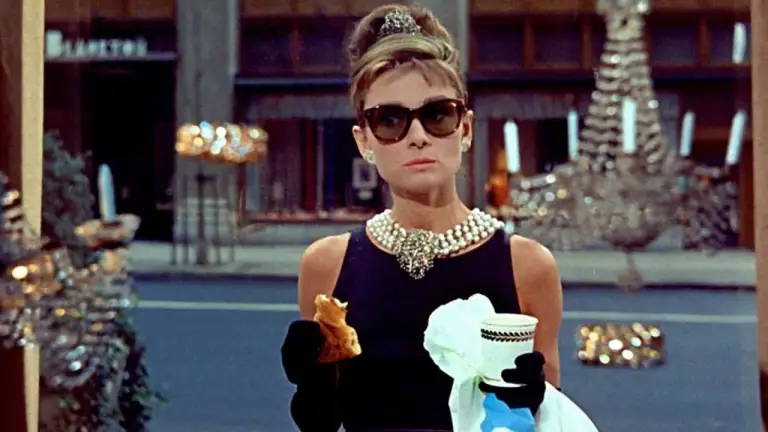
Breakfast at Tiffany’sis a romantic drama with comedic undertones centered on the life of a young, ambitious woman who fits into no frame and accepts no boundaries. It is this untamable spirit—intertwined with a love affair that sweeps through her life—that gives her story its pull and emotional allure.
Blake Edwards, the American writer, director, producer, and actor, is best known for his comedies and his unmistakably personal style, though he also made works in melodrama, suspense, and horror.
Among his most celebrated comedic films are The Pink Panther series and The Party, both born from his collaboration with the legendary British comedian Peter Sellers. These films earned him numerous nominations and awards from major festivals such as the Oscars, Césars, Golden Globes, Moscow, San Sebastián, and more.
In 1983, Edwards was nominated for the Academy Award for Best Screenplay for the musical romantic comedy Victor/Victoria, starring his wife Julie Andrews. In 2004, he finally received an Honorary Academy Award for his lifetime achievements.
The spark that ignited the 1961 romantic comedy Breakfast at Tiffany’s came from Truman Capote’s novella, with a screenplay adaptation by Capote and George Axelrod—whose credits include The Manchurian Candidate and The Seven Year Itch.
The creative engine of the film remains Capote’s novella, first published in Esquire in 1958 and later compiled with three short stories in a volume of its own. Capote—whose works have inspired numerous adaptations—is especially renowned for this novella and his true-crime masterpiece In Cold Blood (1966).
The role of Holly Golightly was initially intended for Marilyn Monroe, at Capote’s insistence. But with a change of studio and advice from Lee Strasberg—Monroe’s acting coach, who believed the role could harm her public image—Monroe ultimately withdrew despite initial enthusiasm.
Her casting would certainly have reshaped the interpretation of Holly’s restless spirit. Yet it was Audrey Hepburn—despite Capote’s early objections, her own doubts about playing such an extroverted character, and the age gap between her and Holly—who embraced this challenging role and filtered the legend of Holly Golightly through her own iconic persona.
Breakfast at Tiffany’s earned five Academy Award nominations, including Best Actress for Hepburn and Best Screenplay for Axelrod. It won Oscars for Henry Mancini’s unforgettable score and for Best Sound. The film also collected nominations at the Golden Globes, the Grammys, and others.
This romantic comedy unfolds around Holly Golightly’s carefree, unanchored life in 1960s New York—a young woman with a mysterious and shadowed past, who belongs to no one and nothing but money, and who flees whenever she senses attachment. Yet within the film’s two-hour drama, this one unwavering principle of her life is destabilized—by the accident of love.
Holly is a multi-layered character moving along a curve full of peaks and plunges: from rebellious girl to cunning woman, from devoted sister to lover of fashion and money, from innocent chanteuse to a rootless, nameless drifter who refuses even to name her cat, lest she become its owner.
These fluctuations—her conflicts and contradictions—create a unique character who, despite her complexities, remains deeply human and relatable. Her believability owes much to the actress who embodies her.
Audrey Hepburn, drawing upon the distinctions between the novella’s Holly and the film’s, adds something of herself to the character. Through a fusion of elegance, beauty, innocence, fragility, and rebelliousness, she shapes a vivid and enduring image—one that transcends page and screen.
The film introduces us to Holly and her adventurous life through a carefully crafted narrative device that serves multiple purposes. The audience enters her world alongside a newcomer, Paul Varjak (George Peppard). As Paul steps into her apartment and her life, we—like him—encounter Holly and the world orbiting around her, eventually arriving at an emotional understanding that mirrors his own.
This mutual curiosity draws them into something deeper: a turbulent mixture of love and jealousy, new and unfamiliar to each of them. The narrative design allows viewers to experience emotions parallel to the characters they’re watching.
This choice stems from the novella’s structure, in which the young writer is the unnamed narrator. In the screenplay and film, this narrative strategy is adapted with intelligence: part of the audience’s connection with Holly arises from this parallel, shared emotional perspective, and the rest—from Hepburn’s unforgettable recreation of the character.
In Breakfast at Tiffany’s, we encounter a love story whose central drama—especially concerning Holly’s past and psychological depth—has been softened compared to the novella, culminating in a happy ending for the central couple, leaving the audience delighted.
Yet even after the joyful ending, one cannot ignore the emotional, psychological, and physical voids of the girl who had to: grow up too soon, become a woman, wear a smile, forget her real name, abandon the fantasy of a prince on horseback, become the heroine of her own story, stand unmasked, toy with morality, remain unfamiliar with love, long for money,
and begin her mornings before the Tiffany’s window—
or stop wondering why such a hollow ritual ever formed in her mind.
© 2020-2026. Phoenix Review