



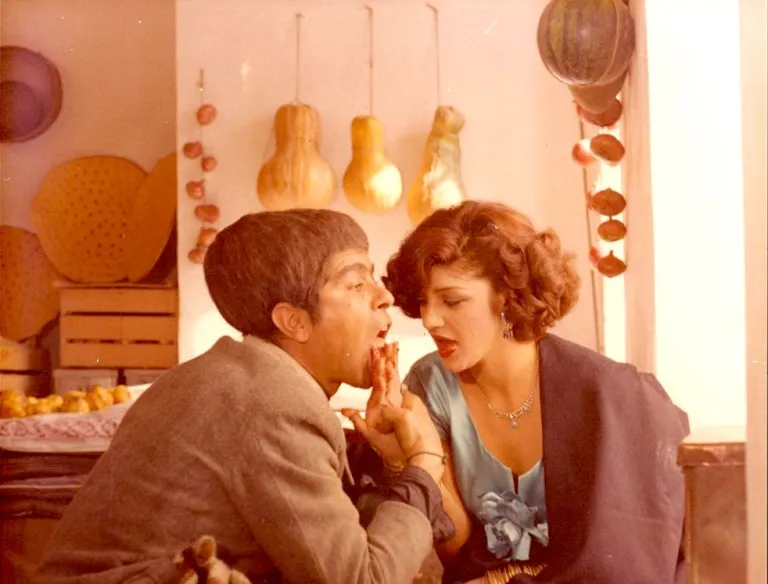
The Soulless (Souteh-Delan) is a romantic drama centered on an old Iranian family and the emotional tensions within it—particularly around a brother whose mental and physical disabilities profoundly affect the entire household, even their experience of love itself.
Ali Hatami, the auteur and stylistic craftsman of Iranian cinema, began his artistic career in the 1960s as a playwright and theatre writer. His entry into film came with Iran’s first musical, Hassan Kachal (1969), a folkloric tale that became a popular success.
Hatami’s most prolific period, the 1970s, culminated in one of his defining works—and one of Iranian cinema’s most important films—The Soulless (1977). Written and directed by Hatami, it bears his unmistakable personal signature, blending poetic dialogue, moral reflection, and a nostalgic devotion to Iranian tradition.
Produced by Ali Abbasi, who had also backed Hatami’s debut Hassan Kachal, the film marked their second collaboration, later followed by Jafar Khan Returns from Europe (1980)—the last production in Abbasi’s distinguished career. During the 1960s and ’70s, Abbasi produced works by some of Iran’s leading filmmakers, including Masoud Kimiai, Amir Naderi, Nosrat Karimi, Parviz Sayyad, and Jalal Moghadam. The Soulless won the Special Jury Prize and an Honorary Diploma for Best Film at the 6th Tehran International Film Festival in 1977, yet amid the political unrest of the era, it was not seen or celebrated as it deserved.
Set in Tehran around 1941, during the turmoil of World War II, the story unfolds within the Zoroufchi family—longtime bazaar merchants who rent dishes and utensils for weddings and funerals. The household consists of three brothers—Habib (Jamshid Mashayekhi), Karim (Saeed Nikpour), and their half-brother Majid (Behrouz Vossoughi)—along with their mother (Roghayeh Chehre-Azad). The elder brother Habib shoulders the burden of caring for both his mother and his mentally challenged brother, Majid, a duty that has kept him from marrying the woman he loves, Forough-ol-Zaman (Fakhri Khorvash).
Through this family, the film explores profound human and moral themes—timeless concerns that recur throughout Hatami’s work. These ideas, simple or even familiar as they may seem, never lose their gravity under his hand. Hatami saw himself as a guardian of Iran’s cultural memory—its values, rituals, and traditions—and his films often strive to preserve them within the fabric of their stories.
The father’s absence and Habib’s role as caretaker place the family at the film’s emotional core. Yet Majid’s condition reshapes the family dynamic, forcing Habib to navigate duty, love, and sacrifice all at once. The choice of their profession—renting tableware—serves as a narrative device, allowing Hatami to interlace scenes of celebration and mourning, joy and sorrow, life and death, creating a rhythm of dualities that mirror the essence of existence itself.
Each brother embodies a different form of love:
- Habib’s repressed affection for Forough-ol-Zaman evolves into a selfless devotion to his family.
- Karim finds passion in his hobby of raising birds.
- And Majid, the childlike soul, experiences love in its purest, most unguarded form—unaware of flaws or social boundaries.
Majid’s innocence makes him the film’s emotional axis. Through him, Hatami constructs a world defined by sincerity, vulnerability, and devotion. Majid’s story unfolds through three encounters with love: the portrait of a girl in a photography shop window, a disabled cinema ticket-seller (Minoo Abrishami), and Aghdas (Shohreh Aghdashloo)—a woman of ill repute whose kindness captures his heart. But in Hatami’s universe, the revelation of truth becomes a kind of death; when Habib, in an act of moral honesty, exposes Aghdas’s reality, his compassion inadvertently destroys Majid’s fragile peace.
Here, Hatami expands the notions of ethics, truth, and love beyond cliché. The two brothers’ devotion collides: Habib’s love for family compels him to reveal the truth, while Majid’s love for Aghdas could have redeemed them both—if only Habib had remained silent.
The film’s visual and emotional language mirrors Majid’s world: childlike yet profound, poetic yet tragic. He wanders the streets like a lost dreamer, seeking love and redemption, only to find healing not in life but in death—failing to reach the shrine of Imamzadeh Davood, where his soul finally rests.
The Soulless stands as a perfect symphony of dialogue, monologue, color, light, and rhythm. Hatami weaves his trademark lyrical prose into the visual texture of the film, transforming the story into a cinematic poem—an ode to the purity of love and the sanctity of devotion, ending with a tragic crescendo that celebrates the eternal majesty of love itself.