



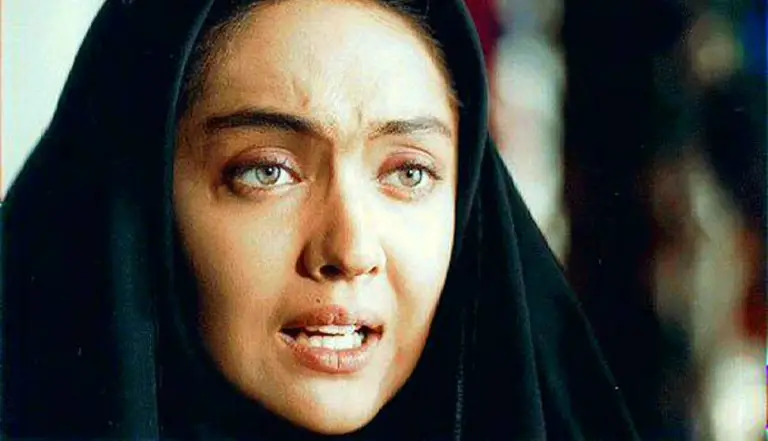
The film Sara is an adaptation-driven drama centered on the life crisis of a housewife who endures her circumstances through a courageous choice. Yet her disappointment with her husband’s response pushes her toward an unexpected act—an act through which, for the first time, she learns how to say no.
Dariush Mehrjui, with his rich body of work shaped by influential films made both before and after the 1979 Revolution, is especially known for creating some of the most significant literary adaptations in Iranian cinema. From his early works in the 1960s that strengthened the Iranian New Wave, to the films he made in the 1980s that gave a sense of identity and meaning—rooted in art, aesthetics, cinematic language, drama, and image—to the uncertain cinema of that era, Mehrjui played a defining role.
With The Tenants (1986), he made a bold leap in Iranian comedy that remains referential to this day; with Hamoun (1989), he forged a lasting bond between philosophy, love, and drama—one that became a turning point both in his career and in Iranian cinema as a whole.
The 1990s marked the beginning of his engagement with what came to be known as his “women’s films.” Although the first of these was delayed for six years due to censorship before reaching the screen, it nonetheless presented a distinctive and thought-provoking image of women. At a time when Iranian cinema was largely male-centered and women were often confined to marginal and passive roles, this portrayal became enduring and significant.
Banoo (1991), Sara (1992), Pari (1994), and Leila (1997) are the products of this intellectual phase in Mehrjui’s career—each made through a different adaptive approach. These works range from an adaptation of Luis Buñuel’s Spanish-Mexican film Viridiana, to Henrik Ibsen’s Norwegian play A Doll’s House, J. D. Salinger’s American novel Franny and Zooey, and an Iranian story by Mahnaz Ansarian.
Sara is the result of Mehrjui’s challenging adaptation of Ibsen’s famous play A Doll’s House (1879). The drama centers on the rebellion of a woman, Nora, who takes initiative beyond her husband Torvald Helmer’s narrow-minded worldview—where he perceives her as a thoughtless doll—in order to save him and their life together, only to have her very legitimacy and worth called into question.
Numerous films around the world have been made over time inspired by or adapted from this play. In Iran, beyond Sara, the work has been staged as theatrical performances, radio plays, and television theater, and has been translated into Persian many times.
Mehrjui believed that the atmosphere of this nineteenth-century work bore a particular affinity with Iranian society in the 1990s, and naturally with the status and condition of women at the time. This perceived parallel is what led him to choose the play for adaptation and localization.
Sara received five nominations at the 11th Fajr Film Festival, ultimately winning the Crystal Simorgh for Best Screenplay and Best Supporting Actress for Yasmin Malek-Nasr. Internationally, the film garnered numerous awards and nominations, including the Golden Shell for Best Film and the Silver Shell for Best Actress (shared) for Niki Karimi at the San Sebastián Film Festival in Spain, as well as the Silver Balloon for Best Film and the Audience Award at the Three Continents Festival in France.
The narrative of Sara unfolds linearly across two time periods separated by three years. In the first phase, we accompany the external crisis faced by the couple—Hessam (Amin Tarokh) and his pregnant wife Sara (Niki Karimi). This crisis stems from the husband’s illness and compels Sara to make a personal and daring decision to cover the cost of his surgery—a decision whose nature is revealed in the film’s second time frame.
In this phase, we witness Sara’s loneliness and inevitability, her difficult position as a woman left to fend for herself, so that her forced (not necessarily correct) solution appears as a product of circumstances rather than a blind, careless, or ignorant act of defiance. This is especially true given that she knowingly resorts to borrowing money, usury, forgery, lies, and secrecy—despite her awareness of her husband’s strong opposition and sensitivity toward such matters.
All of these elements are subtly planted in the film’s opening segment. With the three-year time jump, we enter the second phase, observing the couple’s seemingly ordinary life. Here, Sara’s crisis has moved from the outside into her inner world, trapping her in a tense and agitated psychological state.
At this point, Hessam has received a job promotion, and Sara has managed—alone—to carry this heavy burden and secret, standing on the verge of finally laying it down. Yet despite having repaid her debt to her husband’s colleague, Gostasp (Khosrow Shakibai), once his old friend Sima (Yasmin Malek-Nasr) becomes involved and Gostasp’s professional position is threatened, Sara’s secret is on the brink of exposure.
This intelligent narrative structure and dramatic design allow the audience—thanks to the careful groundwork laid earlier—to stand in a position similar to that of Sima. Equipped with a mental understanding of Sara, the viewer can arrive at a personal assessment of her character, which magnifies the significance of her seemingly self-destructive action within Sara’s own moral and emotional scale.
In the second phase, as these narrative seeds bear fruit and the relationships between characters become clear, the film delicately dramatizes Sara’s volatile situation. Caught between the exhausting routines of daily life, housework, and late-night pearl embroidery on a wedding dress, she struggles to conceal and manage her anxiety, tension, and fear.
While Sara takes pride in the heroic dimension of her secret act—saving Hessam’s life—she can share this truth only with Sima. Yet the scale of her husband’s reaction and his manner of confronting the revelation far exceed her calculations, fears, and anxieties.
Through this progression, Hessam’s inner volcanic eruption—manifested through reproach, blame, indifference, insult, and ultimately the questioning of Sara’s very existence and competence—functions like bridges collapsing one after another, leaving her no path of return. This remains true even after Hessam extends a hand of reconciliation following Gostasp’s “ceasefire letter.”
Sara is transformed from the heroine of her own inner narrative into an unworthy wife, even deemed unfit for motherhood. This overnight fall—from her own self-conception to her husband’s perception—is something she cannot reconcile with or accept.
It is here that Sara, for the first time, standing as an independent identity—someone who has saved her husband, her family, and her life—chooses refusal. She disobeys, and she leaves the house.
Throughout the film, we encounter shifting emotional, psychological, and mental states in Sara, which the filmmaker attempts to convey visually. Through images and frames shaped by color fades, contrasts, and visual oppositions, the film depicts her inner conflicts and turbulent psyche—expressing her mental atmosphere and inner world without the need for words.
Sara is a film that goes beyond portraying the crisis of a simple, traditional housewife. It constructs a dramatic uprising of a woman who conceals her heroic act, like so many unassuming women do. Yet at the very moment she expects—not admiration, but merely understanding—she is met with rejection, pushing her toward defiance and rebellion.
Her ultimate achievement, born from this disillusionment and inner rupture, is the attainment of a single, profound virtue: the ability to say no.