



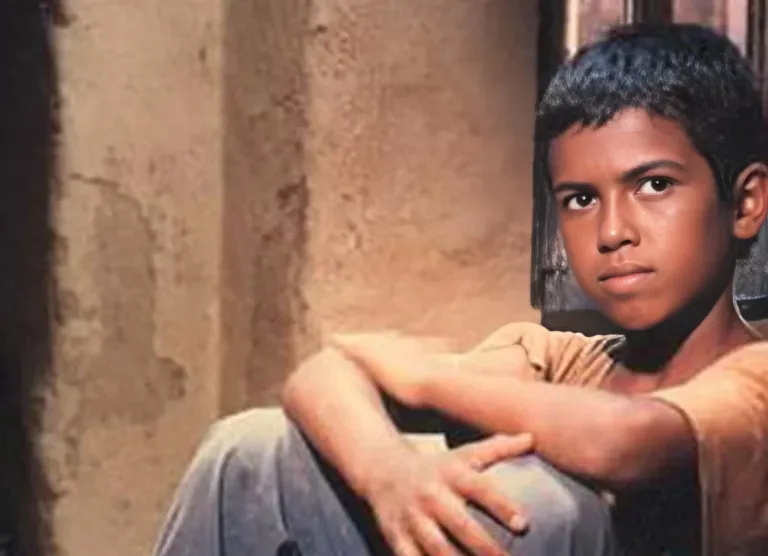
A Stranger Who Became Familiar to the World | On Bashu, the Little Stranger
The restored version of Bahram Beyzai’s Bashu, the Little Stranger won the award for Best Film in the Classics section of the 82nd Venice Film Festival. Perhaps even Beyzai himself did not imagine that forty years after making Bashu, the Little Stranger, one of his finest works would once again shine on a global stage at such a prestigious festival and receive international recognition. This year, the Classics section at Venice showcased the worldwide premieres of restored versions of eighteen cinematic masterpieces from different countries, all reconstructed over the past year by archives, cultural institutions, and film production companies. Even without winning the award, the mere inclusion of Bashu, the Little Stranger among these eighteen masterpieces was a major achievement and an honor for Iranian cinema. It demonstrates that a great film is made once but can bring pride countless times, serving as a national artistic treasure that earns recognition, admiration, and acclaim. On the occasion of this renewed success, this note revisits the making of Beyzai’s enduring film.
The Story
Bashu, the Little Stranger, written and directed by Bahram Beyzai, was produced in 1985 and, after numerous delays, was released in 1990. During one of the bombings in southern Iran amid the Iran-Iraq war, a young boy named Bashu, having witnessed the destruction of his home and family, climbs into a moving truck to escape and falls asleep. When he awakens, the truck has reached northern Iran. Fleeing from explosions meant for road construction, he finds himself in a remote farm belonging to a woman named Naii-Jan, who lives and works there with her two children in the absence of her husband, who has traveled to earn a living. Naii-Jan gives Bashu food and water and tries to understand who he is and what language he speaks. But the boy’s southern dialect is incomprehensible to her, just as Bashu cannot grasp her local language. In return for her kindness, Bashu attempts to help her with daily chores, assuming that Naii-Jan’s husband, away on a trip, would approve—unaware that he actually opposes the presence of this stranger in their home. Discovering this, Bashu leaves, but Naii-Jan finds him in the rain and brings him back, even using mild force. Later, when Naii-Jan falls ill, Bashu manages the household in her place, and concerned for her recovery, he prepares a bath for her in his own southern way. In a letter to her husband, Naii-Jan writes that she has accepted Bashu as a son and will share her food with him. When her husband finally returns, Bashu meets him; the father, having lost his right hand during his journey, accepts Bashu as a surrogate and together the family confronts pests in their fields.
Beyzai explained in an interview that the initial idea for the film came during the war years when he traveled to northern Iran and saw southern war refugees who had migrated there. He wondered what the first southern person to arrive had felt, what thoughts ran through their mind, how they communicated, and how they adapted to this new environment.
The cast included Susan Taslimi, Adnan Afravian, Parviz Pourhosseini, Farrokh Laqa Houshmand, Akbar Dudkar, Reza Houshmand, Azam Rahbar, Mohammad Farkh, Mo’azzaz Bani Dokht, and Azizollah Salmani, with Firouz Malekzadeh as the cinematographer. Beyzai himself selected the music and edited the film.
From Domestic Ban to Global Acclaim
Bashu, the Little Stranger was able to premiere publicly in February 1990, nearly four years after its completion. The film deals with the Iran-Iraq war and its effects on civilians, particularly children. Although it did not directly depict war events, its indirect portrayal of war’s consequences and displacement likely provoked sensitivities that prevented its earlier release. Some extreme interpretations of certain scenes may have also contributed to the delay. Beyzai recalled:
“Honestly, if Bashu had not been a good film, it would not have been banned. One must ask who whispered what to whom, that after five successful preview screenings, the film was suddenly banned, insultingly, by people whose spiritual authority they flaunted. There were seventy-five required changes! First, they didn’t want Susan Taslimi’s name in the credits because she is a woman! An official told me that the first name on the film must be a man’s—I’ll never understand that, even two thousand years after my death!”
Casting Bashu
Undoubtedly, Adnan Afravian, who played Bashu, left a lasting impression and became permanently etched in the memory of Iranians. Susan Taslimi recalled discovering him during a soccer match in Ahvaz:
“He was just one of the spectators. When Beyzai and his team were scouting for the right actor, Adnan looked at them in surprise, then laughed and ran off. That childlike laugh caught Beyzai’s attention. Adnan had a sweet, lovable laugh. Beyzai said, ‘This boy is good.’ They chased him but lost him in the alleys. Finally, after asking locals, they found him. He was from a Romani Arabic-speaking family in Ahvaz, living in a small room with seven younger siblings.”
The main challenge in the early days of rehearsal and shooting was that Adnan hardly spoke Persian. Beyzai noted:
“He barely understood Persian. He had learned just enough at school to struggle with it, and the Persian we spoke on set was largely incomprehensible to him. The little Persian you see on screen is the result of multiple takes.”
Through repeated rehearsals and takes, Adnan transformed into the actor Beyzai wanted: the frightened, dark-skinned southern boy displaced by war, now in northern lands, who cannot understand nor respond to the kindness shown to him.
Critical and Industry Reception
Critics and filmmakers initially had mixed reactions to Bashu, the Little Stranger. Some disliked it, while others praised it. Ali Moallem, who hosted the Art of War program in the 1980s, recounted:
“I remember when we wanted to review Bashu, the network demanded that we give a negative critique! I invited Dr. Kavousi because he had programs banned before the Revolution, and since he was going to speak on Bashu, television accepted. After the broadcast, 55,000 letters reached Hamshahri, and about 30,000 letters were sent to us directly—enough to fill a truck.”
Ebrahim Hatamikia also praised the film, stating in an interview: “I kiss Bahram Beyzai’s hand for making Bashu, the Little Stranger.” Mohammad Rajabi, former CEO of Farabi Cinema Foundation, called it “one of the finest examples of religiously and morally valuable cinema, showing human virtue rather than violating taboos.” Meanwhile, from the government’s perspective, the film had been banned for four years as “non-religious.”
Writer Ghazaleh Alizadeh described the film as “an hourglass-shaped structure, where every point responds to another, creating an inseparable whole. The most coherent of Beyzai’s films; removing any scene damages the essence. There are no superfluous shots.”
The 1990 European and American screenings brought international attention. Critics praised it, including Ella Taylor (Los Angeles Weekly):
“What stands out, at least for a Western viewer, is how Bashu’s inner turmoil unfolds and his uneven relationship with Naii develops, without overt psychological exposition, accomplished purely through performance and gestures.”
Kevin Thomas (Los Angeles Times) wrote:
“Bashu, the Little Stranger ultimately testifies to the power of love to transform humans, transcending experience, education, and ethnicity. Though just under two hours, Bashu is lively, compelling, and as humble as it is flawless.”
Bashu as a Symbol of Patriotism
Years after its release, the film continues to earn praise. The restored version’s screening at Venice, and its award for Best Restored Film, not only reflects the success of the director and production team but also underscores the historical and artistic significance of Iranian cinema globally. For Iranian viewers, this celebration invites reflection on patriotism and national solidarity.
In one scene, village children attack Bashu to beat him, but Naii-Jan intervenes and saves him. Bashu, on the ground, initially reaches for a stone in retaliation, but notices a Persian literature book dropped by one of the students during the scuffle. He picks it up and, in an Arabic accent, reads:
“Iran is our land. We are of the same soil. We are the children of Iran.”
Undoubtedly, the film is a portrayal of love for one’s homeland—a depiction of patriotism showing that the story of devotion to one’s country never ends nor grows repetitive.