



Perhaps back when Travis Bickle, consumed by rage and disgust in Taxi Driver, kicked at his small television set in an attempt to smash the magic box, he could never have imagined that one day this very television—and the supposedly inferior visual medium of the 1970s—would become cinema’s most serious ally against a far greater giant: the video game.
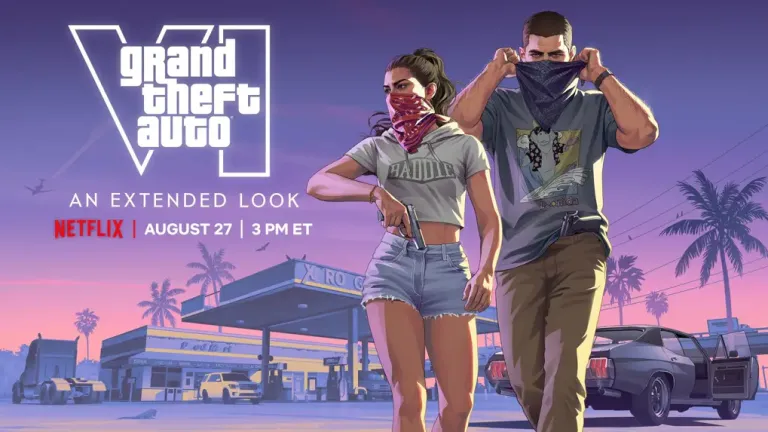
Today, the video game industry has reached such an astonishing scale and breadth that, in terms of economic size and media influence, it stands leagues ahead of the combined industries of cinema, television, and even music. But the story does not end with figures or billion-dollar revenues. What signals the arrival of a media revolution is this young medium’s subterranean conquest of artistic spheres, visual language, and critical culture. The turning point in this historical shift came precisely when the short, film-like trailer for Grand Theft Auto VI entered Letterboxd as a major twenty-first-century entertainment event—into that sacred temple of cinephiles and film obsessives—and a multitude of viewers began writing reviews for it, analyzing its découpage, and treating it exactly as they would a “short film.”
This is a profound sign that we have officially entered a new era of cinema: an era in which the video game, as perhaps the most fertile source of inspiration, has replaced classical literature and playwriting as a foundation for framing and narrative structure. With the emergence of a new generation of filmmakers and young directors—from Oz Perkins and the Philippou brothers to newcomers such as Kain Parsons—we can clearly see that their visual memory and aesthetic references no longer come primarily from works such as Citizen Kane or The Godfather, but from the dark psychological atmospheres of games such as Alan Wake, the nightmarish world of Silent Hill, and the endlessly satirical universe of GTA. This influence has become so profound that even established auteurs of both mainstream and art cinema have not remained untouched by it. In Paul Thomas Anderson’s latest acclaimed success, for instance, one can distinctly sense a deep influence from GTA’s parodic tone, its sweeping satire of American history and society, and its unrestrained rhythm.
There was a time when the fledgling video game industry desperately turned to cinema for legitimacy, attempting to borrow some of the magic of the silver screen by producing mediocre and unsuccessful games such as E.T. But today the equation has been completely reversed. Cinema is now the medium fascinated by, and hungry for, the video game’s rich table, reaching for its storytelling and world-building in an attempt to rescue itself from a crisis of ideas. Major dramas such as The Last of Us are being produced; rumors are circulating about a cinematic adaptation of the vast world of Elden Ring; a God of War series is in production; and an astute filmmaker such as Jonathan Nolan, stepping out from his brother Christopher Nolan’s shadow, has taken the helm of the massive Fallout project. Even franchises such as Mortal Kombat are being rebooted in order to claim a place in this current.
And yet the great and astonishing contradiction is that cinema, for all its claims, remains remarkably incapable of making worthy adaptations of video games. When we look at the second season of The Last of Us, cinema’s formal inability to recreate the force and horror of Joel’s death becomes apparent. An experienced director such as Craig Mazin can never reproduce the sense of presence, suspense, and devastating psychological impact that Neil Druckmann created in his capacity as a video game director. Interestingly, Craig Mazin—the creator of Chernobyl and co-creator of the series—reportedly told Druckmann during the filming of the sequence that his only advice was to “cut a little later, so the shot stays on screen longer.” The remark reveals just how thoroughly video game directors have mastered the cinematic dimensions of découpage, rhythm, and timing. On the other side of the equation, filmmakers such as Josef Fares have abandoned cinema for the world of game development, creating extraordinary works that push the boundaries of interactive, co-op storytelling.
The boundary between video games and cinema is becoming thinner, more transparent, and increasingly indistinct, and we are rapidly approaching a point at which traditional film critics will lose their ability to analyze these works. In less than five years, an avalanche of films influenced by the language of video games will storm cinemas—works that critics of the previous generation, lacking an understanding of the logic of games, unfamiliar with the grammar of moving frames, unaware of their narrative mechanics, and unable to grasp their source material, will struggle to understand or engage with. Critics who remain trapped in the world of theatrical dialogue and linear editing inherited from twentieth-century cinema will be unable to decode the new language of the medium.
The fact that the demanding, cinephile community of Letterboxd now recognizes, reviews, and rates a 27-minute trailer for a video game as an “independent visual work” is not an internet joke or a passing trend. It is an official sign of a history that has changed. Video games are no longer eight-bit entertainment confined to the corner of a bedroom. They are now a leading medium that has absorbed the cinematic frame itself and forced filmmakers to submit to its rules of play if they want to be seen.
© 2026. Phoenix Review