



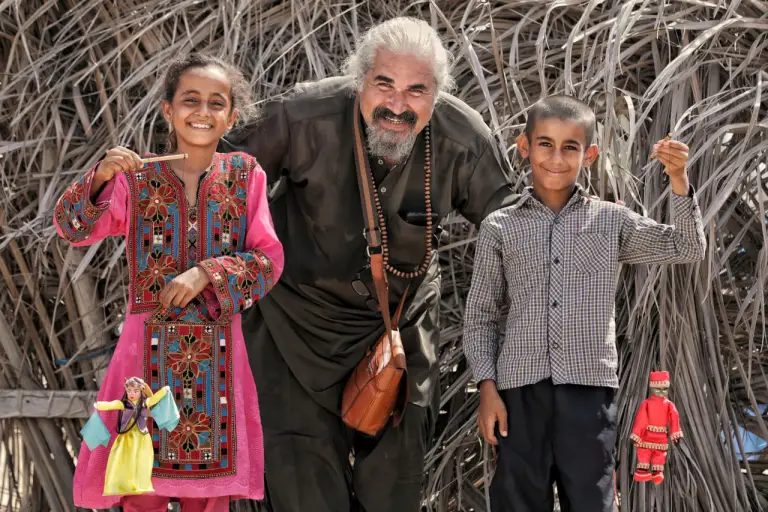
Lo‘bat-Baz tells the story of an art and ritual tradition that is deeply rooted and enduring, yet gradually fading from memory—a heritage passed down from the heart of rituals as old as history itself. Lo‘bat-Baz sets out to revive the art of traditional Iranian puppet theater, moving from the city museum and its culturally devoted visitors to the dusty lanes of villages in Baluchistan. Pouria Nouri’s journey, from the loud commotion of the city to the silence and astonishment of children in Chabahar, stretching as far as the southern sea, is filled with a sense of national passion and devotion to a precious cultural tradition. Lo‘bat-Baz tells the story of master puppeteer Siavash Sattari and his lifelong companion, the puppet Mobarak, as they attempt to connect the innocent smiles of Baluchistan’s children with the history of a forgotten art, rescuing it from the depths of collective memory and inscribing a documentary record of Iranian puppet theater into the history of the arts.
Pouria Nouri’s documentary shows Master Sattari passionately attempting to revisit and reinterpret La‘bat-Baz, an art form that had been forgotten for years. This revival is intertwined with art, love, awareness, and traditionalism. Preserving traditions does not mean rejecting the narratives of modern art. On the contrary, modern art, as a different way of revisiting ancient archetypes, can create a space in which traditions and contemporary artistic practices coexist, allowing traditional arts to be embraced anew.
Engaging with an ancient art form that has spent years on the path toward oblivion, and reintroducing it to audiences whose lifestyles are defined by modern patterns, inevitably requires considerable courage, an awareness of society’s capacity—or incapacity—to embrace indigenous art, artistic sensibility and imagination, and a genuine cultural commitment. All of these qualities have made the production of Lo‘bat-Baz possible.
Directed by Pouria Nouri and featuring a puppet-theater performance by Master Siavash Sattari, Lo‘bat-Baz concerns an art form upon which so many years of neglect have settled that, amid the complexities of the modern world, it seemed destined for oblivion. Yet the filmmakers’ tireless efforts and artistic mission to honor Iranian art and brush away the dust of age inevitably recall the efforts of the great practitioners of this tradition—figures who constitute part of its human and national heritage.
Unlike narrative films, which fundamentally depend on constructing imaginary worlds and exploring inner realities, documentaries have the ability to draw their narratives directly from reality and documentary evidence, confronting their characters and situations with minimal mediation. Documentary, in fact, does not necessarily mean unfiltered reality; rather, it is a representation of a particular part of reality. It can convey the filmmaker’s thoughts to the audience in one of their most direct and personal forms. In all kinds of subjects, and particularly when dealing with artistic traditions, documentary is among the most convincing and appropriate ways of communicating the value of Iranian traditional arts. As an observational documentary, Lo‘bat-Baz succeeds in offering an unmediated narrative, a poetic tone, and a deeply human atmosphere surrounding the history of traditional puppet theater.
Through historical archives and references to the custodians of this art and its authentic history, Pouria Nouri’s film reconstructs the historical and artistic trajectory of puppet theater. It is also an attempt to pass this heritage on to a new generation and preserve cultural continuity in the face of oblivion. The first step is to allow younger generations to recognize the beauty of this art and the distant horizons it opens onto the cultural sphere.
Adolescents belong to a generation deeply integrated into the structures of the technological age. They are, by and large, almost estranged from Iran’s refined and authentic artistic heritage. For a generation whose leisure, everyday life, and even patterns of thought have been profoundly shaped by smart technologies, ancient Iranian arts and their ultimate cultural purpose can seem entirely foreign. Yet those who remain connected to this tradition, and those who have devoted themselves to it out of love and without expectation of reward, hold the key to recovering the appeal of an art form that is gradually disappearing. Pouria Nouri, together with Master Sattari, has clearly developed a deep concern for preserving authentic Iranian art. His photography of figures within the world of puppet theater before making the documentary was itself what encouraged him to embark on the film.
Their artistic and national mission is what drives them to revive the stories and characters of puppet theater amid the noise and distractions of the modern age. They speak of earlier artists who devoted years of their lives, driven by a sense of national identity and love, to preserving and reviving this art—artists who are no longer with us. Yet their art and their mission remain firmly embedded in our cultural and national memory. Drawing on the legacy of the masters who came before him, Sattari attempts to continue and elevate this tradition by teaching enthusiasts and performing the art in different cities.
There are differing views regarding the origins of puppet theater in Iran—particularly forms in which the puppets themselves are visible—but most accounts trace puppet theater, especially shadow theater (khayal-bazi) and traditional tent puppet theater (kheymeh-shab-bazi), back to the fourth and fifth centuries of the Islamic calendar, when such performances were widespread in Iranian cities and villages. Bahram Beyzai’s Theatre in Iran, as well as Yousef Seddiq’s research on traditional puppet theater in Iran, examine this history in detail.
From this perspective, reviving puppet theater might initially appear to have a purely theatrical or museum-like function. Yet considerable efforts have been made to alter society’s and history’s perception of puppet performance. As a cultural legacy, this art can broaden its audiences’ horizons while simultaneously enabling the revival and renewed life of ancient traditions.
Research in this field has generally classified traditional puppet performances such as kheymeh-shab-bazi among forms of entertainment and ritual theater that lack conventional written scripts. Forms such as kheymeh-shab-bazi and siah-bazi, with characters including Mobarak, Pahlevan-e Kachal, Sultan Salim, and others, are based largely on a basic narrative framework. Their development depends on the political, social, and cultural circumstances of the moment, the improvisational abilities of the moršed (the master or storyteller), and the puppeteer, along with the moršed’s performance on instruments such as the kamancheh and tombak.
According to Pouria Nouri, the process that eventually led to the making of Lo‘bat-Baz began as follows:
“Siavash Sattari is one of the masters of traditional puppet theater in Iran. I met him through Setareh Eskandari in 2019. At the time, Mr. Sattari and Ms. Eskandari had established the Puppet Theater House-Museum in Tehran. I became acquainted with Mr. Sattari through photographing the puppets there. I learned that he was planning a trip to Chabahar and intended to establish Iran’s first mobile puppet theater. I was deeply impressed by his efforts to teach and perform puppet theater. Gradually, I became fascinated by the art of kheymeh-shab-bazi itself and decided to make an independent film about an art form that was slowly disappearing from memory.”
Mobarak in the South: From the Frame to the Earth
The Lo‘bat-Baz team embarked on a journey full of stories to Baluchistan, the land of Rostam and Iranian mythology. It was a journey equipped with a historical legacy, intended to guide us through that legacy toward the heart of puppet theater and offer a memorable encounter with a generation of artists whose relationship with this art seems infused with love and sincerity.
Their persistence in keeping the beautiful and traditional art of kheymeh-shab-bazi alive—one of Iran’s oldest performing arts—is not merely an attempt to familiarize audiences with its history and its past practitioners. Its ultimate purpose is to promote this beautiful art, as part of Iran’s rich cultural heritage, among younger generations and preserve it within the historical memory of audiences.
During this journey, Siavash Sattari and his companions set out to establish Iran’s first mobile puppet theater. From the opening of the Puppet Theater Museum in Tehran, to performances at the Salt Men Museum in Zanjan, and eventually to Ramin village in Baluchistan, they tell their story largely through the eyes of children.
This new perspective reveals the coexistence of kheymeh-shab-bazi with the unfiltered enthusiasm of children whose lives have been shaped to a great extent by deprivation of even the most basic civil rights. The creation of the most intimate and genuine moments among underprivileged children in the dusty lanes and mud-brick homes of Baluchistan embodies the artist’s true mission: honoring an art form and passing it on to the next generation.
The difficulties of the journey, meanwhile, have not prevented them from reaching a new horizon. Instead, they have become part of an achievement that helps reduce the cultural distance between earlier generations and today’s youth, while allowing the artistic tradition of puppet theater to continue.
Mobarak: The Voiceless Narrator
If we take a closer look at the nature and typology of Mobarak within the structure of traditional Iranian puppet theater, the character is generally associated with disorder and unexpected events. Mobarak is energetic and tireless, curious about everything, and strikingly forthright. He has the ability to foil the schemes of hypocrites and liars.
For this reason, Mobarak’s characteristics make him particularly suitable for encouraging critical thinking and serving as a coherent model for educational discussions with children. In this sense, the character itself can become a strategy for promoting and preserving this theatrical tradition.
Through his constant interaction with the moršed, Mobarak prevents the performance from becoming static, transforming it into a dynamic and living process. He is the only character who breaks the “fourth wall,” directly addressing the moršed—the master puppeteer—and thereby acting as an intermediary between the world of the performance and its spectators.
His speech and tone are humorous and ironic, bearing something of the resemblance of the Fool in William Shakespeare’s tragedies. Mobarak cannot be reduced simply to the quality of being a puppet. He functions instead as an active symbol, embodying the tension between tradition (kheymeh-shab-bazi) and modernity (contemporary life).
In this documentary, Mobarak becomes a narrator of loneliness and silence offstage, set against the excitement and energy of the stage that he creates for the audience.
In La‘bat-Baz, the presentation of a comprehensive and convincing portrait of Mobarak extends beyond the puppet-theater stage itself. Mobarak seems to become a serious and determined companion to Master Sattari, filling the void left by the absence of people—from those closest to the artist to complete strangers. Even strangers and inheritors of the tradition become part of the story of the puppeteer’s silence and solitude.
Mobarak’s powerful dual presence—both on the stage of a performance that, as history attests, forms part of our national and traditional identity, and within Pouria Nouri’s documentary narrative—functions as a metaphor for the outside world rendered on a miniature scale.
As Bahram Beyzai writes philosophically in Theatre in Iran, the ultimate nature of this performance can be understood in these terms:
“Puppet theater is the world in miniature: a world in which puppets, without knowing it, have hidden hands above them that determine their comic and tragic destinies. Mobarak is the only one who sees those hands, laughs at them, and through that laughter reveals the absurdity of the performance to everyone.”
© 2026. Phoenix Review