



History has shown that the intensity of a government’s violence does not necessarily correspond directly to its ability to preserve and perpetuate its rule. Governments that have remained in power for years by relying on repression, intimidation, and political control can sometimes prove vulnerable in the face of collective public will and the emergence of a broad-based civil movement.
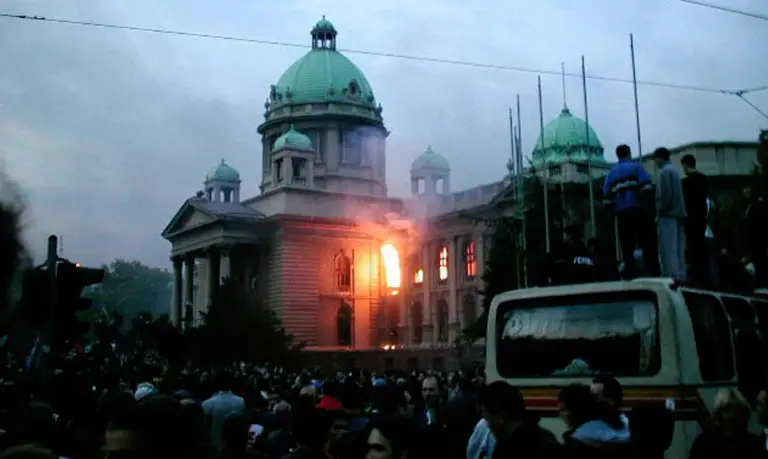
Serbia under Slobodan Milošević offers a compelling example of this historical reality. Known as the “Butcher of the Balkans” because of his role in the Balkan Wars and the atrocities committed during that period, Milošević commanded extensive political and security apparatuses. Nevertheless, in 2000, widespread protests following a disputed election, the participation of various social forces, and the emergence of civil resistance paved the way for the end of his rule.
Young students and other social groups played an important role in the development of a nonviolent civil movement that succeeded in bringing different segments of society together around the demand for political change. The protests, resistance to the announced election results, and the erosion of support for Milošević among institutions of power, alongside other factors, contributed to the end of his government. He eventually relinquished power in October 2000, a transformation that demonstrated that possession of a repressive apparatus alone cannot guarantee a government’s political survival.
The significance of this experience lies in the fact that a government’s power cannot be measured solely by the number of its security personnel, the severity of its treatment of opponents, or the extent of its control over public space. Political legitimacy, public trust, the cohesion of the power structure, and the degree of social support also play a role in the durability of governments. A government may be able to contain protests for a time, but containing dissent does not necessarily mean that public discontent has disappeared.
Indeed, one of the major miscalculations of authoritarian governments is their tendency to mistake society’s silence for public consent. When citizens are denied the freedom to express their demands, opponents are subjected to pressure, and avenues for political participation are restricted, public discontent may become less visible. But this does not necessarily mean that the divide between society and the government has been bridged. At times, that very divide gradually deepens and, under particular circumstances, develops into a political crisis.
Today, too, in various parts of the world, societies live under leaders unwilling to listen to their people or recognize their demands. Such governments may still possess extensive instruments of control and repression, yet a fundamental question about their future remains: Can lasting stability be achieved by disregarding the will of society and relying on fear?
An idea reflected in the words of Archbishop Desmond Tutu, one of the leading figures in the struggle against apartheid in South Africa, emphasizes the importance of the people’s will in the pursuit of freedom. When people decide to struggle for their freedom and rights, no government can permanently eliminate the possibility of change simply by instilling fear. At first, only a small number of people may rise in resistance. Under favourable circumstances, however, such a movement can expand, draw in broader sections of society, and develop into a public demand.
History, of course, offers no guarantee that every protest movement will succeed or that every repressive government will necessarily collapse in the near future. Political transformations depend on a combination of factors, including the level of public participation, the organization of civil forces, economic and social conditions, the cohesion of opposition groups, and the conduct of the military and security forces. Serbia’s experience is no exception. Nevertheless, it clearly demonstrates that even governments with long histories of repression can lose their ability to maintain power when confronted by a combination of social and political pressures.
In this context, nonviolent resistance can play an important role. Historical experiences have shown that the participation of students, workers, teachers, trade associations, and other social groups, when organized around shared demands, can strengthen the capacity for collective action. Strikes, peaceful demonstrations, and other forms of civil disobedience have, under certain circumstances, also helped shift the balance of power. The outcome of such movements, however, depends on the conditions within each society and on how social and political forces interact.
One lesson to be drawn from these experiences is the need to distinguish between domination and legitimacy. A government may possess the instruments of coercive power, but this does not, in itself, mean that it enjoys public trust. Similarly, the ability to silence dissent is not the same as the ability to respond to society’s demands.
The wider the gap between a government and its people becomes, and the more restricted the peaceful avenues for reform and participation, the more complicated the question of political stability grows.
The fate of governments is not determined solely by their capacity to control society. The people’s ability to unite, participate, and pursue their demands is also part of the equation of power. The history of Serbia and the end of Milošević’s rule serve as a reminder that political power, however formidable it may appear, is always subject to social transformations and changing political circumstances.
© 2026. Phoenix Review