



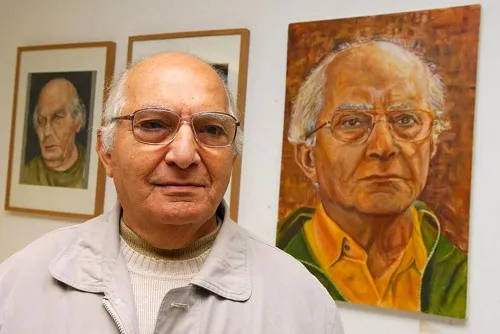
The first time I met Soleiman Minassian (or, in Armenian, Soghomon Minassian), he was no longer the young cinematographer at Golestan Studio. Like Golestan himself, he had become an elderly man who had long since distanced himself from Iranian cinema and was living in London, far from Iran, the land in which he had grown up. Our acquaintance began after the publication of Writing with the Camera (my conversations with Ebrahim Golestan), a book that included a section on the years when Soleiman and his brother, Herand Minassian, worked in Golestan Studio. For my research into modern Iranian cinema and the origins of the Iranian New Wave, I needed to speak with Minassian as an important and influential figure at the heart of this movement. Our relationship subsequently developed into a close friendship, extending beyond the professional and becoming almost familial. It lasted for years, until I heard from his daughter, Nella, that he had died at the age of ninety-four.
Although he was an outstanding cinematographer who had shot several of the most significant and remarkable films in Iranian cinema, including The Brick and the Mirror and The House Is Black, he was, unfortunately, largely unknown, both in Iran and abroad. Few people remembered him. In London, too, he lived a relatively secluded life, rarely appearing in artistic or cinematic circles and maintaining little contact with Iranian media outside the country. For this reason, together with my Armenian filmmaker friend Adom Sabounchian, I decided to organize a tribute to him in London. Alongside a screening of The House Is Black, we would exhibit his paintings and portraits. It was a tribute he deserved, one that should have taken place during his lifetime. I also made a documentary about his life and career, titled Soleiman Minassian: A Man with a Movie Camera. And yet, the more I think about him, the more I realize that he never received the recognition he truly deserved.
In Writing with the Camera, Ebrahim Golestan speaks of Minassian with particular respect. He recalls: “Minass—Golestan always called him by that name—came to the studio just after being released from prison. He had come to do the studio’s electrical wiring.” According to Golestan, Minassian had been a supporter of the Tudeh Party in his youth and was imprisoned in Rasht after the coup of August 19, 1953. (Minassian was Armenian, from Rasht, and had been born in that city.) After his release, Najaf Daryabandari introduced him to Golestan. But Golestan soon realized that he was dealing with no ordinary technical worker. Minassian possessed a talent, intelligence, and creativity that carried him far beyond the confines of his assigned job.
A clear example of this ingenuity was his construction of a camera crane. Relying solely on a foreign catalogue and using scraps of metal, Minassian managed to build a crane that Golestan later used in The Brick and the Mirror and The Secrets of the Jinn Valley. This is more than a story about a piece of cinematic equipment. It reveals that, from the outset, Minassian had an active, intellectual, and creative relationship with the image. He did not merely want to operate equipment; he wanted to understand how an image moved, how space was seen, and how the camera could extend the human gaze. It was this curiosity and dynamism that transformed him from a simple worker at Golestan Studio into one of Iran’s finest cinematographers. Minassian had never studied cinema at a film school. As he himself explained, he learned it at Golestan Studio, through apprenticeship, experience, and watching Golestan and Forough Farrokhzad at work in the editing room.
In one scene of the documentary I made about him, A Man with a Movie Camera, Minassian said something I have never forgotten. “I have shot several films and exposed tens of thousands of metres of film, but there is still one thing I have never understood, and it continues to astonish me: how is an image recorded on film?”
This remark may seem simple at first glance, but it contains a profound philosophy. Minassian was not saying that he did not know how a film image appeared or how light was measured. He was expressing his wonder at the very mechanism through which an image is recorded, at the transformation of reality into an image. Even after exposing tens of thousands of metres of film, the image remained a source of astonishment for him. Perhaps this sense of wonder was the secret of his work: he never regarded the image as a problem that had already been solved, nor was he ever content to repeat ready-made formulas. Each time he switched on the camera, it was as though he were encountering light, shadow, faces, space, and movement for the first time.
It was this freshness of vision that distinguished his images from mere records of reality and gave them the quality of works of art. Through the documentaries he shot for Golestan—particularly Wave, Coral, and Rock, The House Is Black, and The Crown Jewels—as well as through The Brick and the Mirror, Minassian played a significant role in shaping the visual language of modern Iranian cinema: a cinema in which the image was not merely an accompaniment to the narrative but became a form of thought in its own right. The aesthetic power of Minassian’s work lay in his refusal to treat the image as a decorative element. For him, light could create space, the frame could determine the human subject’s position, and camera movement could construct mise-en-scène. This is why Minassian’s work cannot be adequately described in terms such as “good cinematography.” He was a cinematographer who created space, mise-en-scène, and meaning.
In The House Is Black, Forough Farrokhzad gives voice, through her poetic language and mournful narration, to the pain and suffering of the leprosy patients at the Bababaghi leprosarium in Tabriz. Yet it is Minassian’s images, his compassionate camera as it looks upon the patients’ faces and bodies, and the lingering attention he gives to their wounds and disfigured features that, in conjunction with Farrokhzad’s apocalyptic poetic voice-over, lend the film a quality rarely encountered in documentary cinema.
The most important aesthetic feature of Minassian’s work was his ability to depict the bitter and tragic reality of the patients’ lives in all its starkness without rendering them harshly, lifelessly, or inhumanely. His camera does not turn away from their suffering or profound loneliness. Instead, it looks at them with patience, respect, and compassion: at faces society had pushed to the margins; at the monotonous, tedious rhythms of life inside the leprosarium; and at details that might easily escape the ordinary gaze. The beauty of The House Is Black does not arise from concealing the bitterness of reality, but from confronting it with intimacy and honesty. Minassian demonstrates that suffering can be endowed with dignity without being embellished. The film remains one of his most enduring artistic and aesthetic achievements.
If The House Is Black was an example of Minassian’s ability to see and portray the lives of people living on the margins of the city, The Brick and the Mirror demonstrated his ability to see and capture urban spaces. In this film, Tehran is not merely a location; it is a living, breathing city, intimately bound up with the fate of the characters. The ruins of Abbasabad, Baharestan Square, the Seyyed Esmail Bazaar, narrow alleyways, shuttered houses, and the corridors of derelict buildings all become part of the characters’ psychological condition.
The camera’s slow movements on the crane—the very crane Minassian had built himself—are not simply a demonstration of his technical skill. They allow the viewer to perceive more fully the relationship between the city and the film’s troubled, wandering, restless characters. Minassian’s camera follows Taji and Hashem everywhere: through the backstreets and alleyways of 1960s Tehran, the cramped interior of Hashem’s home, the stairwells of an unfinished, dilapidated building, and the rooms and corridors of the courthouse, police station, and orphanage. Minassian does more than frame images with his camera; he creates space. He makes possible the inventive mise-en-scène of Golestan’s filmmaking.
The height of Minassian’s skill and mastery in The Brick and the Mirror comes in the orphanage sequence, when his camera slowly tracks away from Taji Ahmadi, eventually framing her at the far end of the corridor, leaning against a wall. In this way, the camera reveals the full depth of her loneliness and despair. One of the most distinctive features of the film’s cinematography is its film-noir quality, particularly since a substantial part of the story unfolds at night. Here, Minassian, much like John Alton, the distinguished cinematographer of film noir, gives the images psychological depth through carefully calibrated contrasts of light and shadow. Using low-key, high-contrast lighting, deep blacks, sharp shadows, and the ingenious use of limited light sources, Alton created compressed, tense visual atmospheres. In The Brick and the Mirror, Minassian intelligently adapts these same noir visual elements to the social and urban fabric of 1960s Tehran. His nocturnal images of the city—with neon lights, car headlights, narrow, dark alleyways, and unfinished buildings—create a distinctly noir atmosphere. Minassian’s images do more than tell a story: they evoke Taji and Hashem’s sense of disorientation, alienation, anxiety, and vulnerability.
Minassian was not merely a master of black-and-white imagery. In documentaries such as The Hills of Marlik and The Crown Jewels, he also demonstrated his command of colour. In The Crown Jewels (Ganjineh-ye Gohar), a film Ebrahim Golestan made for the Central Bank, Minassian’s camera captures the brilliance of the jewels in the bank’s treasury with astonishing delicacy. The camera’s movement through the vault and its circling of the colourful, glittering jewels—from the Shah’s crown to the precious stones that serve as the country’s financial reserve—stand in striking contrast to Golestan’s narration of the darkness, corruption, and treachery of past monarchs. This contrast lends the film a dimension that takes it well beyond an ordinary documentary about objects. The jewels’ brilliance is not merely a matter of visual beauty; in conjunction with Golestan’s account of power and plunder, it becomes a symbol of opulence, coercion, and the dark underside of history. It is here that Minassian’s aesthetic vision converges with the film’s political and historical thinking.
After Golestan Studio closed, Minassian founded Chaplin Film Studio with his brother, Herand Minassian, who had worked as the sound recordist on Golestan’s films. Arby Ovanessian’s documentary The Monastery of Saint Thaddeus, along with the fiction films Dawn and The Cry, both made by the Minassian brothers, were among the studio’s productions. Dawn earned Minassian the award for Best Colour Cinematography at the Sepas Film Festival. The award confirmed that his achievements were not limited to his collaboration with Golestan: Minassian had an independent visual language that he could bring to other films, beyond the Golestan circle.
In 1980, Minassian emigrated with his family, first to the United States and then to England. Unfortunately, like many first-generation Iranian émigré artists, he was unable to continue his artistic and cinematic work in exile and was forced to take up other jobs to make a living. Among other things, he and his brother Herand established a laundry in London, which became their means of supporting themselves. Minassian was an outstanding artist whose talent and artistic creativity were squandered by emigration and exile. In the final years of his life, however, he turned to portrait painting, demonstrating that a filmmaker always sees the world and its inhabitants through the eyes of an image-maker, whether behind a movie camera or before a canvas. His portraits, too, continued the same lifelong quest to approach the human face through light and shadow.
Minassian taught us that cinematography is not simply the recording of reality in front of the camera; it is a way of thinking about reality and interpreting it through the language of images. He was always asking himself how an image was recorded on film. I wonder what occupied his thoughts in the final moments of his life, as death approached, and whether he had found an answer to this eternal question, this lifelong preoccupation with the very nature of the image.
May he rest in peace, and may his memory endure.
© 2026. Phoenix Review