



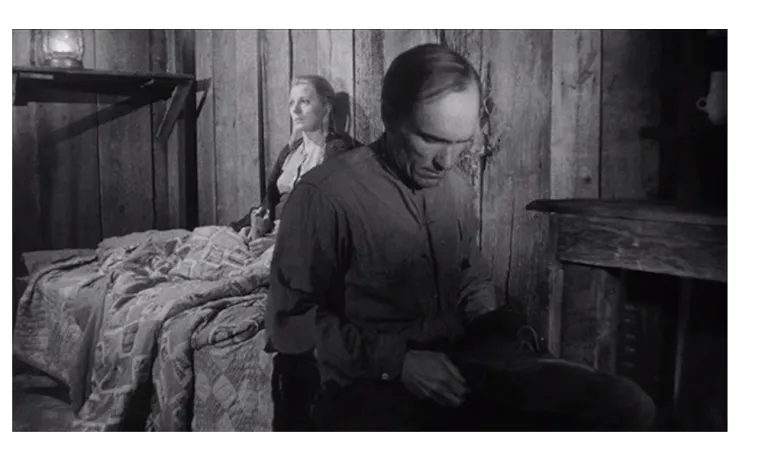
Joseph Anthony’s Tomorrow (1972) is a quiet, unconventional film about loneliness, compassion, and the persistence of love in a world where happiness seems impossible. Adapted by Horton Foote from William Faulkner’s short story, the film tells the story of Jackson Fentry, an isolated farmer from Mississippi who takes in Sarah Eubanks, a pregnant woman abandoned by her husband and family. For a brief time, these two marginalized individuals share a home and establish a kind of marital life together, until death and tragedy tear them apart.
Among the films adapted from Faulkner’s works, Tomorrow remains a relatively obscure and little-known title. Most cinematic adaptations of Faulkner have focused on the dramatic conflicts of his major novels, including The Sound and the Fury, Sanctuary, and The Long, Hot Summer, often transforming his complex narratives into more conventional Hollywood melodramas. Tomorrow, however, is based on a compact short story first published in 1940. Before writing the screenplay for the film, Horton Foote had also adapted the story for television. Tomorrow received only a limited theatrical release. As a result, despite its powerful performances and high-quality adaptation, the film largely escaped public attention. Its relative obscurity stemmed in part from its distinctive narrative and stylistic qualities. Tomorrow is too quiet for conventional melodrama, too literary for straightforward rural realism, too restrained for popular romance, and too slow and undramatic for audiences accustomed to fast-paced storytelling. Yet these apparent limitations are precisely what make the film distinctive.
William Faulkner’s stories are generally known for their psychological depth, temporal disjunctions, multiple perspectives, and profound awareness of the relationship between individual suffering and collective history. His narratives frequently move between past and present, revealing how memory, trauma, guilt, and inherited social conflicts shape his characters’ lives. Faulkner does not treat history as a collection of events that have come to an end; instead, he shows how the past remains active in the present. His modernist techniques—including stream of consciousness, the unreliable narrator, shifts in perspective, and nonlinear narration—create a world in which individual identity cannot be separated from memory and social history.
Faulkner is closely associated with the Southern Gothic tradition, although his work extends the genre beyond horror and the macabre. His fictional Yoknapatawpha County becomes a symbolic representation of the American South, a region marked by the legacy of the Civil War, racial and economic inequality, the decline of old social structures, and unresolved tensions between tradition and modernity. Faulkner’s characters are often isolated, traumatized, obsessive, or socially marginalized. In stories such as A Rose for Emily, grotesque and disturbing elements, along with concealed decay, expose the reality beneath the seemingly respectable surface of Southern society. For Faulkner, then, Southern Gothic is not merely a style built around dark, frightening settings; it is a means of exposing suppressed histories, loneliness, and moral contradictions.
Much of Tomorrow’s significance lies in its preservation of the emotional atmosphere and unadorned quality of Faulkner’s original story without turning it into a romantic melodrama or a conventional Southern drama. Like Faulkner’s story, the film employs a circular narrative structure, using a framing device. It opens in the present, in rural Mississippi in the 1930s, with a murder trial. Here, the protagonist, Jackson Fentry (played by Robert Duvall), serves as a juror and stubbornly votes to acquit the defendant despite all the evidence, bringing the proceedings to a deadlock.
Douglas, the young defense attorney representing the accused murderer, is deeply puzzled by Jackson’s steadfast position and begins investigating his past. As Douglas’s account unfolds, the film enters an extended flashback before eventually returning to the courtroom scene and the present, allowing the full significance of Jackson’s sacrifice and steadfastness to emerge.
The empty, barren landscapes, damaged characters, social marginalization, and pervasive sense of impending loss all belong to Faulkner’s Southern Gothic world. Yet compared with works such as Sanctuary or the story A Rose for Emily, Tomorrow makes less use of grotesque imagery and stylistic excess. Its Gothic quality emerges through loneliness, poverty, rejection, illness, and the violence of social indifference. Jackson Fentry and Sarah are neither monsters nor remnants of an aristocratic class; they are ordinary, vulnerable people whose suffering exposes the failures of the society around them.
Tomorrow can be regarded as one of the simplest and most unadorned cinematic adaptations of Faulkner’s work. Through black-and-white cinematography, a slow rhythm, restrained performances, and an emphasis on silence, the filmmaker translates the moral atmosphere of Faulkner’s writing into cinematic language. Rather than literally recreating Faulkner’s dense prose or stream-of-consciousness narration, the film finds cinematic equivalents in pauses, empty landscapes, physical distances, and unfinished gestures. Anthony transforms Faulkner’s concerns with isolation and human dignity into a quiet, visual tragedy. Instead of relying on incident and the heightened spectacle of Hollywood, the film derives its emotional intensity from silence, waiting, everyday labor, and small gestures of care and human affection.
What distinguishes Tomorrow as a successful adaptation of Faulkner is its approach to storytelling. Its slow pace, restrained performances, rural setting, and tragic ending set it apart from the conventions of popular American cinema in the early 1970s, placing it within an anti-Hollywood current distinct from the New Hollywood movement. When Tomorrow was released in 1972, American cinema was undergoing a period of significant transformation. The cinematic movement known as New Hollywood was generally associated with dynamic editing, urban violence, sexual liberation, political conflict, and formal experimentation. In this context, Joseph Anthony’s film seemed almost deliberately old-fashioned, as though it belonged to another era. It distanced itself from the speed, humor, and visual violence found in many works of the New Hollywood period.
The film is set in rural Mississippi, yet its emotional world seems even more remote and isolated. Jackson Fentry lives amid deserted roads, dilapidated buildings, hard, barren land, grueling labor, and exhausted bodies. The film does not treat this environment merely as a beautiful or decorative backdrop. Instead, the landscape becomes an extension of Jackson’s inner world: empty, cold, and almost void. It is an ancient, seemingly eternal world that has outlasted the human beings who inhabit it. This sense of estrangement from time is essential to the film’s distinctiveness. Tomorrow does not portray rural poverty through melodramatic exaggeration or nostalgic imagery. It observes a world in which people carry on living not through hope, but through resilience and endurance. Work continues, winter returns, illness advances, and life goes on through the monotonous repetition of everyday tasks.
In this respect, the film’s title is particularly significant. The word tomorrow seemingly promises a future, but in Jackson and Sarah’s world, the future is always uncertain. Tomorrow offers no promise of happiness; it provides only a reason to keep going and endure life.
Robert Duvall’s early performance as Jackson Fentry forms the emotional center of the film. Jackson is not conventionally attractive or charismatic. He is awkward, taciturn, socially inexperienced, and emotionally guarded. He speaks slowly and often waits through long pauses before saying anything, as though language itself were a form of arduous physical labor. His inner life is revealed not through exposition or dialogue so much as through his posture, gestures, facial expressions, and actions. Duvall portrays Jackson Fentry as a man who remains silent unless he has something essential to say. This directorial approach, combined with Jackson’s taciturn nature, gives the character a powerful economy of expression. When Jackson finally articulates his feelings, the simplicity of his language makes the moment all the more affecting.
His proposal to Sarah—expressed in the words “Marry me, Sarah”—is unlike a conventional romantic declaration of love. The sentence is direct, almost painfully so, and entirely unadorned. Yet precisely because Jackson cannot express love in poetic language, his words ring true.
Jackson’s silence does not signify an inner emptiness. It carries its own emotional pressure. He has lived for so long without affection or intimate companionship that he lacks the vocabulary needed to express love, shared life, or family relationships. His care for Sarah begins with practical actions. Providing shelter, keeping the house warm, preparing food, and helping her through illness all become ways of expressing his love for her. In this film, love takes shape not as an abstract feeling but as a set of responsibilities. Jackson’s character challenges conventional notions of masculinity. He is neither powerful nor eloquent, sexually self-assured nor socially successful. His strength lies in his patience and loyalty.
Sarah Eubanks (played by Olga Bellin) enters the film in a state of extreme vulnerability. She is pregnant, ill, homeless, and abandoned. Her body bears the wounds of the past, carrying the consequences of other people’s irresponsibility. Her husband has left her, her family has rejected her, and society offers her no meaningful support. Yet Sarah is never reduced to a helpless victim. In the role, Olga Bellin brings a vitality and verbal energy that contrast with Jackson’s silence. Sarah dreams of a home, a garden, and a more stable life. These dreams may seem modest and small, but the film makes clear that even such limited hopes and aspirations remain beyond her easy reach. Sarah’s suffering is both physical and social. Pregnancy, illness, poverty, and abandonment are intertwined in her circumstances. She needs more than medical assistance; she needs to be seen and recognized as a human being. Jackson’s most important act, therefore, is not simply to shelter her in his cabin, but to treat her as someone whose life has value.
Their relationship is unusual because it does not follow the conventions of romantic cinema. There is no seduction, physical glamour, or erotic display. Their intimacy develops through their shared vulnerability. They initially come together out of necessity, but their connection becomes genuine when each discovers in the other a form of emotional refuge. Sarah’s death after childbirth eventually gives her relationship with Jackson a new meaning. What initially appears to be no more than temporary shelter becomes a deeply ethical commitment. Before she dies, Sarah asks Jackson to care for her child. This promise determines the course of the rest of his life.
The tragedy of Tomorrow does not begin with Sarah’s death; it begins with the impossibility of preserving the family the two of them have created. Jackson keeps his promise and raises the child as his own. For a brief time, he experiences the very family life that had previously been denied him. Yet this happiness is fragile from the outset. Eventually, Sarah’s family takes the child away from Jackson. The legal and social structures that should protect human relationships instead privilege blood ties and familial claims of ownership. Jackson’s emotional bond with the child carries no weight within these systems. The film’s tragedy therefore has a social dimension as well. Jackson loses the child because his love has no institutional protection. He is poor, isolated, and socially insignificant. His attachment is genuine, but society refuses to recognize it as legitimate.
Years later, Jackson serves on the jury in a local trial in which a man stands accused of murdering Sarah’s son. At first, the audience sees Jackson as the sole juror unwilling to acquit the accused murderer. The other jurors regard the victim as a worthless human being. They consider his killing almost justifiable because the young man had become a delinquent and a social nuisance. Jackson, however, is the only one who rejects this logic. Rather than seeing the victim solely as a criminal adult, he remembers the vulnerable child he once loved and cared for. His vote becomes an act of defiance—a protest against society’s tendency to divide human beings into lives that matter and lives that are deemed insignificant. It is through this refusal that the film reveals its moral force. Jackson understands that a person’s subsequent failures cannot erase the fact that they were once loved, protected, and mourned.
Although the term slow cinema gained currency in film criticism years after Tomorrow was made, the film already anticipates many of the movement’s stylistic characteristics. It allows its narrative to unfold without haste or rapid movement toward a dramatic resolution. Its attention is directed toward time, waiting, silence, repetition, and the physical experience of everyday life. The film’s slow pace is not merely a stylistic choice or an eccentric feature. It transforms the viewer’s relationship with the characters. Instead of consuming the story quickly, we are compelled to inhabit Jackson’s world: to wait with him, work alongside him, listen to him, and observe the gradual emergence of trust between him and Sarah. This slowness also makes suffering more palpable. Sarah’s illness is not reduced to an explanatory scene. The viewer experiences her frailty through the way she moves and breathes, her dependence on others, and the gradual transformation of the domestic space in response to her needs. Similarly, Jackson’s loneliness is not explained through psychological dialogue. As in Sohrab Shahid Saless’s films, it becomes visible through the silence and tedium of everyday life, empty spaces, solitary labor, and the dead time and prolonged intervals in which seemingly nothing of significance happens. The film’s restraint creates a distinctive form of suspense. The central question is not simply what will happen next, but whether happiness can endure at all. Every moment of affection and tranquility is accompanied by an awareness of its own impermanence.
Black-and-white cinematography is one of Tomorrow’s most important formal features. Joseph Anthony and the film’s cinematographer, Allen Green, were influenced to some extent by Walker Evans’s photographs of the American South, particularly Mississippi and its impoverished rural landscapes. Black and white dispenses with the visual softness and abundance of color, transforming the impoverished landscape into a series of contrasts: a bright sky, dark earth, rough timber, gray clothing, white ice, and shadowed spaces. This visual palette reflects the characters’ emotional condition without reducing the film to simplistic symbolism.
Joseph Anthony’s Tomorrow (1972)

The cabin, the sawmill, and the surrounding landscape possess a tangible material reality. Wood has weight and density; winter has texture; and poverty becomes visible through the absence of things. The imagery neither romanticizes deprivation nor humiliates the characters. This visual austerity lends their lives a dignity that color cinematography might have diminished. Black-and-white imagery also connects Tomorrow to photography, documentary cinema, and an older American visual memory. The film seems to occupy a threshold between fiction and testimony. This impression is reinforced by the use of local actors, location shooting in Mississippi, and the depiction of impoverished rural environments. The result is a world that seems to have been discovered rather than merely constructed.
The psychological atmosphere of Tomorrow is melancholic and sorrowful, but not entirely hopeless. Its Southern Gothic mood is shaped by stillness, cold, and a sense of impending catastrophe. The film rarely offers the emotional release typically associated with conventional melodrama. Even moments of happiness seem temporary, as though the surrounding world were poised from the outset to take them away. Sound plays an important role in establishing this atmosphere. The film uses music sparingly, but one of its most striking decisions is to eliminate music from the final sequence. The ending unfolds in silence, refusing to impose a specific emotional response on the viewer. This silence is more affecting than mournful music because it presents Jackson’s grief directly, without an emotional filter.
The film’s atmosphere also emerges from the relationship between interior and exterior spaces. The cabin offers warmth and intimacy, but it is fragile and isolated. Outside lies a cold, expansive, and threatening landscape. Like the characters in Ebrahim Golestan’s Brick and Mirror, Jackson and Sarah have no secure world to which they can retreat. Their home offers no real safety because their social position offers none either. As in Faulkner’s story, the film’s Southern Gothic atmosphere is constructed without exaggeration or recourse to monsters and supernatural forces. The real horror lies in abandonment, poverty, illness, and society’s indifference.
Tomorrow is an exemplary literary adaptation because it does not attempt to simplify Faulkner for its audience. Horton Foote had previously adapted the story for television before turning it into a screenplay for the film. The film preserves Faulkner’s concerns with marginalized people, moral resilience, and human values. Faulkner’s conception of resilience is fundamental here. The poor and socially invisible continue to live despite the inhuman and destructive conditions of their environment. Jackson’s resilience does not amount to victory in any conventional sense. He never recovers what he has lost and continues living without consolation. Nevertheless, his capacity for empathy gives his continued existence an ethical meaning. The tragic ending of Tomorrow does not render the love between Jackson and Sarah meaningless; instead, it reveals just how fragile and precious that love was. The film’s deepest claim is that compassion may not save us from loss, but it can prevent loss from becoming meaningless.
The film ends with the words: “The invincible, indomitable of the earth who endure and endure and endure again, tomorrow and tomorrow and tomorrow.”
© 2026. Phoenix Review