



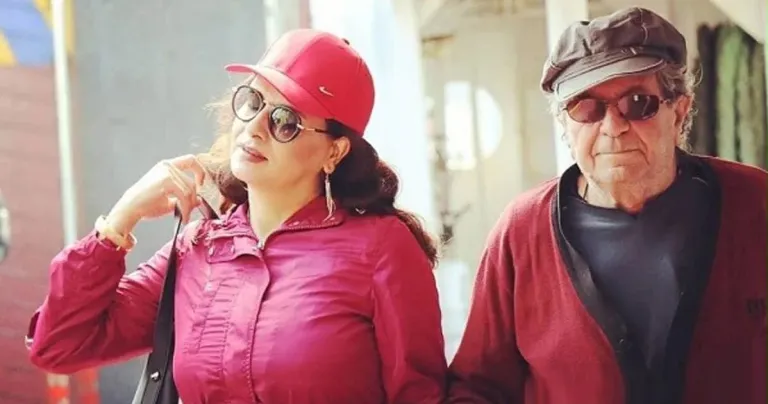
Revisiting the image of Dariush Mehrjui on the third anniversary of his death, alongside his wife, Vahideh Mohammadi-Far, inevitably means confronting an open wound: the relationship between art, philosophy, politics, ethics, and the grim fate of human beings in a turbulent land. As we know, Mehrjui was a multifaceted figure: a filmmaker deeply devoted to literature, knowledgeable about philosophy and foreign languages, a translator of philosophical, literary, and dramatic texts into Persian, and a former film critic. Throughout his life, he resisted being confined within simplistic definitions. Assessing his body of work on the anniversary of the horrific slaughter of him and his wife, Vahideh Mohammadi-Far, in their own home requires an examination of the various layers of his thought, conduct, and cinematic form. Only then can we turn to the social reverberations of his life and death, which, amid the relentless churn of the news and the vicissitudes of everyday life, were consumed and even forgotten with remarkable speed, much like everything else.
One: Philosophical Knowledge and Existential Insight in Cinema
This was what fundamentally distinguished Mehrjui from most of his contemporaries and from the filmmakers who came before and after him. He was not a filmmaker who simply attached philosophy to his work as an intellectual affectation; philosophical thought was instead the lifeblood of his narrative structures and his worldview. His translations of two plays by Eugène Ionesco (The Lesson and The Bald Soprano), as well as his translation of Michael Talbot’s now-classic book The Holographic Universe, testify to his existential, ontological, and existentialist preoccupations. From this perspective, perhaps the central question raised by the circumstances of his death is this: what could be more terrifying than such anguish in the final moments of a human life?
These concerns surfaced in many of his works (The Mina Circle, The Cow, Hamoun, Pari, and Banu). Confronting absurdity, meaninglessness, and decay, and striving for redemption or knowledge in a world that has been lost, were among the central themes of his cinema. Thanks to his philosophical insight, Mehrjui knew how to transform the insecurity, anxiety, and psychological fractures of modern human beings into visual form. In doing so, he turned the relationship between Western philosophical rationality and Eastern mysticism or illumination into a dramatic problem. But why, then, did things have to end this way?
Two: A Profound Engagement with Fiction and Drama
Mehrjui was undoubtedly one of the most literarily astute filmmakers in Iranian cinema. His approach to adaptation was neither mechanical nor an attempt to follow established methods simply to reproduce an existing work. Rather, he absorbed literary texts into his own thinking and drew a new world out of them. His collaborations with the distinguished writer Gholam-Hossein Saedi, which gave rise to films such as The Cow and The Tenants, are significant in this regard. We know that the underlying concept and worldview of The Tenants also emerged from Saedi’s imagination and sensibility. Despite their natural differences, the two shared a broad outlook on the world and its phenomena. Even in the depths of their pessimism, they retained their sense of humor, and they recognized no limits to blending forms and genres. Both were gifted dialogue writers who believed that staying at home or seeking nothing beyond physical security was not enough. Even in accounts of their final days together in Paris, when Saedi and Mehrjui spent hours in cafés writing screenplays such as Molossus Corpus—published in Iran years later and sharing substantial similarities with The Tenants in its ideas and narrative design—the overriding concern was always literary and narrative creation.
It is also worth noting that Mehrjui’s adaptations of Western works, from Salinger in Pari to Ibsen in Banu, demonstrate the breadth of his literary reading and his ability to transplant Western stories into an Iranian context and reshape them for the screen.
Three: Directing Actors and Discovering Lasting Talent
Mehrjui’s ability to discover and nurture talent, and to draw the finest performances from actors with vastly different backgrounds, has virtually no parallel in Iranian cinema. He could bring out the best in seasoned theater and film actors such as Ezzatollah Entezami, Ali Nasirian, Khosrow Shakibai, and Jamileh Sheikhi, but he was equally adept at working with newcomers, unfamiliar faces, and even television actors. You have probably heard the famous stories of how he selected several actors for different projects simply by looking at their photographs. He stripped acting of its dependence on makeup and external mannerisms, drawing performers into the lived reality of their characters. As colleagues observed in their recollections and elegies after his death—including Ali Mosaffa’s poignant tribute—Mehrjui paid particular, if understated, attention to detail when directing actors. He accompanied them in their performances while allowing part of the directorial process itself to remain invisible.
Four: The Struggle to Survive and Keep Pace with the Times
Unlike many of his peers, who faded into obscurity after a period of brilliance or rested on the laurels of past achievements, Mehrjui continued, until quite recently, to seek ways of renewing his work and remaining engaged with the generational changes reshaping Iranian society. He listened to changing social attitudes, the intellectual transformations of younger generations, the realities of urban life, and new conversations about women’s rights, freedom, and individual autonomy, and reflected them in his screenplays. His responses to social events, his solidarity with popular movements—particularly the Woman, Life, Freedom uprising—and his opposition to compulsory hijab in the final year of his life all demonstrated his continued engagement with the society around him. He did not want to become a forgotten filmmaker. With every ounce of his being, he fought to remain active, to keep making films, and to continue breathing within the cultural sphere.
Five: The Absence of Perfectionism and a Certain Sloppiness in Execution
One of the most significant formal and aesthetic features of Mehrjui’s work, setting him apart from the meticulous directors of his generation—figures such as Bahram Beyzai, Nasser Taghvai, and Shahram Aslani—was a certain ease, lack of pretension, and even deliberate untidiness in execution. His films were largely free of formal showmanship, excessively polished compositions, and displays of technical virtuosity. At their best, his direction appeared simple yet precise. This organic mode of filmmaking gave his films a sense of lived reality. Crowded sequences, houses full of comings and goings, gatherings, family rituals, and especially scenes of people eating all felt tangible and immediate. The last of these has repeatedly been identified in criticism as a hallmark of his work—or, incorrectly, as an authorial signature unique to his films. Mehrjui had no qualms about allowing a scene to become a little chaotic, dialogue to overlap, or the overall form of a film to appear somewhat disorderly.
Six: Candor, Bluntness, and Professional Self-Interest
Mehrjui was a complex personality, embodying all the contradictions of a culturally engaged individual. In public and in interviews, he was frank and outspoken, sometimes even aggressive. At the same time, as a filmmaker determined to keep his filmmaking career going at almost any cost, he was hardly indifferent to practical considerations and professional self-interest. His shifting responses to the banning or release of his films, his changes in tone when addressing officials in power to preserve the possibility of screening his work, and his efforts to circumvent censorship all reveal a filmmaker oscillating between intellectual idealism and a hard-nosed pragmatism necessary for economic and professional survival. For this reason, he had no qualms about changing his tactics to rescue a film from a ban or attract an audience. And, of course, this very quality also made him a living, distinctive personality.
Seven: The Circumstances of His Death
The fate of Mehrjui—and Vahideh Mohammadi-Far—must be regarded as the most horrifying, and at the same time the most metaphorically charged, chapter in the turbulent life of this aging man. He was not merely the victim of a horrific crime; it was as though he had been forced to inhabit one of the darkest, most nightmarish scenes from his own films. The stabbing and slaughter of an artist who had spent his life warning of moral collapse, insecurity, the plundering of cultural property, and the intrusion of evil into the supposed sanctuary of the home sent a profound shock through society. We have not forgotten how often his films returned to the effort to turn a ruin into a habitable place, or to the intrusion of irrelevant people into the private lives of their inhabitants—from The Tenants and Banu to Pari and Maman’s Guest. The home was supposedly a place of safety, but it became a slaughterhouse. His death, with all the ambiguities and media-driven polarization surrounding the alleged killer, foreign nationals, and their supposed sinister motives, marks a staggering descent into the cultural history of our society.
At their best, Mehrjui’s films revealed a persistent struggle to understand the suffering of Iranian people. Having seven films banned over the course of forty years had left him depleted, but he never stopped struggling. We are now forced to remember the account of the severed head in Hamoun through the horrifying image of two victims in a shudder-inducing tableau—a trauma so immense that the suffering of the protagonists in his films (Hamoun, Banu, Pari, and Leila) seems insignificant by comparison. Mehrjui had never made a crime film, but did not The Holographic Universe itself suggest that seemingly unrelated things might be connected? His death brought together all the apparent irrelevancies of a society that blends mourning, buffoonery, manufactured news, and political obsession. The famous image of the severed head in Hamoun—a character played by Amrollah Saberi—suddenly seemed to step out of the frame, acquiring a real and tangible embodiment.
© 2026. Phoenix Review