



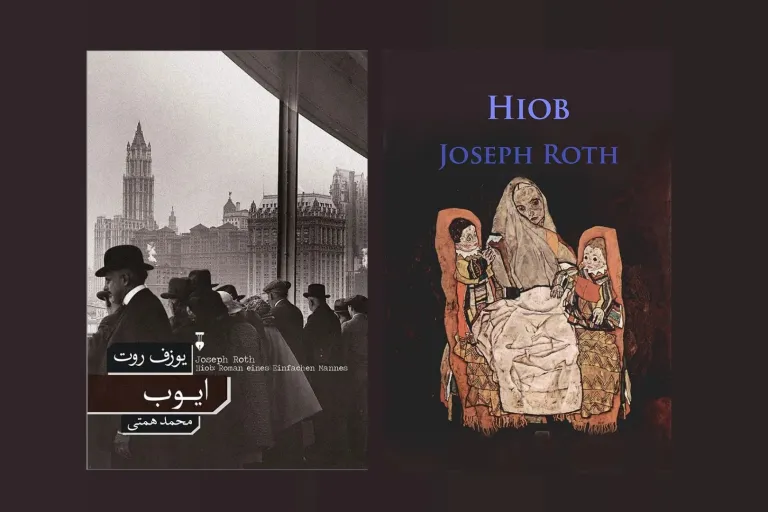
It is the year 1775. There are still 120 years to go before Joseph Roth is born, nearly 170 before Auschwitz, and 251 before thousands of Iranians are killed, injured, and suppressed in the streets, followed by war and the bombing of a school in Minab. We are in the capital of Portugal: Lisbon. God is listening to the prayers of His most obedient and steadfast servants in church—or at least that is what those praying believe. They may not be as devout as Mendel Singer, the protagonist of Joseph Roth’s novel Job, but they are hardly any less so. And then, suddenly, God commands the earth to tremble, and tremble it does. Just as the Quran declares, immediately after “In the name of God, the Most Compassionate, the Most Merciful”: “When the earth is shaken with its [final] earthquake, and the earth throws out its burdens, and man asks, ‘What is happening to it?’” Fires and tsunamis upend the lives of the people of Lisbon and its surroundings. The church roof collapses. The roofs of houses and marketplaces collapse. The foundations of the earth shake without respite, and 60,000 people lose their lives in what is called a “natural evil.”
The aftershocks of this earthquake reverberate through the keenest and most brilliant minds of the age. Arguments begin. From Kant onward, thinkers attempt to explain what has happened. The answers vary. Some try to shift the focus away from the Creator and toward His creation, in the hope of minimizing the damage when such disasters occur again. They believe that science can offer a better explanation of the world’s phenomena and prevent the harm caused by evil. They are still a long way from Auschwitz, the streets of Tehran, and the school in Minab, and they do not yet know that science itself, when unleashed without ethics in the manner of the Karamazovs, can produce an even greater evil. This is why the Lisbon earthquake is said to mark the beginning of modernity, and Auschwitz its end. At the same time, others attempt to argue that the existence of evil is incompatible with the existence of an omnipotent and just God. They put God on trial, reasoning that if He can prevent this evil but does not, then He must be malevolent; if He wishes to prevent it but cannot, then He must be powerless. Still others attempt, like lawyers, to “defend” God in this court of judgment. But is the world really, as Leibniz claimed, “the best of all possible worlds,” and is science one day supposed to reveal to human beings both the powers of the Creator and the limitations of His creation? On the other hand, could dualism not account for the existence of evil better than monotheism? From a dualist perspective, at least, we can say that the force of Ahriman sometimes gains the upper hand over that of Ahura Mazda and commits evil deeds. As we can see, these arguments are not confined to the Western world. Perhaps it would be worth taking a look at Iran as well before turning to the “Jobs” of literature and connecting these worlds to one another.
In The Alchemy of Happiness, Al-Ghazali views the world through the lens of his Ashʿarite outlook and writes:
“The world and everything in it are His creation, and He created everything in such a way that nothing could be better or more beautiful than it is… Whatever He created, He created with justice and wisdom, and He created it in its entirety. He created things as they ought to be. If something more perfect than this had been possible and He had not created it, that would have been due either to impotence or to miserliness, and both attributes are impossible in Him. Thus, whatever He has created, whether suffering, illness, poverty, ignorance, or incapacity, is all justice. Injustice is impossible on His part.”
This is the same outlook we find in Leibniz: the world cannot possibly be better or more beautiful than it already is. As far as I know, however, Iran has never had its own Voltaire to mock this proposition through a novel like Candide.
Another figure is ʿAḍud al-Din al-Iji, a judge and theologian who lived in the eighth century of the Islamic calendar, around the same time as Hafez Shirazi. His outlook differs somewhat. Revisiting his ideas—which are not entirely unrelated to the perspective of the author of Job—may prove useful. He argues optimistically:
“Although, for instance, illness is widespread, health is more widespread still; and although suffering is abundant, comfort or pleasure is greater still… Nothing exists that is purely evil, or in which evil outweighs good, or in which the two are equal.”
His argument ultimately leads to the conclusion that some good lies hidden in every evil. A flood, for example, may rightly be regarded as an evil, but abundant rainfall naturally brings many benefits as well. Indeed, floods have prompted human beings to build dams and devise other means of controlling water. Is the illness of Menuchim, a character in Roth’s novel, one of these “evils that bring forth good”? Is Roth trying to arrive at the same conclusion Al-Ghazali reaches elsewhere in The Alchemy of Happiness?
“And if they should think that the divine creation ought to have been better than this, they would be mistaken and unaware of the secret wisdom and purpose behind it. They are like a blind man who enters a house in which every object has been placed in its proper place, though he cannot see. When he stumbles over something, he asks, ‘Why have they put this in the way?’ Yet the object is not in the way at all; it is simply that he cannot see the way.”
Is Mendel Singer like the blind man in this little story by Al-Ghazali? Is he unable to see that what lies before him is not an obstacle but something precisely where it belongs, and that he himself is the one who has lost his way? Or, to put it more bluntly, is God attentive to His creatures, and, whenever He inflicts evil upon them, does He do so in pursuit of some greater good? Can Menuchim’s reappearance in Roth’s novel even be regarded as a “miracle”? Or is this merely another instance of God mocking His foolish servant?
To my mind, the most cunning and subtle treatment of the problem of evil in Persian literature can be found in this ambiguous, double-edged couplet by Hafez:
“Our master said that no error had slipped from the pen of creation;
May praise be upon his pure gaze, which veils all error.”
Hafez’s extraordinary wit and the intelligence with which he selects and arranges his words prevent us from answering these questions with any certainty. Is there truly no error in divine creation, and is “our master” right? Or has “our master,” through his way of looking at things, drawn a veil over the errors and evils inherent in creation? This is the very question we encounter in Joseph Roth’s Job and, long before Roth and all the other narratives discussed here, in the Book of Job in the Old Testament.
Unlike Islamic accounts, the Old Testament’s Book of Job has little to do with “patience.” It begins with a genuinely wicked wager. God is seated in His majestic court, where Satan walks freely, unrestrained and cunning, and makes a bet with God over Job’s piety. Job is described as “a blameless and upright man, one who fears God and shuns evil.” God tells Satan that he may subject Job to any trial he wishes, provided he spares Job’s life. Satan then sets to work, exercising his own “agency,” and the rest follows.
In his introduction to The Book of Job, Qasem Hasheminejad observes that nowhere else in the Old Testament does God become so human, or humanity so divine. In this account—unlike the Islamic perspective—the issue is not “patience,” but “evil” and justice. After Job endures all the suffering imposed upon him, as well as the sharp-tongued reproaches of his friends, who insist that God’s actions are perfectly just and that Job must surely have sinned to deserve such calamities, God intervenes personally and performs a “miracle.” Everything taken from Job is restored to him, and both Job and his friends are struck silent.
Mendel Singer’s friends likewise believe that his misfortunes are the result of his having left Menuchim behind in Russia. In Roth’s eyes, they are no different from Job’s foolish friends—Eliphaz, Bildad, and Zophar.
Yet the most important similarity between Roth’s novel and the Old Testament narrative lies neither in their structures nor in the resemblance between their names, but in their openness to interpretation. On the surface, both stories seem to offer a conservative invitation to trust in divine providence. Yet both can be read differently, reinterpreted, and called into question. The fundamental question always remains: “Did Job or Mendel deserve so much suffering?”
We can also question the author’s own ideas. Was Dostoevsky not more “modern” and more grounded in earthly reality than Roth, decades before him? I am referring to a chapter of The Brothers Karamazov in which Alyosha eagerly awaits a miracle from God, only for no miracle to occur. Instead, the corpse of Father Zosima begins to rot and stink, and Alyosha’s faith is shaken. Does Deborah, in Roth’s Job, make our whole being tremble more when, on the night before emigrating to America, she approaches Menuchim with a candle in her hand, hoping to witness a miracle but seeing none, than when Menuchim appears at the end of the novel, perfectly healthy and full of life?
Of course, other voices can also be heard clearly in the novel, and this is precisely what makes Roth’s work so valuable. I recall a scene in which Shmuel and Jonas are sitting on a train. The former is fleeing from war, though he eventually dies fighting in a war for another country; the latter loves war and the military, and ultimately survives three wars. Jonas says something to Shmuel that is particularly important: “I want to be a peasant.”
The implication is that he does not want to be like his father, an unsophisticated, rigidly religious, and naïve man. Another way of translating Jonas’s words would be: “I want to live. Through my body.”
In the end, each of Mendel’s children becomes a “peasant”—though not in the dictionary sense of the word. None of them turns out like their father; each goes their own way. Even Menuchim, who most resembles Mendel, is different from him. He does not join the army or ride horses, as Jonas does. He does not pursue money and advancement, as Shmarya, or Sam, does. Nor does he indulge in purely sexual, bodily pleasures, as his rebellious sister Miriam does. And yet he is redeemed. First, medical science heals him; then art and music redeem him, and he returns to his father’s embrace, becoming himself an agent of another person’s redemption.
Ultimately, although the novel bears traces of an attempt to revive religious morality, I do not think Job can be regarded as a novel overtly devoted to religious propaganda or the justification of evil. Menuchim, the novel’s true hero, at least, does not turn religion into stagnant water in which everything rots, as his father does. Mendel himself experiences genuine freedom only when he “rebels.” He stands up to Yahweh, insisting that he has committed no sin that would warrant such punishment. It is true that, as the novel progresses, he is dehumanized and treated as a superfluous, pitiable, and even repulsive creature. Yet at the very moment of his greatest brokenness, he finally recovers his full humanity.
And it is at this point that Menuchim appears, and a renewed relationship between Mendel and Yahweh begins to take shape. The Christian Trinity of Father, Son, and Holy Spirit is completed. This new relationship is based not on “fear,” but on “love.” Mendel is no longer “afraid” of this God. He can remove his skullcap whenever he pleases and let the sun shine on his head.
One possible interpretation of the novel, then, is that the miracle Roth speaks of is the miracle of love, science, music, and art—and, of course, a considerable amount of good luck after a great deal of misfortune, along with a little faith that God’s slaps upon His servants may not, after all, be entirely without purpose!
© 2026. Phoenix Review