



Prelude — In this final piece in a series of essays focusing on important Iranian films at the age of forty, I would like to return to the broader image of the 1980s: an ambiguous, turbulent, and strange decade that, despite all its dangers and unforeseen new paths, brought at least three generations of Iranian filmmakers together under the same umbrella. Interestingly, many of these filmmakers also made the finest work of their careers during these very years. The Farabi Cinema Foundation, as the executive and policymaking arm of cinema in the new era, was defining the limits and restrictions; filmmakers, wary of experimentation and trial and error, were nevertheless forced to adapt to these strange new parameters. And, remarkably, cinema had effectively become, in retrospect, a barometer of its time. In this process, it is hardly surprising that some films would even wrestle with cinema itself—an opportunity that has been denied to filmmakers working in the mainstream for years—and that narrative and generic diversity would gain the upper hand.
The year 1986, moreover, marks an extraordinary turning point in the history of Iranian cinema. It was a year that produced works defining new standards in a range of genres: action, war, historical drama, comedy, thriller, and even films that were alternative and entirely removed from the mainstream. As my esteemed friend and critic Shahram Jafarinejad wrote in his exemplary piece on The Spell, the film brings before our eyes something Iranian cinema lacks, and that quality remains valuable to this day. (“The Spell and the Sanctity of Woman,” Film Monthly, no. 60, February 1988.)
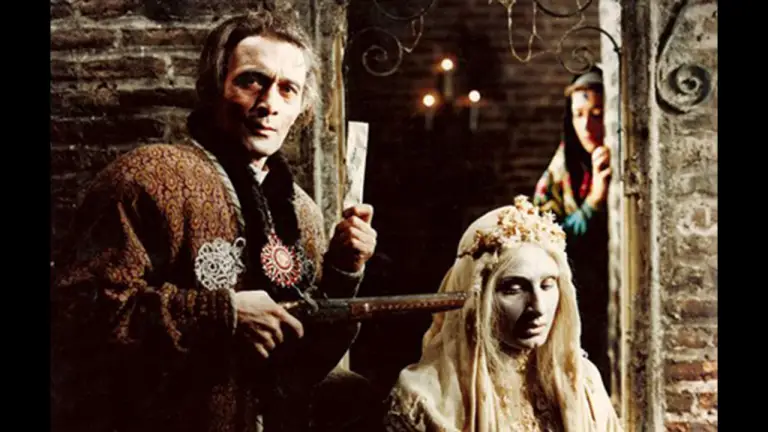
It is best to view The Spell within this context. At forty, this remains Dariush Farhang’s finest film and one of the strangest aesthetic experiences in Iranian cinema: a formal synthesis of a cinema saturated with Gothic elements, archetypal rituals, and historical-mystery drama, as well as a turning point in the formal and technical experiments of Iranian cinema during the first decade after the 1979 Revolution.
One possible way of dissecting the film is to examine the foundational texts and historical connections scattered throughout its drama. Another is to reread the direct traces of Bahram Beyzai’s cinema in Farhang’s techniques and formal devices, as well as his attempt to move beyond the source text—the unpublished screenplay The Blizzard Castle by Bahram Beyzai. I do not raise this merely because Farhang was Beyzai’s direct student at the Faculty of Fine Arts at the University of Tehran, or because he worked as his assistant on Bashu, the Little Stranger. Consider, for instance, how the film opens with silent, static shots: a space saturated with ambiguity, governed less by the logic of narrative than by a ritualistic logic. Later, the continuous camera movements through enclosed spaces, the use of elevated angles, and the precise tracking shots all recall Beyzai’s dynamic camera in works with ritualistic and mythological dimensions, such as The Stranger and the Fog and The Ballad of Tara.
In The Spell, ancestral customs prevail over rational thought and modern civilization. The Characters act not according to individual will but within the constraints imposed by magical rituals, superstition, and the hierarchy of the feudal khanate. Is this not the familiar worldview that Beyzai has repeatedly brought to life in his theatrical and cinematic works? Farhang has managed to transform the ritualistic structure inscribed in the text into a lived form through carefully choreographed camera movements—a form deeply indebted to Beyzai’s directorial school.
The film has retained its structural freshness and formal power, but its historical significance lies partly in the fact that, rather than gravitating toward realism—the dominant mode of yesterday and, to a large extent, still of serious cinema—it boldly moves toward genre cinema, combining Gothic, mystery, and psychological elements. In this respect, a reference to Mohammad Reza Aslani’s masterpiece Chess of the Wind (1976), even if indirect, extends beyond similarities of plot and setting to reach the level of theme: the decline of the aristocracy, the ascendancy of the lower classes, the intensification of class resentments, and the ambiguity and fear surrounding the encounter with a new era. (Come to think of it, isn’t this also the story of the filmmaker himself and the dark decade in which the film reached the screen?)
The magnificent cinematography of Alireza Zarrindast, with its complex lighting schemes—including one particular mirror hall that prompted considerable speculation about where, exactly, the master cinematographer had placed the camera—marks the height of the filmmaker’s achievement in visual structure: stark chiaroscuro, low-key lighting to represent the opposition between good and evil, and the dominance of the past over the present of the narrative, combined with the twists of a plot in which newcomers—the bride and groom—unwittingly enter a mysterious domain. All of this creates classical suspense and stages the human encounter with unfamiliar rituals, going beyond an entertaining story to construct a lived world in a geography without time or place.
The work of the young Amir Esbati also deserves mention. At the beginning of his professional career, he played an essential role in making the film’s fictional world believable through his demanding production design. If we trace the marks of ambiguity and forgotten rituals through the film’s formal construction, much of the responsibility for bringing this world to life falls on Esbati: the specter of the old, ruined castle, its dark halls, dust-covered mirrors, the recreation of the Shah’s constant, unconscious torment, his imprisonment in time, and his loss of identity.
Whatever the case, it is no small achievement that the film can still be confidently recommended to viewers who have never encountered it. Yet there are also obvious shortcomings that keep The Spell several steps below a fully accomplished work.[1] That is to say, despite the formal distinctions mentioned above and its extraordinary technique, The Spell falls short of the exalted level achieved by Beyzai’s masterpieces, particularly his collaborations with Susan Taslimi. To my mind, two incongruous elements constitute the Achilles’ heel of this cinematic achievement:
Language and the Shape of the Dialogue: The language of the characters in The Spell, instead of possessing the orchestration, rhythm, and mythological depth of Beyzai’s language, comes closer to the generic, conventional diction of our historical films and television series: overly literary and artificial. It is as though the young director’s hands were not entirely free in constructing his personal world and he had been forced to submit to the demands of the market. The dialogue fails to establish an organic connection between the Gothic ritual and its verbal form, remaining at the level of a generalized, highbrow literary style.
Dubbing: Despite the ever-impressive performances of Manouchehr Esmaili and Nasser Tahmasb in their respective roles—dubbed for Jamshid Mashayekhi and Parviz Pourhosseini—the polished voices of the dubbing artists and the familiar images they conjure in the viewer’s mind ultimately seem less effective than the potential use of the actors’ own voices. The film needed a more local, rougher, earthier sound to convey the horror and suffering trapped inside the castle with greater depth. Even the ambient soundscape could have helped consolidate the film’s texture in this regard.
Ultimately, what gives the film its aesthetic distinction is the position of the camera and Farhang’s treatment of indigenous elements through a modern formal mechanism. The filmmaker has a grand idea in mind, but he does not shout it; indeed, he does not even whisper it. The collapse of the old order and the burning of the signs of yesterday at the feet of the young couple constitute a muted yet decisive position, one articulated with caution and, ultimately, brought to resolution. It is worth noting, however, that the ending can reasonably be understood as one of the impositions of the homogenizing censorship system under the newly established Islamic Republic: perhaps the hurried resolution of the situation was designed to prevent the wedding from taking on the color of mourning. In this sense, the screenplay leaves us with a question: Was what we gained worth what we lost?
© 2026. Phoenix Review