



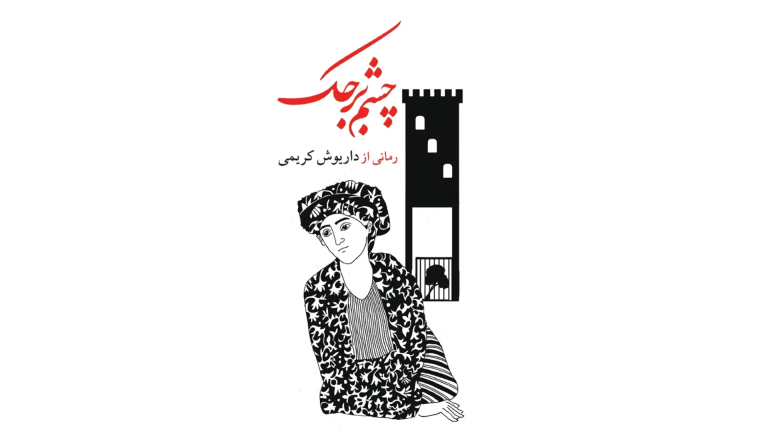
Today I want to talk about a novel that is, in one respect, remarkably fresh and significant in contemporary Persian fiction. Not because no crime or detective novels have ever been written in Persian, but because its author has taken the conventions of the genre and brought them into one of the most distinctly Iranian—and at the same time least represented—settings in our literature: a gendarmerie company in a border region during the turbulent years following the Revolution. The novel is The Watchtower’s Eye by Dariush Karimi, published in 2026 by Asmana Publishing.
But before turning to the book itself, it is worth saying a few words about its author. Dariush Karimi was born in Kermanshah and studied English literature in Tehran. During that period, he translated Tzvetan Todorov’s book on Mikhail Bakhtin’s ideas into Persian under the title The Dialogic Imagination, and for a time taught English literature and literary theory. In 1999, he joined the BBC and later played a role in the establishment of BBC Persian Television. For many audiences, his name is above all associated with Parag, a program whose purpose was not to offer a final answer, but to bring different perspectives and voices into confrontation.
This background is interesting because, in Karimi’s novels as well, truth rarely belongs to a single voice. Truth emerges from the collision of narratives, memories, silences, and misunderstandings. In The Watchtower’s Eye, language is not merely a means of communication; it is itself part of the mystery. The characters speak Persian, Turkish, and Kurdish, but they do not always understand one another. Sometimes someone remains silent, sometimes another person provides an incomplete translation, and sometimes power exploits precisely this inability to communicate. This polyphony can be connected to the same sensitivity with which Karimi engaged with Bakhtin through his studies and translation years ago.
The plot can be summarized very briefly. A young Kurdish woman named Aghrin makes her way, after a long journey, to a gendarmerie company near Urmia. Apparently, she has come seeking refuge, but no one can properly understand her language, and it is unclear whom or what she has fled. Jalal, the young deputy commander of the company, decides that they should keep her there overnight and send her to the regiment headquarters the following day.
But by morning, the situation has turned into a criminal case, and Jalal unwillingly finds himself drawn into an investigation that threatens not only the peace of the company but also his own position. This is enough to enter the story; the rest is better discovered while reading the book.
To understand the significance of The Watchtower’s Eye, we need to say a little about the place of crime fiction in Persian literature. Contemporary Persian literature has a rich tradition of social, political, psychological, historical, and modernist fiction. Genre literature, however—especially detective and crime fiction—has generally remained on the margins. This kind of fiction entered Persian through translation, beginning in the late Qajar period, and later continued through serialized fiction, police narratives, memoirs by law-enforcement officers, and a number of independent works. But it never developed into a broad and continuous literary current in the way it did in English, French, or American literature.
There are, of course, important examples. Qasem Hashemi-Nejad’s Elephant in the Dark is one of the most notable, while some of Ismail Fasih’s novels also employ crime and detective structures. Yet even with these examples, their generic potential never developed into a sustained tradition. A literary genre is not built by one or two books; it requires continuity, experimentation, readers, and reinvention.
From this perspective, Dariush Karimi’s work is important. The Watchtower’s Eye is neither an accidental experiment nor his first encounter with crime fiction. Karimi had previously turned to a political mystery and detective narrative in his novel The Last Alley. The Watchtower’s Eye is not a direct continuation of that book’s story, but it is certainly a continuation of the same generic project: using suspense, crime, and investigation to open up a larger case involving political memory and the mechanisms of power.
Even the novel Rudi and Ravi and Mawji, although primarily a psychological and polyphonic work, has a subtle connection to The Watchtower’s Eye. At the center of that novel, too, is an absent woman whom different men attempt to understand by recounting their memories of her. Yet none of them can provide a complete or definitive picture. One of Karimi’s recurring concerns, therefore, is how we construct a story about someone who can no longer speak for herself—and whether these narratives actually reveal her or merely expose the narrators’ own fantasies and desires.
The same question is present in The Watchtower’s Eye. Aghrin has only a brief encounter with Jalal, barely speaks to him, and soon becomes an absence. Yet her image remains in Jalal’s mind: a woman sitting on a rock, one hand on her headscarf and the other raised against the light. Gradually, Jalal is no longer simply trying to uncover a criminal truth; he wants to understand a woman whom he has effectively never had the opportunity to know.
This is one of the old conventions of noir: the absent woman whom the male investigator constructs an imaginary image of. But Karimi does not reproduce this convention uncritically. Nahid, Jalal’s fiancée, confronts him with precisely this issue at one point: you have turned someone you saw for only a few hours into an imaginary being, while you may be failing to see the people who are alive and standing right in front of you.
This encounter is important because it prevents Aghrin from being reduced to the image of a beautiful, silent, mysterious woman in a man’s mind. Jalal’s gaze itself becomes part of the novel’s subject.
But, in generic terms, what kind of crime novel is The Watchtower’s Eye?
In the classic detective-story model, famously exemplified by Agatha Christie, a crime has taken place in the past and the detective must reconstruct it by assembling the clues. Tzvetan Todorov argues that this type of novel is actually made up of two stories: the story of the crime and the story of the investigation. The crime disrupts the order of the world, and the detective, by discovering the truth, restores that order—at least intellectually.
But in the tradition of Dashiell Hammett and Raymond Chandler, that of hard-boiled fiction and noir, crime is not an exceptional event occurring within an otherwise healthy society. Crime is part of that society’s ordinary life. The police, politics, business, and the judicial system may themselves be corrupt or incapable. The detective finds the truth, but finding the truth does not necessarily repair anything. Philip Marlowe in Chandler’s novels is a fundamentally ethical man moving through a harsh and corrupt environment; his value lies not in saving the world, but in refusing to become entirely like the world around him.
To my mind, The Watchtower’s Eye is much closer to this second tradition. It is an institutional noir: the problem is not simply the presence of a criminal within the story. The institution itself—with its hierarchy, regulations, report-writing, fear of scandal, and desire to close the case—becomes part of the mystery.
The choice of Jalal as the protagonist is crucial here. He is not a private detective like Marlowe, standing outside the police apparatus and looking upon it with suspicion. Jalal is himself an officer. He wears the uniform of the very institution whose secrets he is trying to uncover. As a result, almost every action that would be perfectly logical in a conventional detective story becomes, from a military perspective, a form of insubordination. Going to a village, talking to local people, contacting a friend in intelligence, or asking questions that the commander would rather leave unasked can all be interpreted as violations of the hierarchy.
In a conventional detective novel, the criminal resists the investigation. Here, at times, it is the administrative structure itself that resists. The report must be written quickly, the case must be removed from the desk, the superior officer must not be upset, and the company’s reputation must not be put at risk. Truth is acceptable only as long as it does not disrupt the organization’s order. That is why the more Jalal behaves like an investigator, the more dangerous he becomes to the organization he belongs to.
This transplantation of noir into an Iranian setting is, in my view, the book’s most important achievement. Karimi has not simply replaced Chandler’s Los Angeles streets with the roads of Urmia. He has embedded the logic of noir within Iranian history and institutions: the gendarmerie, the watchtower, the outpost, the radio, soldiers’ leave, the relationship between officers and enlisted men, the language of official directives, political suspicion, and the profound distance between military personnel and local communities.
What is even more distinctive about this shift is that noir moves from the big city into a rural and borderland geography. In literary and cinematic memory, noir is usually associated with rain-soaked streets, neon lights, hotels, bars, police stations, and the anonymous crowds of the city. In The Watchtower’s Eye, however, darkness emerges from villages, empty roads, mountains, remote outposts, and the closed relationships of a local community.
This is not simply a change of backdrop; it also transforms the genre’s rules. In a city, anonymity and crowds allow a criminal to disappear. In a village, almost everyone knows everyone else, and the secret emerges precisely from this apparent familiarity and proximity. In this sense, The Watchtower’s Eye can be considered one of the relatively rare examples of “rural noir” in Persian literature—a noir that draws not on neon lights and wet asphalt, but on watchtowers, dusty roads, mountain silence, and suspicion between military forces and local people.
Even the novel’s humor emerges from this setting. Despite its dark subject matter, the novel is often funny—not because its subject is light or trivial, but through a distinctly dark form of humor. Commanders use grandiose, bureaucratic language; soldiers explain the same situations through everyday speech and jokes; and the distance between official language and reality can become deeply absurd.
Karimi constructs the military environment through small details: boots, tea, barracks food, official directives, guard duty, soldiers’ homesickness, and the childish rivalries among people carrying guns.
The book’s central symbol is, naturally, the object named in its title: the watchtower. The watchtower is supposed to be the eye of the security apparatus. From above, it can see the road, the village, the water well, and the movement of people. But the novel draws a distinction between seeing and understanding. An institution may keep everything under surveillance and still understand nothing about people’s real lives. It may know who has left a house without knowing why that person is fleeing. It may see a woman’s movements without seeing the violence unfolding in her life.
That is why the title The Watchtower’s Eye is so precise. This is not really an eye of care; it is an eye of surveillance. It watches in order to control, classify, and report—not necessarily to understand or save.
As a mystery, the book should be approached with the right expectations. If a reader is looking only for the perfectly geometric architecture of an Agatha Christie mystery—a closed circle of suspects, precise clues, and a final revelation that places everything neatly in its proper position—they may find The Watchtower’s Eye unconventional.
The novel’s strength does not lie solely in the complexity of its mystery. The mystery is a gateway into a larger world: a world in which the truth may be discovered, but discovering it does not necessarily lead to justice.
This difference is not a weakness; it is where the novel’s generic choice resides. The Watchtower’s Eye is closer to noir than to the classical mystery. Gradually, the novel’s question moves beyond “Who did it?” toward a more difficult question: What conditions made this crime possible, and why does the institution that is supposed to uncover the truth sometimes fear the truth itself?
In my view, The Watchtower’s Eye is one of the most serious and successful attempts in recent years to write an Iranian crime novel. The book has suspense and keeps the reader turning the pages, but at the same time it brings history, politics, geography, domestic violence, ethnic relations, and the mechanisms of power into the story without turning the novel into a political essay.
More importantly, the book demonstrates that there is no wall between serious literature and genre fiction. A novel can be both gripping and readable and, at the same time, speak about power, responsibility, and truth. Indeed, this is what genre fiction does at its best: it draws the reader into a story with a mystery, only to confront them with a world more complicated than the mystery itself.
That is why I recommend reading The Watchtower’s Eye—not merely to find out what happened, but to see how a writer has managed to take the tradition of noir out of the familiar setting of Western cities and give it new life inside a gendarmerie company, among the mountains, villages, and roads of northwestern Iran.
Ultimately, The Watchtower’s Eye is a novel about the distance between seeing and understanding; about a power that watches everyone from above but may be incapable of truly seeing the human being standing directly in front of it. With one final question lingering in the mind: the watchtower has an eye, but does it have a conscience?
© 2026. Phoenix Review