



Steven Spielberg is, without question, one of the principal architects of cinematic imagination and one of the enduring pillars of science fiction in the history of the seventh art. With timeless masterpieces such as Close Encounters of the Third Kind and E.T. the Extra-Terrestrial, he transformed humanity’s fear of the unknown into wonder, compassion, and solidarity. Later, in Jurassic Park and A.I. Artificial Intelligence, he explored the uneasy intersection of science, ethics, and human hubris. Even the bleak vision of War of the Worlds demonstrated his extraordinary ability to fuse geopolitical anxieties with existential dread. Spielberg’s science fiction has always embodied a kind of astonished humanism, in which dazzling cinematic technique consistently served profound emotional, philosophical, and social concerns.
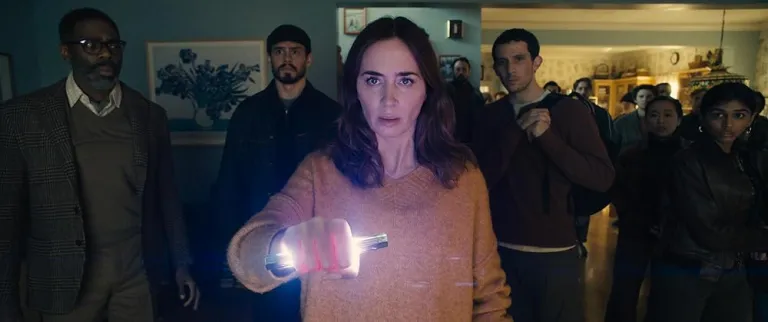
Disclosure Day unfolds against the backdrop of escalating global tensions and the looming shadow of an ongoing Third World War. The film opens with a professional wrestling match before shifting to the arrival of extraterrestrial beings and the decades-long cover-up orchestrated by the U.S. government. The narrative follows a female investigative journalist (Emily Blunt) and her companion (Josh O’Connor), who unexpectedly become entangled in exposing the greatest secret in human history—a truth that governments, intelligence agencies, and even the Church are determined to suppress. As they infiltrate highly classified facilities, witness the torture of alien beings, and struggle to bring their discoveries to a television news anchor, the story attempts to stage a conflict involving truth, morality, and the survival of humanity itself.
Disclosure Day begins with a wrestling match, and the most unfortunate truth about the film is that it never rises above the level of that opening spectacle. It remains theatrical, artificial, hollow, loud, and intermittently drenched in sentimentality and manufactured dramatic moments. Beneath its polished surface lies an unmistakable emptiness.
The first third of the film is devoted to introducing mysteries, posing intriguing questions, and constructing suspense—an atmosphere that strongly recalls the contemporary science-fiction novels of Blake Crouch. Yet the difference between Crouch and today’s Spielberg is profound. Crouch possesses the rare ability to extract deeply human and socially resonant ideas from technically complex science-fiction premises. Spielberg, astonishingly, seems here to have forgotten the very gift that once defined him.
Throughout the film, there are repeated attempts to engage with serious political, social, and even religious themes. References to an ongoing Third World War, echoes of the 1962 Cuban Missile Crisis, the torture of extraterrestrials as a bitter metaphor for America’s treatment of its Indigenous peoples, and the involvement of the Church in concealing knowledge of extraterrestrial life all initially appear to offer fertile dramatic material.
Yet Spielberg’s reluctance—or perhaps fear—to pursue these ideas to their logical conclusion becomes painfully obvious in one crucial line of dialogue: “This is probably even more important than World War III.” Had Spielberg simply read that sentence aloud three or four times before filming it, he might have realized how completely it trivializes not only his own film but the real world as well. With a single line, the narrative reduces one of humanity’s greatest imaginable catastrophes to a disposable plot device, exposing the intellectual shallowness at the heart of the screenplay.
Thematically, Disclosure Day is fragmented, inconsistent, and fundamentally uncertain about its own identity. Until the very end, the audience is never quite sure what kind of film they are watching. Is this meant to be a plea for global peace disguised as an alien invasion story? Is it intended as an exciting blockbuster science-fiction adventure? Or is it a post-Watergate conspiracy thriller about government secrecy and institutional deception?
This thematic confusion infects the screenplay itself, producing astonishing narrative flaws from a filmmaker widely regarded as one of cinema’s greatest masters. The chase sequences are painfully sluggish, oddly lifeless, and almost comically ineffective. Narrative logic frequently collapses altogether. Why does Josh O’Connor’s character not simply leave his girlfriend earlier, thereby preventing the disasters that befall them both? Even more absurd is the sequence in which Emily Blunt casually infiltrates a top-secret military installation and effortlessly deceives an entire security apparatus through embarrassingly childish tricks.
As though this fragmentation were not already severe enough, moments of supposedly intense drama are repeatedly interrupted by Disney-like tonal shifts and broad comic relief, ensuring that neither the audience nor—one increasingly suspects—Spielberg himself ever truly takes the material seriously.
From a technical standpoint, Disclosure Day resembles less the work of a mature auteur than a mechanical exercise in executing familiar, exhausted Hollywood formulas. The immaculate compositions, Janusz Kamiński’s signature overexposed lighting and vertical shafts of light, together with an orchestral score that relentlessly forces emotional intensity upon every scene, all function primarily as distractions from the screenplay’s fundamental weaknesses.
There was once a Spielberg capable of creating cinematic miracles through nothing more than elegant découpage and masterful camera movement. The chase sequences in Duel or Raiders of the Lost Ark required remarkably few technical resources to achieve extraordinary suspense. Here, however, he has become trapped within lifeless digital effects and impatient, hyperactive editing.
This is where the distinction between technical mastery born of habit and formal vitality born of artistic passion becomes unmistakable. Spielberg’s camera continues to glide with flawless precision, but its elegant movements no longer convey the energy of living cinema. Instead, they resemble the graceful motions of an automated machine, dancing mechanically above the ruins of an emotionally barren screenplay.
The emptiness of the characterization inevitably affects the performances as well. Emily Blunt, despite being the film’s most recognizable presence, never develops beyond a simplistic archetype devoid of psychological nuance. Spielberg himself seems curiously unconvinced by her character’s emotional journey. At the film’s decisive turning point—the climactic revelation itself—he inexplicably assigns the responsibility of delivering humanity’s greatest discovery not to his protagonist, but to an anonymous NBC television reporter with virtually no dramatic significance.
Ultimately, the greatest and most unanswerable mystery of Disclosure Day is not the existence of extraterrestrials but the question of what the film itself is actually about. Is it a serious warning about humanity’s near future? Is it an awkward attempt to minimize the horrors of real-world warfare by replacing them with science-fiction spectacle? Is it intended as a theological meditation on alien life? Or, as conspiracy enthusiasts might eagerly suggest, is it a carefully engineered piece of cultural conditioning designed to prepare the public for long-awaited governmental disclosures?
Whatever the answer may be, Disclosure Day remains suspended in a limbo between ambition and incapacity. It is a film that demonstrates how even cinema’s greatest masters, once they lose the courage to excavate the deeper truths buried within their own stories, may ultimately settle for constructing empty spectacles wrapped in glossy cinematic packaging.
© 2026. Phoenix Review