



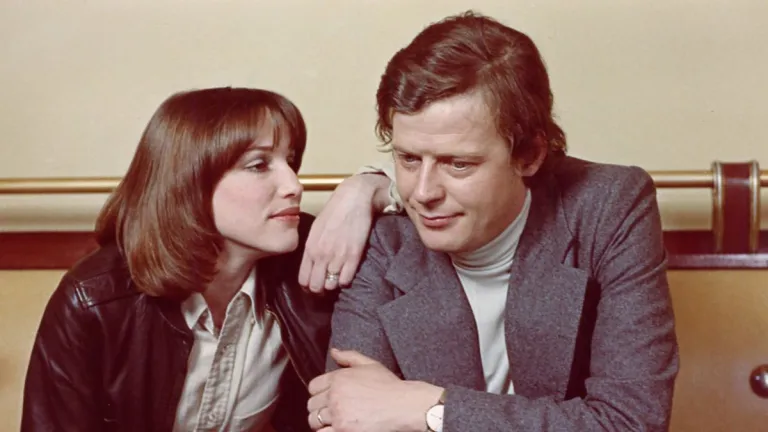
Frédéric wanders through Paris before settling into a café facing the street. People drift across his field of vision one after another. Some he sees for only a few seconds; others linger a little longer. His voice enters as narration: “I love the city because people appear and disappear, and I never have to watch them grow old.” He goes on to explain that what makes the streets of Paris so captivating is the endless procession of women he is almost certain he will never see again. It is precisely this impossibility of approaching them, he admits, that sets his imagination in motion.
I paused the film at that moment. The story gave way to questions. Does anyone still spend the middle of a workday sitting in a café simply to watch strangers pass by? Is it still possible to glimpse someone on the street and immediately accept that they may vanish from your life forever?
My first instinct was to answer no. Not because people have become less curious, but because everyday life—and, more fundamentally, our encounters with strangers—has changed. Frédéric watches women, yet what arrested me was not the nature of his gaze so much as the quality of the encounter itself. It suddenly occurred to me that Éric Rohmer may have made Love in the Afternoon not merely to tell the story of a married man in 1970s Paris. Perhaps, without intending to, he also preserved a particular way of inhabiting the city—a mode of urban life that has quietly disappeared.
A Parisian watching Love in the Afternoon today might notice little difference in the city’s physical landscape. The buildings remain much the same. What would probably stand out instead is the transformation of everyday life: how people walk, how long they pause, the way they look at strangers, and how they spend their time in public space. Perhaps this is why films inevitably become something more than narratives. They also preserve ways of living. That is what Rohmer’s film became for me. Suddenly, I found myself thinking less about its plot than about the very possibility of wandering through a city without purpose.
Frédéric does not merely observe the women passing before him; he invents stories for them. That led me to another question. Has only our way of wandering changed, or has imagination itself changed as well?
Could Frédéric have looked at those women in quite the same way if, before leaving the café, he already knew their names, professions, vacation photographs, and lists of friends? Had he encountered them again the following day—or known even a little about their lives—perhaps there would have been far less room for fantasy. After all, his everyday relationship with his secretary, who is no longer a stranger, never generates the same imaginative possibilities.
It seems that part of the pleasure of wandering lies not in knowing people but in leaving them unfinished. They remain strangers, allowing the mind to fill the empty spaces with stories. Frédéric’s imagination begins precisely where information ends. At least in that moment, the city becomes more than a place through which people pass; it becomes a space where absence itself invites narrative.
Perhaps this is because great cities have never been merely places of transit. They have always been landscapes of imagination. People entered public spaces not only to reach destinations but because the presence of others constituted part of the city’s attraction. Every stranger who appeared for a few fleeting seconds carried the possibility of a story that would never be written. All it took was a woman hurrying past, a man waiting briefly at a traffic light, or someone asleep on the metro. Much of the experience emerged not from the people themselves but from the distance between what we saw and what we could never know. Imagination completed the picture.
Long before Frédéric wandered through the streets of Paris, this experience already had a name. Charles Baudelaire called such an observer the flâneur: a man who strolls through the modern city not to reach a destination but to experience urban life itself. For him, the street was never merely a thoroughfare; it was a stage upon which every passerby might briefly become the protagonist of an unwritten narrative.
Baudelaire’s own poem To a Passerby emerged from precisely such an encounter. The entire poem rests upon the few seconds during which a woman walks past the poet. He knows neither her name nor her destination, nor does he ever see her again. Yet that fleeting moment proves sufficient to generate an entire universe of imagination. One of the poem’s most celebrated lines captures this feeling perfectly: “Shall I never see you again except in eternity?” What gives the poem its emotional force is not the woman herself but her disappearance.
Seen from this perspective, Frédéric’s decision to flee Chloé’s apartment and return home to his wife acquires another meaning. Imagination survives only so long as distance is preserved. Intimacy dissolves the very game upon which the flâneur depends.
At this point, my thoughts inevitably return to the present—not to claim that the flâneur has vanished or that imagination has simply been replaced by social media. I am not convinced that either proposition is entirely true. We still spend time in cafés and public spaces, and strangers remain among the richest sources of our curiosity, even if the rhythms of contemporary life rarely allow for the prolonged pauses Frédéric enjoys in the middle of a working day.
We continue to imagine the lives of people we encounter on Instagram and other social platforms. Much of their existence remains hidden from us. Yet the nature of that imagination differs from Frédéric’s. He confronts an absence of information; we confront an excess of carefully curated information. He constructs an entire world from a single glance. We construct narratives from hundreds of photographs and videos that nonetheless remain filled with invisible gaps.
Perhaps another difference lies in our relationship with strangers themselves. The women Frédéric sees on the street may disappear forever, and that possibility gives every encounter its weight. Every glance might be the last. Today’s strangers, however, usually leave behind a profile to which we can always return. They disappear less often than they are archived. For that reason, the experience of encounter has changed—not necessarily becoming shallower, but fundamentally different. What was once shaped by absence and irretrievable loss has become an experience that continually offers the possibility of return.
For all these reasons, Love in the Afternoon made me think less about Paris in the 1970s than about the present. If Baudelaire’s flâneur wandered the streets of the nineteenth century, and Frédéric inhabited the cafés of the 1970s, where is today’s flâneur? Does he—or perhaps she—still stroll the sidewalks, or wander endlessly through the infinite scroll of a smartphone?
Some theorists have described this transformation through the notion of the post-flâneur: a figure whose gender is no longer predetermined and for whom the street is no longer the sole terrain of experience. Yet even amid these changes, can the city still generate imagination in the way it once did for Baudelaire—or for Frédéric? I have no definitive answer.
What has become increasingly clear, however, is that when I watch older films, I find myself searching for something beyond altered streets or renovated buildings. I look instead for people: the rhythms of their everyday lives, the ways they encounter strangers, and their relationships to urban space. A city is not built solely from stone and asphalt. It is also built from these fleeting encounters. And cinema, often without intending to, becomes the most precise archive of them.
That is what Love in the Afternoon ultimately became for me: not simply the story of a married man, but the record of a particular form of everyday life—one that may no longer be experienced in quite the same way.
© 2026. Phoenix Review