



In recent years, Iranian documentary filmmaker Pouria Nouri has pursued a distinctive path in portrait filmmaking—one that favors figures on the margins of official narratives over celebrated public icons. His subjects have ranged from Vahid Ghalich, the outspoken and controversial former goalkeeper of Iranian football, to Parviz Fannizadeh, the beloved actor whose name endures in the history of Iranian cinema despite the relative obscurity surrounding his personal struggles, and Siavash Sattari, a traditional puppeteer whose work embodies a fading chapter of Iran’s theatrical heritage. Across these films, Nouri has sought not merely to document individual lives but to explore the relationship between a person and the historical moment they inhabit.
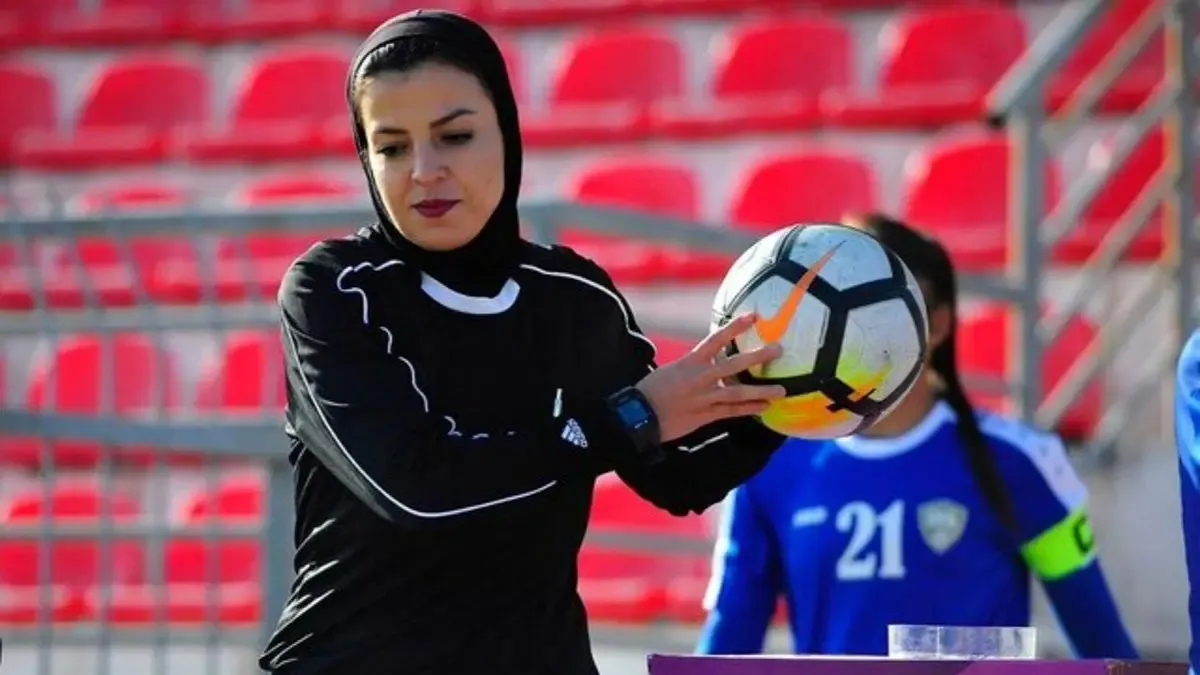
In his fourth portrait documentary, Nouri turns his attention to Aso Javaheri. At first glance, she appears markedly different from his previous subjects. Yet a closer look reveals that her selection is the logical continuation of the same long-term project. Javaheri is not simply a football referee; she is simultaneously an athlete, researcher, writer, social activist, and ultimately an exile compelled to leave her homeland. Her life unfolds at the intersection of sport, politics, gender, and migration—a convergence that lends itself naturally to cinematic portraiture.
From its opening moments, Aso the Boulder Kicker establishes its intentions with remarkable clarity. The film does not begin with sporting triumphs or a conventional introduction to its protagonist. Instead, it opens with newspaper headlines and reports documenting Javaheri’s suspension from refereeing, her professional exclusion, and ultimately her farewell, marked by the symbolic invocation of the name “Jina”—the Kurdish name of Mahsa Amini that became a rallying cry for the Woman, Life, Freedom movement.
It is a shrewd narrative choice. Before viewers come to know Aso herself, they are confronted with the consequences of her existence. This opening immediately shifts the documentary away from the conventions of chronological biography and transforms it into a story of resistance.
Climbing the Mountain
Following this introduction, the whistle that signals the beginning of one of Aso’s women’s football matches fills the soundtrack. Initially, it seems to mark the start of a game. As the film unfolds, however, it acquires a broader significance, becoming the signal for a struggle that began years earlier and remains unresolved.
The film cuts almost immediately to images of Aso climbing a rocky mountain trail while speaking about the difficulties faced by women in Iranian sport. Here, Nouri introduces the documentary’s central metaphor. The mountain and the stones are more than elements of landscape; they become structural components of the film itself. Aso compares the development of women’s sport in Iran to such an arduous ascent, insisting that every step forward comes at a cost.
It is at this moment that the film’s title appears: Aso the Boulder Kicker —literally, “Aso’s Foot Strikes the Stone.” The phrase functions as far more than poetic imagery. In Persian, stumbling against a stone evokes pain, interruption, falling, and yet continuing despite adversity. Throughout the documentary, Aso repeatedly encounters obstacles without ever allowing them to halt her journey. From childhood through exile, her life becomes a succession of encounters with barriers.
Football and the Experience of Exclusion
The film returns to Sanandaj, Aso’s birthplace—a city that represents not merely where she was born but an essential part of her identity. The stadium where she first watched football as a child reappears before the camera. On one wall hangs a notice specifying the hours reserved for women’s training while emphasizing that men are prohibited from entering. What initially appears to be a simple administrative sign gradually assumes symbolic weight, standing for the gender segregation that shaped Aso’s life from childhood onward. In a series of intimate monologues, Aso recalls falling in love with football at the age of six, only to discover almost immediately that being a girl meant exclusion from the sport she adored.
Her memories of neighborhood football games form some of the documentary’s most affecting moments. She was the only girl in the district determined enough to force her way into games played by boys who neither welcomed nor accepted her, often fouling her deliberately to drive her away. The bruises on her knees and injured fingers become more than childhood memories. They represent her first encounter with systems of exclusion.
The same lesson returns later at school, when she discovers that girls are denied the opportunity to study football as an organized sport. She describes the realization as feeling like “a slap in the face”—a moment when the reality of institutionalized gender discrimination became unmistakable. Through these personal recollections, the documentary simultaneously traces the broader history of women’s football in Iran: the complete suspension of women’s football following the 1979 Revolution, the gradual return of women’s futsal during the 1990s, and the establishment of the country’s first organized women’s football league in 2005. Here, Nouri succeeds in weaving together private memory and collective history.
The Female Body as a Site of Control
One of the documentary’s greatest achievements is its sustained attention to the female body as the central terrain of political struggle. Aso explains that even on fully enclosed pitches, completely hidden from male spectators, women were still required to observe mandatory hijab regulations. Her observation that “only the blue sky watched us train” stands among the film’s most moving moments. The issue extends far beyond clothing. It concerns control over women’s bodies.
This theme becomes even more explicit when Aso reflects on her years as a referee. She recounts being instructed to penalize players simply because a sleeve had slipped above the wrist. Her refusal to comply becomes one of the documentary’s defining moments. She insists that she will issue cards according to the laws of football—not ideological regulations. The statement may appear straightforward, yet it constitutes a declaration of professional independence against mechanisms of political control.
At this point, the documentary broadens its scope, arguing that disciplinary control over female athletes’ bodies can become even more severe than that exercised in ordinary public life. According to Aso, compulsory hijab occupies a deeply symbolic place within the state’s ideological framework, which explains why surveillance is especially intense in women’s sport. Yet sport also depends upon visibility. And that very visibility can become a form of resistance. One of the documentary’s most compelling ideas is precisely this: the visible presence of women’s bodies within sporting space constitutes an act of defiance against systematic erasure.
Fear Captured in Real Time
Midway through the film comes a brief but remarkably significant scene. While Aso speaks to the camera in a public park, she suddenly notices police officers nearby. Her anxiety is immediate and unmistakably genuine. She quietly tells the film crew that they need to coordinate their story in case they are questioned.
Nouri makes the crucial directorial decision not to remove this moment. Its inclusion transforms the documentary. Rather than merely depicting fear, the film allows fear itself to enter the frame. The audience no longer hears about political pressure—they experience it alongside the filmmaker and his subject. The scene vividly exposes the fragile boundary separating ordinary daily life from constant political surveillance.
Silencing a Voice
The account of Aso’s suspension from refereeing forms another emotional climax. Newspaper headlines documenting her gradual exclusion demonstrate that this was never merely an administrative disagreement.
She is removed from refereeing at the height of her physical and professional abilities. The documentary makes clear that what is being eliminated is not simply a referee, but a critical public voice—a woman who writes openly about women’s sport and refuses silence. Here, the film transcends the level of individual biography to address the systematic marginalization of dissent. Aso repeatedly emphasizes that countless others have likewise been pressured into silence. Her experience, therefore, is not exceptional; it reflects that of an entire generation.
Exile as the Final Stage
The documentary’s conclusion is both devastating and beautifully restrained. Following the Woman, Life, Freedom movement, Aso decides to leave refereeing altogether. The decision is simultaneously political and deeply personal. In the closing interview, the filmmaker’s voice becomes more prominent as he asks why she has chosen to leave Iran. Her answer may be the documentary’s defining statement: “When you can no longer make your dreams possible, leaving becomes a form of exile.”
Migration is portrayed not as an act of free choice but as the consequence of a steadily shrinking space in which life can be lived. Before departing, Aso begins photographing streets, neighborhoods, and familiar places, fully aware that she may never return to them. The act of recording becomes an effort to preserve memory itself—a memory on the verge of rupture.
The final airport sequence provides the inevitable culmination of everything that has preceded it. A woman who spent her childhood fighting simply for the right to play football, who was later barred from refereeing, who paid the price for writing openly, and who ultimately finds herself compelled to abandon her homeland.
The sound of the departing aircraft over the closing credits is more than the sound of a flight taking off. It is the sound of a bond being severed—a bond the documentary has spent thirty minutes patiently constructing.
A Portrait Beyond Football
Aso the Boulder Kicker is far more than the portrait of a football referee. It is the story of a woman’s body repeatedly subjected to control, surveillance, and erasure throughout every stage of her life. It is the story of a human being caught between staying and leaving, ultimately forced into exile.
At the same time, it represents the logical continuation of Pouria Nouri’s broader documentary project: a body of work devoted to individuals who exist beyond the boundaries of official narratives. If his earlier portraits explored memory and forgetting, Aso the Boulder Kicker is, above all, a film about resistance—a resistance that begins on the football pitch and continues until the moment the airplane finally leaves the ground.
© 2026. Phoenix Review