



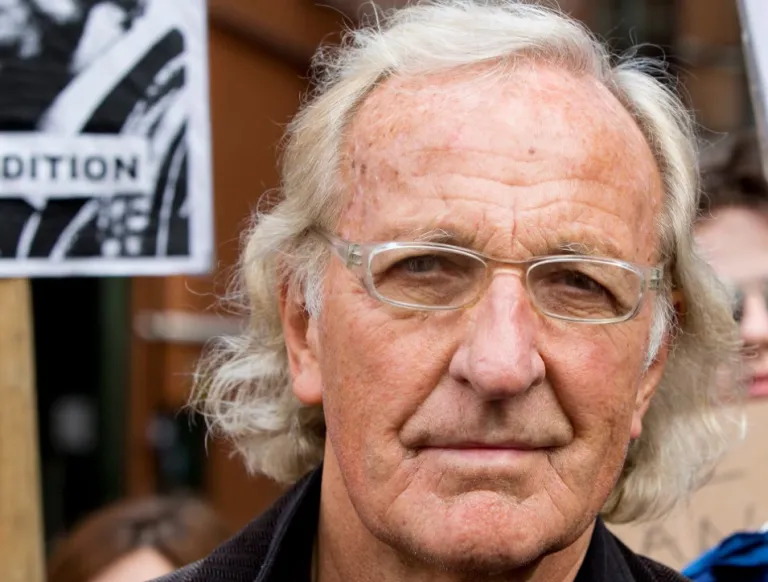
John Pilger, the Australian journalist and documentary filmmaker who passed away in 2023, was widely known for his investigative reporting from some of the world’s most turbulent regions, from the Vietnam War to the Iraq War. A journalist and filmmaker of international renown, Pilger received numerous awards throughout his career, including recognition as one of the world’s leading journalists.
Pilger believed that the duty of a genuine journalist was to protect public memory. Much like Milan Kundera, he maintained that the struggle of people against power is ultimately a struggle of memory against forgetting. For this reason, he sought through his films to restore a historical consciousness that he believed had been weakened and distorted by mass media. Yet a persistent question surrounded his work: how could someone who was himself part of the media landscape and operating within its structures successfully challenge its dominant narratives?
The War on Democracy is the title of Pilger’s feature-length documentary examining Latin America and fifty years of American intervention in the political affairs of the region, interventions carried out in the name of democracy and freedom. The film is ultimately about injustice and the abuse of political power under the seductive banner of democratic ideals.
Pilger demonstrates how the United States engineered coups, crises, and destabilization campaigns against democratic and reformist governments and movements throughout Latin America—in countries such as Chile, Guatemala, El Salvador, and Venezuela. Following the overthrow of independent national governments, Washington often supported compliant regimes and dictators, including figures such as Augusto Pinochet. Throughout the film, Pilger adopts a grounded and human-centered perspective, giving residents of the slums and impoverished communities of Venezuela, Bolivia, and Chile the opportunity to speak openly before his camera without censorship or fear.
In doing so, he illustrates that political understanding is not the exclusive domain of academics, experts, or television commentators. Ordinary people, when given a voice, can often provide insights that are more direct and illuminating than those of professional analysts.
By examining the failed CIA-backed coup attempt in Venezuela, the organized overthrow of Salvador Allende in Chile, and popular resistance against pro-American governments in Bolivia, Pilger reveals how societies that present themselves as champions of democracy, human rights, and civilization can resort to extraordinary violence when their interests are threatened. In another documentary about the Iraq War, he similarly documented the devastating human consequences of military intervention, arguing that hundreds of thousands of Iraqi children died as a result of the conflict and its aftermath.
During one of his speeches about the Iraq War, George W. Bush invoked the words “freedom” and “democracy” repeatedly. The War on Democracy seeks to uncover what those terms meant in practice. Admittedly, the subject matter itself is not new. Numerous documentaries—particularly those made by Latin American filmmakers such as Miguel Littín—have addressed similar themes. Yet several elements distinguish Pilger’s film from others in the genre.
First, Pilger’s documentary style is characterized by his own presence as narrator. He constantly interprets events and engages in conversations with his subjects. Although he is not always visible on screen, his voice-over remains a continuous guide throughout the narrative. In this respect, his approach resembles that of Michael Moore and Nick Broomfield.
However, important differences separate Pilger from Moore. Pilger’s narration lacks Moore’s trademark dark humor and satirical aggression. Their personalities differ as well: whereas Moore presents himself as energetic, humorous, and provocatively informal, Pilger comes across as serious, restrained, and intensely focused.
Part of this distinction stems from the fact that they belong to different generations of documentary filmmakers. Pilger began making political documentaries in the 1960s and produced more than fifty films throughout his career. Moore emerged in the late 1980s and transformed documentary storytelling by foregrounding his own role within the filmmaking process, exposing the difficulties of obtaining access, securing interviews, and navigating institutions.
According to documentary theorist Bill Nichols, Michael Moore’s films typically combine several documentary modes simultaneously: the participatory mode, the performative mode, and the expository mode. The participatory mode involves the filmmaker directly entering the narrative, interacting with subjects, and making his presence highly visible. Moore exemplifies this approach by appearing on camera, conducting interviews, and actively shaping events.
The performative mode emphasizes personal experience, subjective perspective, and emotional engagement. Moore frequently narrates from a personal point of view, employing humor, sarcasm, and outrage. His work also incorporates elements of the expository mode through voice-over narration, strategic editing, and structured arguments designed to persuade viewers.
Pilger’s documentaries, by contrast, belong primarily to the expository mode, although they occasionally incorporate observational elements. Unlike Moore, he rarely employs participatory or performative strategies. Pilger represents a classic example of expository documentary filmmaking, characterized by authoritative narration, a clear argumentative structure, and the use of archival footage, interviews, and visual evidence to support a political thesis.
At times, Pilger allows events and situations to unfold without direct intervention, particularly in scenes depicting war zones or impoverished communities. Yet even these observational moments serve a broader argumentative framework rather than functioning as neutral observation. While Pilger is undeniably present in his films, he appears primarily as a narrator and reporter rather than a performative protagonist.
Although his documentaries were produced for cinematic audiences, their structure often resembles the investigative reporting style associated with television programs such as Panorama and other current-affairs documentaries.
Some critics have described Pilger’s perspective as politically biased and have argued that he failed to maintain journalistic neutrality. In my view, this criticism misses the point. Why must a documentary filmmaker necessarily adopt a neutral stance toward their subject matter? A reporter working for a public broadcaster may be obligated to adhere to institutional standards of objectivity—however questionable those standards may sometimes be—but an independent journalist or documentary filmmaker confronted with deliberate distortions of historical truth and systematic manipulation of public opinion cannot reasonably be expected to remain indifferent.
When political power deploys sophisticated mechanisms of deception, remaining “neutral” can itself become a political act. Under such circumstances, exposing falsehoods and challenging official narratives is not evidence of bias but an expression of journalistic responsibility.
The War on Democracy offers viewers an opportunity to understand the realities behind the packaged and exportable version of democracy promoted during the presidency of George W. Bush and the broader framework of the so-called War on Terror. Early in the film, Bush declares: “America does not impose our form of government on the unwilling. Rather, we help others find their own voice and freedom.”
Pilger’s ninety-minute documentary seeks to demonstrate the opposite. According to his argument, American foreign policy has repeatedly imposed governments aligned with U.S. interests regardless of the wishes or democratic choices of local populations.
As Pilger explains at the beginning of the film, The War on Democracy is ultimately about people’s struggle to free themselves from modern forms of domination. In one memorable sequence, he looks directly into the camera and observes:
“George Bush has promised to save the world from evil and build free societies across the globe. But to understand the nature of this monumental lie, we must know history—especially the history that has been hidden and suppressed. It is a history that explains why we in the West know so much about the crimes of others, yet remain largely ignorant of our own.”
Pilger argues that since 1945, the United States has played a role in the overthrow of approximately fifty governments in more than thirty countries, many of which had come to power through democratic processes. Among the countries discussed are Argentina, Brazil, Bolivia, Chile, Cuba, El Salvador, Venezuela, and Iran under the government of Mohammad Mosaddegh.
A significant portion of the documentary focuses on Venezuela, where Pilger interviews Hugo Chávez about democracy, healthcare, education, social welfare, and poverty reduction. Pilger presents Chávez as a voice for the residents of Caracas’s vast shantytowns—a capital city built atop immense oil wealth and belonging to one of the world’s major oil-exporting nations, yet marked by severe inequality.
The film contrasts the luxurious villas of eastern Caracas, inhabited by the country’s wealthy elite, with the living conditions of the poor. These affluent sectors strongly opposed Chávez’s nationalist and socialist policies aimed at reducing poverty and limiting elite control over Venezuela’s oil revenues.
Former defense officials and political opponents portray Chávez as a threat to national interests, while hostile media outlets depict him as a dangerous and authoritarian figure. Chávez himself acknowledges the country’s poverty but insists that wealth accumulation is not the ultimate objective. As he states in the film, “We do not aspire simply to become rich.” Instead, he argues, the goal is to live with dignity and self-respect.
Pilger interviews people from across Venezuelan society, from slum dwellers to wealthy business owners. Poor Venezuelans often describe Chávez as a reformer who brought free healthcare, public education, and literacy programs to communities that had long been neglected. Many explain that before Chávez they never truly felt they belonged to Venezuelan society.
In contrast, members of the business elite express fears about the country’s future and contemplate leaving Venezuela altogether. Pilger’s interpretation is that what this class had primarily lost was its privileged control over the nation’s immense oil economy.
Ultimately, The War on Democracy is less a conventional documentary about Latin America than a broader examination of power, memory, and political legitimacy. Whether one agrees with Pilger’s conclusions or not, the film remains a provocative challenge to official narratives of democracy promotion and humanitarian intervention. It asks viewers to reconsider not only the history of Latin America but also the assumptions that often shape Western understandings of freedom, democracy, and global power.
Pilger then demonstrates how Chávez’s opponents, with the assistance of the CIA, organized a coup against him in 2002, only for the attempt to collapse in the face of intervention by Chávez’s supporters. To expose the deceptive nature of the opposition’s narrative, Pilger employs an intriguing cinematic device. The film first presents archival footage of street clashes between Chávez supporters and opponents. We then see Chávez supporters standing on a bridge, apparently firing at opposition demonstrators gathered below. However, Pilger introduces footage of the same events shot from a different angle, revealing that the people on the bridge were in fact defending themselves against snipers and anti-Chávez police forces rather than shooting at opposition protesters. In other words, anti-Chávez media outlets and pro-American military figures constructed a narrative suggesting that Chávez had ordered the massacre of civilians and therefore had to resign. A CNN correspondent in Caracas also tells Pilger that several generals had informed him and other journalists in advance that there would be large-scale bloodshed, even though no such bloodshed had yet occurred.
Drawing on declassified CIA documents, Pilger further argues that the United States had warned Chávez beforehand about the coup plot. Throughout the film, Chávez’s opponents describe him as a devil and an Antichrist intent on creating another Cuba and transforming himself into a second Castro. While such claims are not entirely without foundation, the realities of Venezuela indicate that the country’s political and economic conditions differed significantly from those of Castro’s Cuba. According to Pilger, unlike Cuba, Venezuela did not dismantle its capitalist system, and the media continued to enjoy a high degree of freedom. A historian named Margarita López argues that censorship did not exist in Venezuela and that the attacks launched by privately owned television networks against Chávez and his government would be unimaginable in many other parts of the world. To support this point, Pilger shows footage of a local television presenter claiming that Hugo Chávez was evolving from a fascist into a Nazi.
One of the film’s most striking scenes is Pilger’s interview with Duane Clarridge, a former CIA operative in Latin America. During the conversation, Clarridge unapologetically defends both the CIA’s policies and activities in Latin America as well as the crimes committed under Augusto Pinochet, insisting that meaningful change sometimes requires unpleasant and morally questionable actions. The principal weakness of Pilger’s film is that it tends to portray Chávez as a heroic figure and the embodiment of Latin America’s liberation movements. In reality, the nationalist and populist policies pursued by Hugo Chávez and later by Nicolás Maduro, while contributing to poverty reduction at certain points, failed in the long run to provide a sustainable solution to poverty, inequality, and political corruption. Indeed, they ultimately contributed to the deepening of Venezuela’s economic and social crises.
What remains clear, however, is that American interventionist and militaristic policies carried out under the banner of democracy have reached an impasse not only in Latin America but also in the Middle East, where they have often strengthened nationalist sentiment and popular resistance. In pursuing its geopolitical objectives and its self-proclaimed mission of promoting freedom, the United States has repeatedly relied on war, violence, and the killing of innocent civilians as well as nationalist and anti-colonial forces throughout Latin America and the Middle East.
© 2020-2026. Phoenix Review