



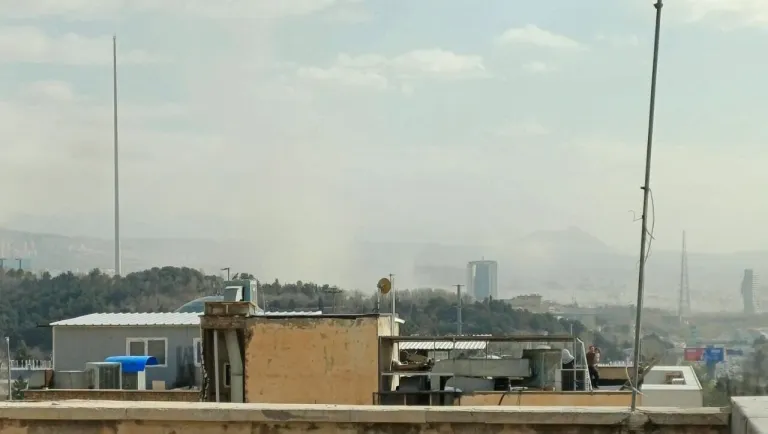
The City from the Rooftops | A Narrative of Changing Atmospheres and Urban Life in Wartime
In the final days of the war, we had been invited to dinner at someone’s home. The table had not yet been fully cleared when the sound of an explosion rang out. Without saying a word, our host got up and headed for the rooftop, and we instinctively followed. We knew that within a few minutes the news would tell us what had been hit, but none of us seemed capable of waiting. We wanted to know for ourselves—directly, with our own eyes—what had happened before the news told us.
The building was four stories high, and from its rooftop a large section of the city’s horizon was visible. Yet there was no column of smoke to be seen. On neighboring rooftops, people had also emerged and were scanning the distance. Some, after a few minutes of seeing nothing, lit cigarettes, as though trying to find a reason for having come up there in the first place.
Our host lit a cigarette as well, pointed south, and said that on the night the Isfahan ammunition depot had been struck, the sky had suddenly turned bright and warm. He said that although the weather had still been cold, the heat was so intense that people could feel the warmth of the air even from that distance—as though the door to summer had abruptly opened in the middle of winter. For several hours the sky had taken on the color of sunset, and people had stood on their rooftops watching.
As he described it, he sounded more like someone recounting a strange and magnificent landscape than a military attack. The contradiction made perfect sense to me. I had seen footage of it before: behind Mount Sofeh, a vast area was burning, flames erupting into the sky like a volcanic eruption. What I had witnessed safely through a screen, they had watched live from their rooftops.
The excitement of that uncanny scene was still visible in his eyes. Then he added, “It was beautiful.”
And I was reminded of a scene from Chernobyl: people standing on a bridge, gazing up at the sky with fascination, unaware that the beautiful glow they were admiring would destroy their lives only days later.
I was not in Tehran on the night the oil depots were hit, but later I heard almost identical accounts from several people who did not know one another. They said that when they stepped outside the next morning—to buy bread or go to work—the city no longer felt like itself. The sky was so dark that it seemed like the middle of the night, yet at the same time an unnatural heat filled the streets, as though it were midsummer rather than winter. It was as if the city had changed seasons overnight.
Some people realized that very morning that they could no longer remain in Tehran. Then the rain began, and warnings about severe air pollution and acid rain were issued. I imagine that must have been the quietest, emptiest, and darkest day of the war. The war had not only changed the color of the sky; it had disrupted the ordinary rhythm of time itself.
Yet this alteration of the physical atmosphere was only one side of the story. The war also transformed the function of urban spaces in a very literal sense. Rooftops ceased to be forgotten service areas and became semi-public spaces—places that had once been used for adjusting antennas, repairing air conditioners, hanging laundry, or drying carpets, but had now become urban observation decks where people gathered to witness events together.
From the very first day, when the war reached Tehran and fighter jets shook the house as they passed overhead, rooftops were already beginning to assume their new role.
The emergency staircase of the office building overlooking our home had always been a gathering place for employees to smoke, laugh, and occasionally celebrate birthdays. That day, however, everyone stood facing the same direction, filming with their phones as though watching a street performance.
I called my brother. He was drinking tea.
“Are you still sitting there?” I asked. “The war has started.”
Then I went up to the rooftop.
A column of smoke was visible to the south, and a cloud of dust hung in the west. I looked around. More than the smoke, it was the people who caught my attention—neighbors standing in different corners of the rooftop, cigarettes in hand, talking and analyzing what they were seeing. The murmur of so many spectators gathered to witness the first moments of the war was so loud that it was almost impossible to make out exactly what anyone was saying.
I went back downstairs, but with every explosion came the sounds of applause, whistles, and excited conversation from outside. From that day on, rooftops, emergency staircases, and balconies became something like theater boxes. Every explosion turned a part of the city into a stage for a few minutes, and people tried to become eyewitness narrators before the news could tell the story.
Perhaps it was precisely this physical distance that made spectatorship possible. As long as the explosions were far enough away that only their sound and smoke reached us, it was still possible to remain in the role of observer.
The war had temporarily redrawn the spatial boundaries of the city. Rooftops, once neglected parts of residential buildings, now functioned as urban balconies—a place for watching, analyzing, speculating, and sometimes simply standing beside a neighbor whose name you did not even know, but with whom you suddenly shared a common experience.
For the first time, I was discovering our neighbors—from the rooftop.
One of my friends told me that during those days he had become close with several of the people living in his building. Since moving around the city had become dangerous, people compensated for their need for social contact by spending time with the closest people available—their neighbors. Before the war, their interactions had been limited to a brief greeting by the elevator. The crisis, however, had opened the doors to one another’s most private spheres of life.
Even gatherings with friends took on a different shape. Meeting old friends happened mostly around lunchtime, when the perceived danger was lower.
A friend of mine said:
“Eventually we stopped being afraid of the explosions. We would just fall silent for a few seconds, ask whether it was anti-aircraft fire or a strike somewhere far away, and then continue our conversation.”
Gradually, guessing the location of an explosion became part of the conversations—and even part of the entertainment at these gatherings.
It was as if being together increased one’s courage to keep living.
Here’s the continuation in English, keeping the reflective, literary tone and narrative flow of the previous translation:
I spent one night at a friend’s house. Under normal circumstances, I would never have stayed out overnight. But that night, the moment he said, “Stay,” I stayed. It suddenly felt unnecessary to cross the entire city and sleep alone in my own apartment when I could remain beside a friend—even if it meant being awakened at dawn by the sustained sound of bombing.
As rooftops and balconies grew crowded, the streets, cafés, and restaurants became noticeably emptier. There was no longer any need to stand in the usual endless line outside Shahrzad Restaurant, listening to your stomach growl and checking your watch every few minutes while waiting for your name to be called. Cafés and restaurants had fallen quiet. The “third places” people normally retreat to for companionship—those spaces that are neither home nor workplace—had largely emptied out.
Unlike cafés and restaurants, however, some bookstores—another form of third place—had become livelier than before. One day, a friend called me from Tehran and said that he had just run into an old friend by chance at the neighborhood bookstore. I was surprised; I had heard that only shops selling essential goods remained open. But he said that, on the contrary, now that the internet was down, people suddenly had more free time and a greater need for books.
Yet some of the things the war had taken from the city had no substitute. The cities that had been targeted most heavily no longer possessed the atmosphere and vitality that usually accompanied the final nights before Nowruz. It was as if the war had occupied traditions as well. Until the previous year, stalls selling flowers, wheatgrass, and samanu filled the streets until midnight, and we would usually go out late at night to buy our Haft-Seen items, when the traffic had eased and the air carried the scent of night-blooming flowers. But this year, I had heard that the streets of Isfahan and Tehran fell silent early, and that the familiar clamor of New Year street vendors had disappeared from the sidewalks.
I spent the New Year’s holiday in a small town at my mother’s house—a place where the war felt more like distant news than a visible presence in the streets. The shops were lit, people were buying for the holiday, and families who had fled the war-stricken cities talked about the future of the conflict while purchasing wheatgrass or waiting in line at pastry shops.
At moments like that, I felt that both places had become stages of a sort, though the nature of seeing and experiencing them was entirely different. In the cities under attack, people stood at the edges of rooftops staring into distant smoke and flashes of light. In this small town, people stood directly within the scene itself, surrounded by spring greenery and pre-holiday crowds, trying to preserve the continuity of ordinary life.
I was in Isfahan during the week leading up to the ceasefire. Although our neighborhood was considered relatively safe, and walking through it was easy because of how quiet it had become, the very day after the ceasefire was announced the sidewalks filled with so many people that it was hard to believe this was the same street.
Khaghani Street once again became a gathering place for young people who had spent more than forty days sitting indoors, listening to the sounds of explosions. Once again, the laughter of teenage girls echoed through the air. I watched them and realized how much I had missed that sound.
The city was returning to itself with astonishing speed—as though the war had not been so close only the day before, as though the ceasefire were not merely a fragile, temporary arrangement lasting two weeks. Life was flowing again.
Now more than a month has passed since that temporary ceasefire. I have returned to Tehran, and the streets have resumed their familiar rhythms and routines. Literary gatherings are being held again, and I imagine the speakers begin their talks with the same uncertain remark: we do not know when the next gathering will take place, and we do not know whether we will be able to meet again.
The cafés and restaurants are crowded once more, though not as crowded as before. Yet the reason is neither the shadow of war nor the fear of missiles. It is the severe economic turbulence that has found its way onto every menu.
These days I go out more than ever. I tell myself that perhaps everything will unravel again and I will no longer be able to walk beneath this spring sky. Sometimes it even seems that the streets and cafés are fuller than they used to be.
Perhaps everyone feels the same thing: that one should walk while it is still possible, drink coffee while it is still possible, watch people while it is still possible, and begin collecting memories now for whatever uncertain days may come next.
A hidden urgency has entered everyday life. It is as though we are compelled to live in advance, and to live more intensely—to store enough images, scents, and sounds of the city’s ordinary days in our memories, our skin, and our bones. For the days when perhaps the city can once again be seen only from a rooftop.