



Twenty years have passed since The Lives of Others was made. Twenty years since that gray winter—a cold season in which voices were not merely voices, but evidence of guilt, and sometimes the only trace human beings left behind. A film born from the heart of East Germany, from beneath the skin of Berlin: a city divided by a wall 155 kilometers long and 3.6 meters wide, though the fears surrounding it stood even taller. Two decades later, this film is no longer merely a brilliant cinematic work; for us Iranians, it has become a kind of mirror. A mirror that, if we step a little closer, will inevitably reflect our own image back at us.
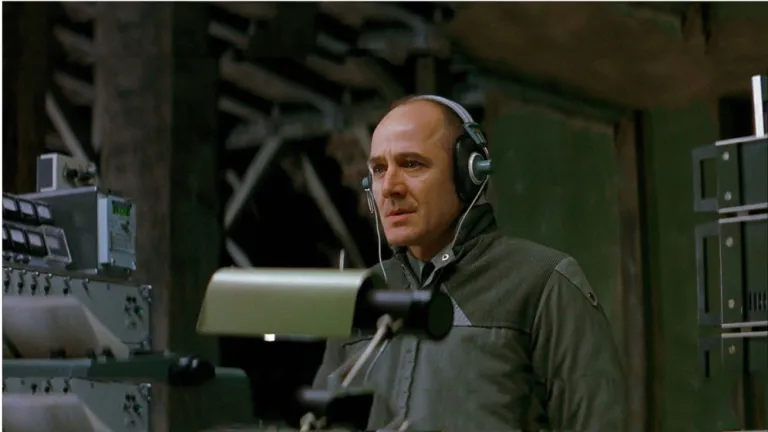
Released in 2006 and written and directed by the German filmmaker Florian Henckel von Donnersmarck, the film tells the story of a Stasi officer in East Germany in 1984 who is assigned to surveil the life of a playwright and his lover, a theater actress. Their apartment—home to two politically active artists opposing the communist dictatorship through writing and creation—is wired with listening devices, and suddenly the walls themselves grow ears. Behind the surveillance equipment sits Gerd Wiesler, the Stasi operative. Through his headphones he listens to their lives: to conversations, silences, parties, arguments, piano music, and lovemaking. But gradually something begins to change. Listening turns into experiencing. And experiencing the life of an artistic couple—whose emotional and intellectual world lies miles away from the harsh mentality of a security officer—simply through hearing them, plants doubt inside Wiesler. A doubt about existence itself, about obedience and disobedience, about carrying out orders or resisting them.
Wiesler, who is supposed to submit daily reports on the couple’s activities, slowly begins to create distance between truth and what he is expected to write. Instead of recording reality, he starts composing false reports. Yet within his own life, it is through lies that he arrives at truth. In the end, he transforms from a mere instrument—from a tool of repression and suffocation, from an agent of arrest and torture—into a human being. Or perhaps, more accurately, the human being within him finally hears his own voice for the first time after years of silence.
The Lives of Others is not about seeing; it is about listening. About hearing. About how listening to another person’s life can awaken conscience. And on another level, it reminds us that nothing in this world is truly private—not even what happens inside your bedroom. This aspect of the story recalls the experience of the Iranian writer, literary critic, and political activist Faraj Sarkohi. During the chain murders of Iranian intellectuals in the 1990s, when he was arrested, the authorities possessed recordings from his bedroom with his wife; even their most intimate conversations had been secretly monitored. In this world, sometimes even silence becomes part of a report. And in such a world, one must occasionally decide not to speak at all in order to survive.
This is precisely what we witness in present-day Iran: a country that, for more than thirty-three days, has been cut off from the global internet, where even calling a landline from outside the country is nearly impossible. And if, from within Iran, one somehow gains access to a VPN, one still must remain careful about every word spoken—because telling the truth can place a noose around your neck.
Watching The Lives of Others gives Iranian audiences a feeling akin to déjà vu. It is like seeing scenes you have already encountered throughout your own life, moments so familiar that at times it feels as though you are watching your own existence unfold on screen. The experience is deeply recognizable and equally terrifying. In today’s Iran, the tools may have changed, but the experience remains painfully familiar: life beneath the shadow of surveillance, beneath the fear of being overheard, beneath the constant sensation of pursuit. For forty-seven years, Iranians have lived under the shadow of a religious dictatorship, often leaving sentences unfinished, speaking in reversals and codes, or choosing silence altogether. Silence—a language all of us know intimately.
The film also reminds us that surveillance is not only external; eventually it becomes internal. People begin censoring themselves long before anyone actually listens to them. This is not merely something many Iranians have encountered—it is something they live with every day. Self-censorship has become a natural and ordinary principle of life, as though we were born carrying it inside us.
One of the film’s most beautiful moments is the scene in which Wiesler listens to music. In that instant of listening, the world seems to stop, and the machinery of oppression collapses. Not through slogans, revolution, or bloodshed, but through a single piece of music. The film shows us that art is the place where human beings can truly become themselves. It is where they can resist self-censorship, remove their masks, and reach truth. It is where they can stand against repression—and against forgetting.
Twenty years have passed since this film was made, and thirty-seven years since the fall of the Berlin Wall, yet our world today remains disturbingly close to its reality. In today’s Iran, millions of people are trapped behind walls built around an entire nation: cut off from the free world, from free information, from uncensored news. And when even the smallest opening to the outside world appears, fear of being heard still prevents them from expressing their genuine feelings and beliefs.
At the end of The Lives of Others, Wiesler enters a bookstore and buys the memoir written by the playwright whose life he once surveilled. The book is dedicated to an unknown man who saved the playwright’s life—a man who is none other than Wiesler himself. The bookseller asks him, “Would you like it gift-wrapped?” Wiesler replies, “No. It’s for me.”
And perhaps this is one of the most beautiful, quiet, and redemptive endings in the history of cinema: the moment Wiesler realizes that he became the savior of the man who ultimately redeemed him. A savior who can be real this time—not buried in the grave—and who may yet come to rescue an entire people.