


“Woman, Life, Freedom — A Point of No Return” is the title of a series of interviews conducted with women in Iranian cinema—women who, following the Woman, Life, Freedom movement, supported the protesting people and removed the compulsory hijab, and as a result no longer wished to—or were able to—continue their professional work and were banned from working.
I first saw Hana Kamkar on a theater stage in the 2000s, in a production where she played Anahita, the goddess of water. It soon became clear to me that she was a singer with a distinctive and beautiful voice. Hana, the daughter of Bijan Kamkar of the renowned Kamkars Music Group, had been singing and shining with the group since those years. Yet the sun of her voice remained hidden from the public eye beneath the dark clouds of the Islamic Republic—because women in Iran are only permitted to sing in choirs or as backing vocalists.
Ms. Kamkar, who is also a daf and frame-drum player, has for many years acted, sung, and composed music in Iranian theater. She has also performed vocals for several prominent Iranian films, including Hey You People by Rakhshan Bani-Etemad and The Salesman directed by Asghar Farhadi. Hana Kamkar was among the first female artists to protest the state killing of Mahsa Jina Amini and dedicated a song to her on Instagram—a gesture that led her to become one of the earliest women to be summoned and threatened by security forces.
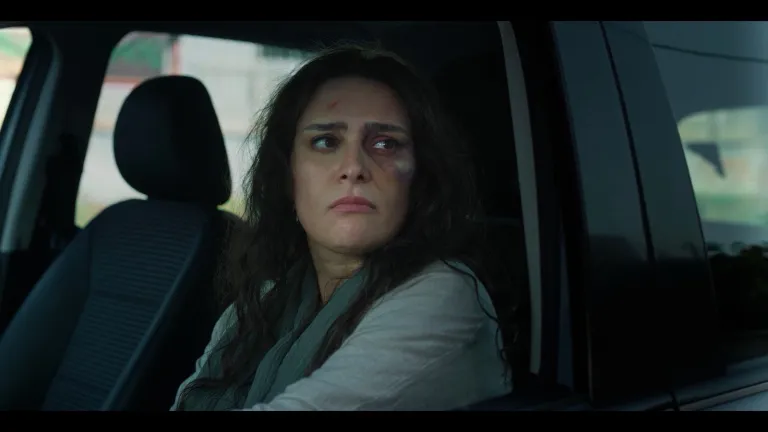
In 2024, Kamkar appeared in Iran in an independent underground film titled The Witness, directed by Nader Saeivar, performing without compulsory hijab and with optional dress. She played Zara, a dance instructor murdered by her husband, who collaborates with the regime. After acting in this film, she left Iran.
Ms. Kamkar, you were among the artists in theater, cinema, and music who published photos of yourself without hijab following the state killing of Mahsa Jina Amini. This was despite your previously extensive and active participation in music, theater acting, documentary filmmaking, and even environmental work. Given that injustice, oppression, political killings, and gender discrimination have existed throughout the 47 years of the Islamic Republic, what was it about the Woman, Life, Freedom movement that prompted such action from you and many other women artists?
Hana Kamkar: Honestly, my patience with injustice and inequality had run out long before, and the killing of Mahsa–Jina–Amini made my blood boil. As soon as she fell into a coma, I began raising awareness online and shouting against this atrocity. At the moment of her death, I dedicated one of my most well-known Kurdish songs to Jina. It went viral very quickly, was shared by many artists, and that’s why I was among the first to be summoned and threatened—accused of leading and inciting unrest.
My Instagram page was shut down, because if it had stayed open I would have been forced to publicly “repent,” post an apology, and delete all my posts and stories. As a result, that song—despite receiving 900,000 views in just two days—was silenced. Otherwise, it could have become the defining song of that period and reached far more people, both inside Iran and internationally.
For a long time, I had been loudly protesting the ban—an illegal ban—on my singing. I was shouting against this injustice constantly, both online and in real life. So it wasn’t that the movement caused my action; I myself had been in a state of resistance long before.
More precisely, since 2016, when my award for Best Theater Music was stolen at the Fajr Theater Festival and given to someone else, I raised my voice and permanently boycotted that festival. Then in 2017, when I was singing while acting in Peykan-e Javanān by Mohammad Rahmanian—after having firmly defended my solo singing—the Intelligence Organization of the IRGC stormed the Shahrzad Theater, tried to shut down the show, opened a case against us, summoned us to the Guidance Prosecutor’s Office, and subjected us to repeated interrogations. I was banned from leaving the country and from working for a year. From that point on, I gave up on compromise, silence, and quiet protest. I protested openly on my page, for any reason I could.
The year 2022 was the peak of my personal protest. What I went through afterward in order to leave the country is a long story.
I truly believe that women like myself, who live this way, were themselves movement-makers. Honestly, I don’t know what motivated those who took action only after Woman, Life, Freedom emerged—perhaps harmony with the orchestra of equality-seekers and justice-demanders.
You are the daughter of Bijan Kamkar and a member of the Kamkars musical family, a group widely loved in Iran and known for performing Kurdish songs. Given that you are Kurdish and a promoter of Kurdish culture and traditions, did Mahsa Jina Amini’s Kurdish identity influence your decision?
Hana Kamkar: I have independently been a film soundtrack singer since 2005, and most of those works were in Kurdish. One hundred percent—Jina’s Kurdish identity influenced what I did in those days. I only wish my page hadn’t been shut down, so that the song “Sarbaz-e Gomnām” could have been heard more widely, and the voice of a Kurdish woman—both identities being minorities in Iran—could have echoed around the world.
Since leaving Iran, you have performed as a solo singer in several concerts, while for years inside Iran you were deprived of public performances. What does this 47-year injustice against Iranian women mean to you as a female singer?
Hana Kamkar: It has no meaning—because it is pure evil. Because it is sheer corruption. Because it is filled with injustice, obstruction, and energy-draining cruelty. Something has “meaning” only if it contains meaning; this ban is the most empty sentence and word in the world.
Imagine that instead of spending my time and energy on vocal training, technique, experimenting with genres, and performing on diverse stages, I had to struggle at the very bottom levels of Maslow’s hierarchy—and the hierarchy of singing. Every day I was battling obstacles in my singing work, whether in theater, cinema, children’s television, or concerts. We independent female singers had to constantly work on our mental health instead of working on the practical aspects of our craft.
Did your choice of optional dress face opposition from your family, colleagues, or friends? What were their reactions?
Hana Kamkar: No—there was no opposition from my family or like-minded loved ones. Those acquaintances who opposed it are no longer my friends and have joined the past of my relationships. Everyone aligned with me expressed gratitude and appreciation. I remember in May 2023, after singing at the 83rd birthday ceremony of Abbas Kiarostami in front of several hundred people—when a video went viral and cyber trolls attacked me and mocked my singing—my cousin Saba, several close female singer friends, and my family all comforted me and reminded me of the page of history I had turned.
What consequences has this choice had for you so far?
Hana Kamkar: Numerous illnesses rooted in stress and nerves. Losing many friends due to differences in outlook. Being separated from my home, my family, and my homeland. Rebuilding my life from zero in the middle of my life—though, for certain reasons, I actually like this last one.
You acted without compulsory hijab in the independent film The Witness inside Iran, alongside Maryam Boubani, another actress who rejected mandatory hijab. Given the subject of the film, do you see yourselves as witnesses for history and future generations?
Hana Kamkar: I hope so.
How has the Woman, Life, Freedom movement affected your view of life and art? And how do you see its impact on Iranian society?
Hana Kamkar: I feel freer. I was always bold and dynamic, but my muscles were constantly tense. After the movement, I am truly living freedom and liberation. Migration also broadens one’s perspective, of course, but now I feel like an eagle flying high—watching both my brave companions on the ground and the jackals. My approach to life has become more joyful, and I cherish every fleeting moment of living, every phenomenon that owes its existence to the sun. And I enjoy women’s art more than ever.
What place do you see for today’s independent Iranian cinema, inside Iran and globally? Will this forward movement continue?
Hana Kamkar: Recently I was a jury member for a Kurdish short film festival in Birmingham, and quite remarkably, four-fifths of the films were from Iran—despite submissions from European countries with large Kurdish immigrant populations, as well as from Turkey, Syria, and Iraq. Or look at it this way: Iranian films have been submitted for this year’s Oscars from multiple countries.
I was speaking with a female filmmaker friend, and we said it feels as though only Iran is making films, and the rest of the world has nothing left to say. Honestly, I think that first, if cinema returns to its vibrant, earthly life as it existed before COVID—when its vitality had nothing to do with state politics or propaganda dictating what films should or should not be—then independent Iranian cinema will undoubtedly hold a strong position.
Second, however, I worry about the lack of unity among Iranians as a whole. This sense of collective solidarity barely exists. That’s why I fear that even in independent cinema, cohesion may fade and personal interests may dominate. I hope this does not happen, and that independent filmmakers—both inside and outside Iran—continue to think of one another and focus on making good films, in both form and content, rather than chasing political awards and suspicious funding.