



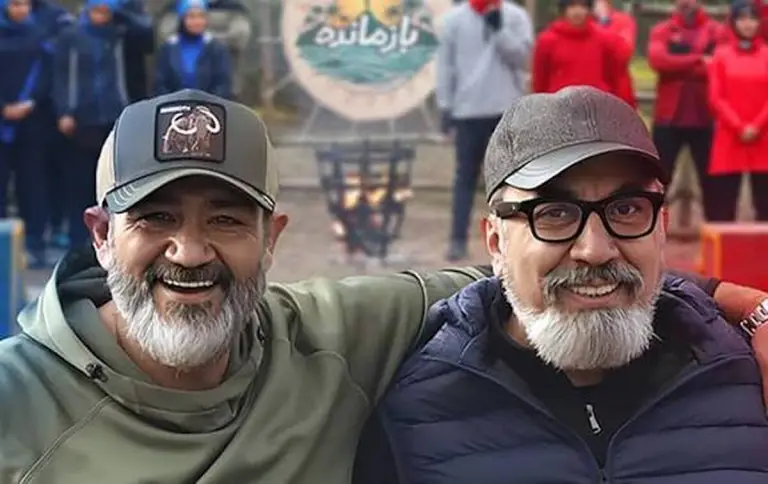
The controversy surrounding the show Bazmande and its mockery of Iran’s ancient symbols (the griffin and the Derafsh-e Kaviani) has turned a simple entertainment program into a cultural and media identity crisis. At first, there was silence—a silence born either of indifference or of the producers’ false confidence. But the very moment public outrage flared and the platform hosting the competition was officially suspended, the apologies began. First the producer, and now Siamak Ansari—the show’s host—stood before the camera to soothe the “offended” public. But is this apology a moral act, or an economic tactic?
Jacques Derrida—the philosopher who articulated some of the most complex ideas about “forgiveness” and “responsibility”—offers the conceptual tools to show why accepting Ansari’s apology in this context is philosophically “impossible,” or at the very least, fundamentally incomplete.
1. Apology as “Tribute”
Derrida distinguishes between “conditional forgiveness” and “pure forgiveness.” Whenever forgiveness or the request for it enters a system of exchange, he argues, it ceases to be forgiveness and becomes political or economic negotiation.
Consider the timing of Siamak Ansari’s apology. It happened after the platform was shut down. Derrida would ask: “If there had been no punishment, would the apology have occurred?”
From a Derridean perspective, Ansari’s apology is tainted by teleology—a purpose. He apologizes in order to reopen the platform, in order to continue the show, in order to calm the crisis. This is a strategic gesture for survival, not an existential trembling born of genuine guilt.
True forgiveness, Derrida insists, must exist outside the logic of profit and loss. When Ansari uses apology as a key to unlock the show’s suspension, what we see is commercial diplomacy, not moral remorse. His words carry exchange-value—not emotional weight.
2. The Question of “Intention”: I didn’t mean to offend
From the beginning, one refrain echoed constantly in the producers’ statements: “We didn’t mean to offend.” “It was a misunderstanding.”
“Our only goal was to make people laugh.”
Derrida criticizes this classical appeal to intention. When someone says, “I had no bad intentions,” they are in fact claiming innocence: “My intentions were pure; only my execution was flawed.”
But for Derrida, excuses are the enemy of forgiveness.
If Ansari truly had no intention to offend, then his mistake is merely technical—something requiring correction, not moral forgiveness. Yet mocking the Derafsh-e Kaviani and the griffin inflicts a symbolic wound upon the body of history itself. Symbolic wounds cannot be healed by saying “I didn’t mean it.”
Derrida speaks of “infinite responsibility”: Even if you did not intend to insult, once your speech created the structure of insult, you are fully responsible. The show’s attempt to reduce the offense to “a joke” or “an innocent misunderstanding” becomes, in Derrida’s view, an escape from confronting the traumatic nature of the wound.
3. The Absence of the Victim: Who Signs the Forgiveness?
This is Derrida’s most complicated question: Who has the right to forgive Siamak Ansari?
In On Cosmopolitanism and Forgiveness, Derrida insists that forgiveness must occur face-to-face. Only the one harmed has the right to forgive. But who is the victim in the Bazmande incident? Iran? History? Kourosh? National pride?
These are abstract entities. No individual exists who can definitively represent the Derafsh-e Kaviani and declare: “I forgive Siamak Ansari.”
When Ansari apologizes to the camera—to an amorphous public—he is performing in an empty theatre. People who comment online are not the authorized representatives of history. According to Derrida, when an offense targets a universal or symbolic entity (like cultural heritage), forgiveness becomes impossible—because the victim is not physically present to grant it. Thus, Ansari’s apology hangs suspended in a vacuum: neither accepted nor rejected, because there is no authority to accept it.
4. The Host’s Paradox: Puppet or Agent?
Siamak Ansari occupies a paradoxical position. On the one hand, he is “just the host” (the script was written by others). On the other, he is the face of the show. Derrida emphasizes the significance of presence and of the “signature.” As Ansari delivered the segment in which the offense occurred, his performance embodied the insult. His presence is his signature. He cannot now hide behind “the production team.”
Mere silence from Mehran Ghafourian (the other host) complicates the picture further. Is Ansari a scapegoat sacrificed to save the producers and investors? Or is he genuinely responsible? In either case, this apology lacks authenticity for Derrida—because it emerges under external pressure (the suspension) and serves the purpose of saving the show, not of confronting guilt.
5. Conclusion: Pragmatic Peace, Not Ethical Forgiveness
From Derrida’s standpoint, Siamak Ansari’s apology in the Bazmande affair cannot be accepted within the realm of higher ethics. It is, at best, a truce, not forgiveness.
- Forgiveness is conditional: Ansari apologizes so the show may return; the public “forgives” so the tension subsides. This is commerce.
- The victim is absent: No one can grant forgiveness on behalf of the griffin.
- Coercion is present: An apology after suspension is a confession extracted under economic pressure.
Thus, the platform may reopen and Siamak Ansari may smile once more, but in the court of philosophy, the offense remains unforgiven. It has simply been covered over by media mechanisms and economic necessity.
The symbolic fracture on the griffin will not be mended with the adhesive of forced apologies.
© 2020-2026. Phoenix Review