



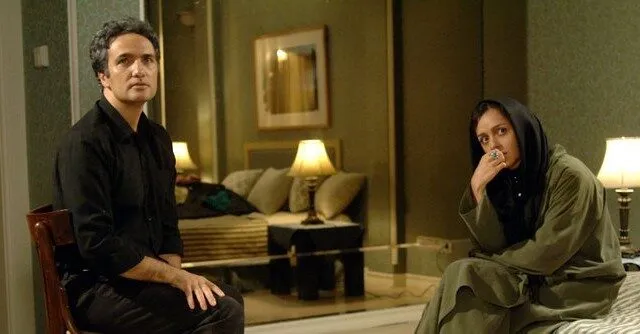
Canaan is a diagnostic drama centered on the relationship of a married couple. With the addition of two complementary characters, this exploration expands from the present into the past and implicitly reflects the future of their relationship. A seemingly ideal marriage that, worn down by routine and shifts in temperament, is on the verge of collapse. Mani Haghighi—an Iranian actor, writer, and director—entered cinema through an unintended acting experience in childhood, but it took years before his deliberate entry into filmmaking through screenwriting and directing.
The 2000s began turbulently for him, with the direction of three feature films and two documentaries. Since Abadan (2002) and Men at Work (2006) were banned and never released publicly, his third film, Canaan (2007), became the first of his films to be screened in theaters. During this period, Haghighi made a significant leap as a screenwriter by collaborating with Asghar Farhadi on Fireworks Wednesday (2006), a partnership that continued with Canaan. Farhadi collaborated on four films by other directors during the 2000s, an experience that never again appeared in his subsequent career.
Low Heights, Canaan, The Ring Road, and The Trial on the Street resulted from these collaborations. The importance of this lies in the fact that Farhadi’s presence as a writer or co-writer, though influenced by the director’s vision, still carries traces of his worldview and concerns—traces that can be identified. In other words, although these films are not fully akin to Farhadi’s own works, one can discern his thinking and perspective embedded within the deeper layers of their central dramas while still interwoven with each filmmaker’s distinctive style.
The film unfolds through a linear drama focusing on the marriage of Mina (Taraneh Alidoosti) and Morteza (Mohammad Reza Foroutan) during a critical phase of their relationship. The crisis intensifies with Mina’s decision to emigrate, her unwanted pregnancy, the sudden return of her older sister Azar (Afsaneh Bayegan) from abroad, and the quiet revival of her old university romance with Ali (Bahram Radan). The filmmakers establish a symbolic prelude early on, guiding the audience toward the deeper layers of this broken relationship. The opening scene—dropping a coil spring into the kitchen sewer—felt novel and inventive in 2007, long before it became cliché.
This moment is shown from Mina’s point of view, as though the stench of this sewer/life has disturbed her more than anyone else. She seeks a solution and sees separation—voiced as emigration and continuing her studies—as the only path to relief. Throughout the film, we witness a chain of missteps and emotional misalignment between the couple—a coldness and inevitable bitterness neither can resolve nor fully articulate. Meanwhile, Morteza desperately tries to find a way to prevent Mina from leaving, but his efforts are futile.
This smartly constructed and concise setup, free of unnecessary exposition, offers a generalized view of their ten years of eroded marriage. With effective visual back-and-forths, it shapes a complete picture of a relationship that has reached its end. Azar’s return at a decisive turning point disrupts both the dramatic structure and Mina’s inner world. Her sudden reappearance contrasts sharply with the couple’s forced trip to the north to visit Morteza’s mother—a condition he sets for honoring his promise of divorce.
In this landscape, the arrival of an unpredictable character like Azar—with her ambiguous past—reveals new facets of Mina’s past and present while triggering fresh complications. Meanwhile, Ali’s presence exposes forgotten dimensions of the couple’s history and Mina’s hidden emotional layer, suggesting the possible revival of her old love. Up until the northern journey, one can clearly trace Farhadi’s familiar multi-layered, symbolically structured dissection of marital relationships—the hallmarks of the cinematic worldview he would later develop more fully in his own films.
But in the second half of the film—more precisely, its second movement—we shift into the metaphysical, fate-driven sensibility characteristic of Mani Haghighi’s early works. This tonal shift diverges from the grounded realism of the first half, steering the narrative toward symbolic and ambiguous resolutions.
The portrayal of Morteza’s mother’s death—its timing and its emotional impact on Mina—though potentially meaningful given her pregnancy, ultimately feels unearned. The fatalistic, symbolic weight attached to these events does not stem organically from Mina’s character; instead, it appears imposed by the filmmaker’s intention.
Motifs such as the journey, the road, death, funeral rituals, foggy roads, a cow-related accident, the “wish tree,” tying votive ribbons, and similar symbols belong to the familiar—indeed clichéd—toolbox of metaphysical dramas. They are planted hastily to provide grounds for Mina’s transformation and her shift from seeking an abortion to choosing to remain in a deteriorating marriage. However… the execution falls short, lacking conviction.
Thus, Canaan becomes a film marked by fragmentation and rupture in its dramatic progression. Each half could have formed a separate film with its own beginning and end, aligned with its distinct logic. In its current form, we encounter an impactful, concise, and profound first half that fails to harmonize with the second. The characters, carefully developed early on, are abandoned midway as the filmpursues an altogether different story—without achieving a unified whole.