



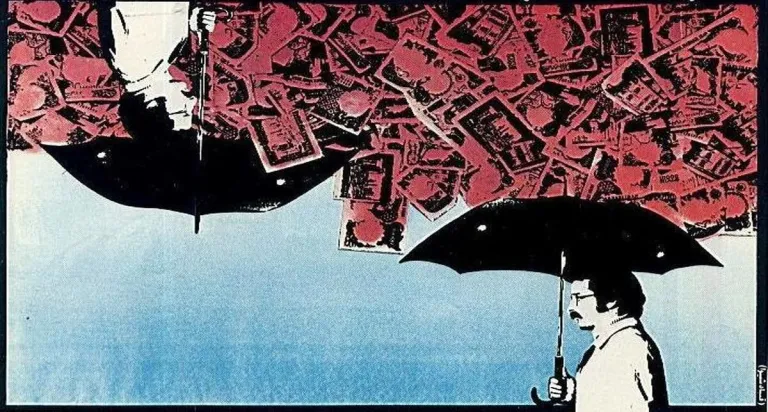
Report (Gozāresh) is a realistic psychological drama about a man whose career in the tax office and family life fall into crisis and eventual collapse. The film examines the deeply ingrained passivity of its central character, dissecting his behaviors and vulnerabilities.
Abbas Kiarostami, the renowned Iranian filmmaker with a distinctive global presence, made Report as his first feature-length film for adults, after creating short and medium-length films for the Institute for the Intellectual Development of Children and Young Adults.
Earlier works such as Bread and Alley, Breaktime, Experience, The Traveler, I Can Also Do It, Two Solutions for One Problem, Colors, A Dress for Wedding, and How to Spend Our Leisure Time: Painting belong to this formative period. These films earned Kiarostami domestic and international recognition and established him as a filmmaker on a path of growth, whose unique style would make Iranian cinema known worldwide.
Report, Kiarostami’s first feature-length work, was made in 1977 (1356 in the Iranian calendar) from a screenplay by Kiarostami himself. The film emerged during the rise of the Iranian New Wave, alongside works by young filmmakers like Bahram Beyzai, Nasser Taghvai, Dariush Mehrjui, Ali Hatami, and Masoud Kimiai.
This film is notable for a series of “firsts”: it is Kiarostami’s first adult-oriented feature, addressing mature societal issues, and one of the earliest Iranian films to employ on-set sound recording. Produced by Bahman Farmanara and shot by Alireza Zarrindast—who had worked with Kiarostami on his 1972 short Breaktime—Report has a runtime of 112 minutes.
The screenplay, penned by Kiarostami, reflects his personal worldview and minimalist realism, presenting a deceptively simple and documentary-like surface concealing complex, multi-layered thematic cores. The narrative intertwines three true-life experiences that the filmmaker fused into the central storyline, centering on a man whom Kiarostami later acknowledged resembles himself—an unconscious mirroring that the director admitted he could never watch from start to finish: “Report drives me crazy!”
Report premiered at the 6th Tehran International Film Festival and received a general release in Tehran cinemas in 1978. Afterward, it fell into obscurity, only resurfacing roughly twenty years later in 1995 at the Locarno Festival in Switzerland as part of a retrospective of Kiarostami’s work. It took another decade for the film to appear at international festivals, including São Paulo (2004) and Thessaloniki (2004), with its screening in the Masters section of the Hong Kong International Film Festival occurring in 2022. However, in Iran, the film remained largely unseen until 2016, when it was shown posthumously at the Iranian Artists Forum with one minute of censorship.
The story follows a critical period in the life of Mohammad Firoozkouhi (portrayed by Kourosh Afsharpanah), a tax auditor facing professional and marital crises. At work, he suffers a demotion due to bribery allegations; at home, his relationship with his wife, Azam (Shohreh Aghdashloo), deteriorates into arguments, abandonment, and her attempted suicide, intensifying his personal crisis.
The film focuses on the male protagonist, juxtaposing his behaviors in two spheres—work and home—to gradually reveal his internal struggles. Rather than actively confronting life’s challenges, the character exhibits passivity: avoidance, denial, or eruptions of blind anger. These reactions stem from deep-seated internal fear.
Firoozkouhi is a representative character shaped by his social, economic, political, and cultural context, particularly the pressures of bureaucratic work and societal expectations, yet his struggles resonate across time and geography. External pressures act as catalysts, exposing previously hidden facets of his personality, yet he remains mostly a spectator to his own life, incapable of meaningful change.
Kiarostami’s cinematic style reflects this worldview: long takes, fixed cameras, slow pacing, and an emphasis on mundane, everyday actions create a visual language that mirrors the protagonist’s mental and emotional state.
The wife, Azam, is not confined to the stereotypical role of a nagging, dissatisfied spouse. Through her interactions with Firoozkouhi, she evolves into an active, rational force within the narrative. Her demands for accountability—from herself, her husband, her life, and society—culminate in an attempted suicide, a dramatic act intended to pierce the “glass wall” of her husband’s fear-driven avoidance.
Her suicide attempt also symbolizes the despair of women in effecting change, both in their world and within their families. Though she survives, offering a glimmer of hope, the film’s ending emphasizes the man’s continued inaction: he leaves the clinic without confronting his own transformation, observed by the camera from behind glass as he visits his sleeping child in the car, again avoiding engagement.
The child, unlike in Kiarostami’s earlier films, appears marginal, merely observing the conflicts and struggles. Yet in reality, he occupies the central, volatile core of the family’s—and society’s—tensions, a silent victim representing the next generation.
Perhaps for this reason, Kiarostami admitted he could never view Report in its entirety: the film functions as an unflinching mirror for audiences and society, forcing reflection on one’s own relationship with men, women, children, family, and society. In its most piercing effect, it reflects this same truth back upon its creator.