



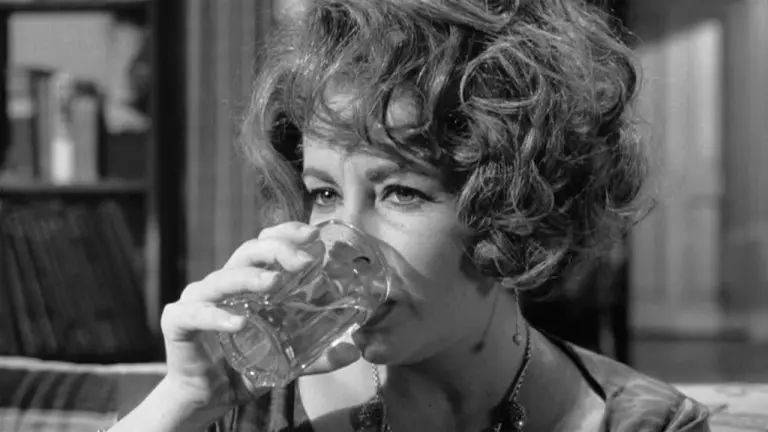
Who’s Afraid of Virginia Woolf? is a psychological drama about two couples whose late-night gathering gradually exposes hidden facets of their personalities, relationships, pasts, and presents—culminating in their mental and emotional breakdown.
Mike Nichols, the German-born American writer, director, and producer, began his career in stand-up comedy and by launching a satirical movement mocking modern American life. He then turned to playwriting and stage direction on Broadway, where his works received wide acclaim and major awards.
In 1966, Nichols made his feature film debut with an adaptation of Edward Albee’s celebrated play Who’s Afraid of Virginia Woolf?—a playwright who would go on to win three Pulitzer Prizes. Albee wrote the play in 1961, inspired by the popular children’s song “Who’s Afraid of the Big Bad Wolf?” and its thematic resonance with his work. The play premiered on Broadway the following year.
Like Albee’s other works, this play delves deeply into the knots of human and emotional relationships, peeling back the inner layers of its characters. Focusing on the brief interaction between a middle-aged couple and a younger one, it reveals over a single night unexpected and unsettling dimensions of their lives.
Nichols adapted the play with a screenplay co-written by Albee and Ernest Lehman—whose credits include Sabrina, North by Northwest, West Side Story, The Sound of Music, and Family Plot.
This film marked Nichols’s astonishing first step into cinema, earning thirteen Academy Award nominations and winning five: Best Actress (Elizabeth Taylor), Best Supporting Actress (Sandy Dennis), Best Cinematography, Best Art Direction, and Best Costume Design.
Among the film’s numerous accolades, it also won the BAFTA Awards for Best Film, Best Actress, and Best Actor (Richard Burton), and received seven Golden Globe nominations.
The entire story unfolds over the course of one night. Shot in black and white, the film’s stark aesthetic amplifies its bleak atmosphere, mirroring the constant verbal and physical clashes among its four characters and the revelation of their hidden truths. The result is a full-fledged tragedy of emotional and psychological disintegration.
The middle-aged couple, Martha (Taylor) and George (Burton)—she the daughter of the university president, he a history professor—invite a younger couple, Nick (George Segal), a biology professor, and his wife Honey (Sandy Dennis), to their home after an academic party. Unbeknownst to George, Martha has arranged the evening as another round in her cruel game of humiliation—this time with an audience.
Within minimal shifts of setting—essential for narrative rhythm and cinematic logic—the film relies almost entirely on dialogue, subtext, and the gradual release of key information to propel the drama.
The tension between the two couples is unpredictable from the outset, yet it steadily exposes shocking fragments of their pasts. These revelations serve two purposes: first, to explain how they’ve come to their current emotional turmoil, and second, to reveal the deeper psychological dimensions that drive their present behavior.
While this dynamic applies to both couples, the film’s central axis remains Martha and George. Their toxic, codependent relationship becomes a mirror through which Nick and Honey’s fragile facade begins to crack. The guests, initially mere spectators to their hosts’ hysteria, soon become participants in the same feverish psychological game—blurring the line between reality and illusion, sanity and delirium.
At times, it even seems as though Nick and Honey are projections—phantoms conjured from Martha and George’s intoxicated psyches.
As we descend beneath the surface quarrels into the film’s deeper layers, Who’s Afraid of Virginia Woolf? reveals itself as a study of a long, weary love—a bond sustained not by tenderness but by shared wounds. Every time Martha and George wound each other more viciously, they also draw closer, bound by their mutual fear of loneliness—their ultimate torment.
Their elaborate lie about having a son, which has grown into an almost sacred shared illusion, becomes the film’s emotional core. When the truth is finally spoken, it lands as a mortal blow—Martha’s unraveling and George’s cruel act of closure in this night of madness.
A fascinating extra-textual dimension heightens the film’s realism: Elizabeth Taylor and Richard Burton were married in real life during filming. Their tumultuous decade-long marriage, ending in 1974, was followed by a brief remarriage and final separation—a mirror to the destructive passion their characters enact onscreen.
This real-life parallel extends the film beyond Albee’s precise writing, Lehman’s skillful adaptation, and Nichols’s expert direction. It transforms Who’s Afraid of Virginia Woolf? into a haunting reflection of a marriage devoured by its own intensity—an unforgettable performance where art and life collide.