


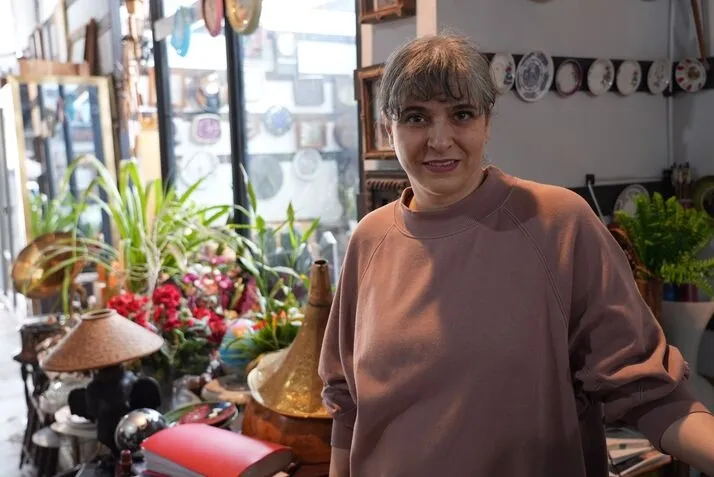
“Woman, Life, Freedom: The Point of No Return” is a collection of interviews with Iranian women filmmakers who, following the Woman, Life, Freedom movement, chose to stand with the people and remove their compulsory hijab—decisions that led to professional bans and exile from the industry. While the media largely focused on actresses’ participation, many other women—directors, screenwriters, set and costume designers, and others behind the camera—also joined the protests. In this conversation, we hear from Leila Naghdi Pari, one of the most accomplished production and costume designers in Iranian cinema over the past two decades.
I first met her at the Iranian Film Festival in Prague, where she accompanied her husband, filmmaker and producer Majid Barzegar, for the screening of their acclaimed independent feature Parviz. A woman of passion and courage, a creative designer with boundless energy, Naghdi Pari has long been a committed presence in Iran’s independent and underground cinema.
Her open support for the 2022 protests—appearing in public without compulsory hijab—led to her arrest and imprisonment in Qarchak and Evin prisons. Her detention drew international attention, including statements from the Berlinale and dozens of filmmakers demanding her release. Among her most recent works is the production and costume design for A Simple Accident, directed by Jafar Panahi, which won the Palme d’Or at the 2025 Cannes Film Festival and was selected as France’s entry to the 2026 Academy Awards.
You were among the women filmmakers who, in protest at the killing ofMahsa (Jina) Amini by Iran’s morality police in 2022, posted a video of yourself without hijab, joining figures like Taraneh Alidoosti, Hengameh Ghaziani, and many others. What led you to this act of defiance?
Leila Naghdi Pari: The night Mahsa was dying in the hospital, my husband Majid was sentenced to a year in prison, banned from work and travel—punished simply for signing a statement. That same night, Mahsa passed away, and her name became the symbol of a revolution.
But my anger didn’t begin there. It had been growing since 1999, during the student protests, and reached a breaking point in 2009. I was depressed for years. The repression of 2019 only deepened that despair. When I saw Masih Alinejad’s “White Wednesdays” campaign and the women who filmed themselves removing their hijabs, I asked myself: Why have I been silent since 1980, when I first had to wear compulsory hijab at school?
All those years, I treated it as part of my “outfit”—an accessory I disliked but accepted. Shortly before Mahsa’s death, I began removing it quietly, in solidarity with other women. When I saw the rage and bravery of young people in the streets, I couldn’t remain a bystander. I recorded a video without hijab and shared my position publicly.
We even tried to organize a protest at the House of Cinema, but under threat from the security forces, we backed down. After Hengameh Ghaziani’s arrest, I posted another video tying up my hair in her support. That act cost me my freedom to work and travel. Since then, only filmmakers like Nader Saeivar (The Witness) and Jafar Panahi (A Simple Accident)—both working underground—have invited me to collaborate. And I’ve done so wholeheartedly.
You were later arrested again during the first anniversary of the protests and spent time in both Qarchak and Evin prisons. Despite imprisonment and professional bans, you remain strong and active. Where does this strength come from?
Leila Naghdi Pari: I think despair, anger, and witnessing injustice make people brave. Of course I get scared—I don’t want to waste my life in prison—but how could I stay silent while young people are being executed?
After the brutal murder of Dariush Mehrjui and his wife, I received another travel ban—one and a half years more. It doesn’t matter. Did Jafar Panahi not endure thirteen years inside Iran? Was Amir-Entezam not imprisoned for decades? I am no different from those who’ve paid far higher prices. Compared to the mothers who’ve lost children, what I’ve endured is nothing. I’m proud to serve my homeland in any way I can.
How have you managed to make a living despite being banned from work?
Leila Naghdi Pari: I began working in 1995, but during the COVID lockdown, I finally built something I’d long dreamed of—a small workshop renting out costumes and accessories for film productions. While others isolated at home, I worked nonstop and built my business from scratch. It now helps cover our basic expenses.
Majid, despite his ban, continued teaching at private film schools like Hilaj and Karnameh—until the Ministry of Culture forced those schools to dismiss him. Thankfully, a few institutions like Farsh Film and Majara stood by him for as long as they could. We’ve survived by supporting each other. Maybe someday I’ll write about those hard years—but for now, with so many Iranians suffering far more, it feels selfish to complain.
Our studio, Chideman (“The Arrangement”), has since grown into a well-known hub for independent designers. We live with fewer worries now, though the struggle continues.
You’ve always supported independent cinema—even working without pay to keep it alive. What is its current state, and what future do you see for it?
Leila Naghdi Pari: Independent cinema is real cinema. It’s where honesty survives. I could have made more money in commercial films, but I refuse to betray what I believe in.
Every Iranian film that has reached the Oscars has been an independent one. I was recently telling Panahi that whether or not A Simple Accident makes it to the final list, the mere fact that it’s there is a triumph for all of us. From Kiarostami to Panahi and Rasoulof, the face of Iranian cinema abroad has always been independent.
The government may resist, but as I like to say, we leak like oil—we always find a way out from underground.
How has theWoman, Life, Freedom movement affected Iranian art, cinema, and everyday life?
Leila Naghdi Pari: After the movement, more filmmakers began working without censorship. Some still use wigs or shaved heads for female characters, but others, especially in independent productions, film freely—without hijab, without fear. Countless short and feature films are now being made without permits. This current can’t be stopped.
Socially, the change is uneven. In Tehran, women have more freedom with family support; in smaller towns, less so. I don’t expect everyone’s beliefs to change overnight, but clarity takes time. Iranians are used to complaining quietly rather than acting. When someone does speak up, their voice is silenced immediately.
Why do you think many women filmmakers did not—or could not—join the movement openly?
Leila Naghdi Pari: Actually, many did. The problem is that the media only highlights actresses, ignoring women behind the camera—those who’ve been imprisoned or beaten but remain unnamed.
A close friend of mine, Zahra Shafie Dehaghani, an animation director arrested with me, suffered severe brain injuries from police beatings. She had multiple strokes in prison and lost vision in one eye. Who has spoken her name?
Many such women exist—in film, in theatre—but because they aren’t celebrities, their pain is invisible. I don’t judge those who still work within the system; many do so for financial reasons. But no one has offered real support—financial or moral—to artists like Hengameh Ghaziani or Taraneh Alidoosti after their arrests.
And please—let’s stop saying “artists stand beside the people.” We are the people.
We now see many women in Iran appearing publicly without hijab—even at film events, such as the recent funeral of Nasser Taghvai. Is this the end goal of your demands, or just one step?
Leila Naghdi Pari: The hijab issue is a symbol—a civil act of disobedience. For my generation and the one after, going unveiled is a way of saying no to everything we’ve endured over the past forty years.
There’s no mention of head covering in the Qur’an; it’s a patriarchal invention meant to keep women hidden. They justify it by calling it “law.” But we are breaking that law every day simply by existing freely.
Women in Iranian cinema are standing firm. Through underground filmmaking, we will soon dismantle both censorship and the hijab code. No one can fight an awakened mind.
We are the women who have run with the wolves.
We will find the way. Hijab or no hijab—it no longer matters.
Freedom will come, and one day, we will celebrate it.