



For decades, Stephen King has been more than just a beloved author; he has become a small universe within cinema—a world where the boundary between nightmare and reality dissolves as quickly as a breath. From The Shining and The Shawshank Redemption to The Green Mile, The Mist, and It, filmmakers have repeatedly sought to visualize King’s dark yet deeply human imagination, creating works that are both terrifying and moral.
But The Long Walk, brought to life this time by Francis Lawrence, speaks neither of fear nor redemption; it only reminds us of the exhaustion of ideas. It is a film that aspires to reflect the political and social world but ultimately becomes a dull, repetitive game—a lifeless attempt to replicate The Hunger Games formula in an emptier, colder, and weaker setting.
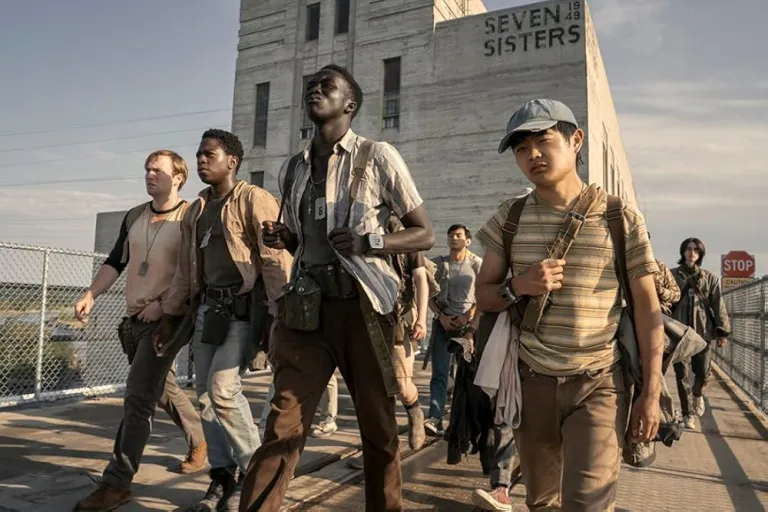
The story unfolds in an unspecified future where, each year, young people volunteer to participate in “The Long Walk”—a deadly contest in which a hundred teenagers must keep walking without rest, as stopping means instant death. Among them is a young man named Ray, who enters this horrific race seeking both survival and meaning in an endless journey. Along the way, he forms fragile, fleeting bonds with others, only to discover that the end of the road offers no salvation—only blood, death, and suffering await.
The film opens with a familiar image: young contestants lined up for a fatal test, loudspeakers announcing the rules. For a brief moment, it seems we are about to witness a story about rebellion and obedience—a struggle between the individual and a system that consumes both body and will. But that illusion quickly fades. The Long Walk offers neither rebellion nor resolve; it never connects its serial deaths to the outside world. Everything is exposed within minutes, because the film has nothing to build—only a random repetition of events.
The problem begins with the screenplay. It avoids linear storytelling, opting instead for an episodic structure without any narrative justification. Every few minutes, Lawrence tries to shock us—a sudden death, a brief flashback, or a new face that is instantly eliminated. This rhythm, which once worked symbolically in The Hunger Games, here feels random and meaningless. Whenever creativity runs dry, the writers simply kill off a character or reveal a secret without buildup or payoff. The entire story revolves around hollow surprises, leaving only tedium in its wake.
Characterization is even weaker. None of the teenagers—even the protagonist—rise above cliché: the determined boy, the wisecracker, the ruthless soldier, and of course, the mysterious overseer in sunglasses, played by Mark Hamill. Yet even Hamill’s presence, which might have added complexity, remains a caricature of authority—neither frightening nor layered, just a cold, empty figure mouthing clichés. With such flatness, even the violence loses its impact, becoming oddly aestheticized and ultimately lifeless.
Visually, the filmmaker attempts to add metaphorical weight through a hazy atmosphere and undefined setting. But this very vagueness becomes the film’s Achilles’ heel: we never learn where the contest takes place, who organizes it, or why such cruelty is accepted. In dystopian literature, ambiguity can be a strength—but here, it merely signals the director’s fear of clarity. The film’s world lacks any cultural or political marker, rendering its social messages ineffective. It aims to critique repression, obedience, and militarized order, yet delivers nothing beyond tired slogans and recycled ideas.
The dialogue, meant to carry the film’s tragic weight, feels like an imitation of teen-oriented dramas from the past decade—lines that try too hard to sound profound about courage and sorrow, but create neither emotion nor meaning. By the film’s midpoint, the viewer realizes that nothing will change, and what remains is merely a long procession of forgettable deaths.
Worst of all is the ending—a sudden, causeless twist that changes everything without logic or buildup. It’s not the result of the protagonist’s struggle, nor a natural culmination of the story; it’s simply an attempt to shock. In cinema, surprise works only when it grows organically from the narrative, but here it’s a shallow trick. We are not astonished—just indifferent.
Visually, the muted tones and misty lighting strive to convey exhaustion and monotony. Yet, without narrative depth, these aesthetic choices become mere decoration. In The Hunger Games, controlled frames and contrasting colors carried symbolic meaning—the glamorous facade of power versus the suffering of the oppressed. In The Long Walk, everything remains on the surface, dissolving into a fog of apathy from which no emotional engagement emerges.
Francis Lawrence had once shown how a commercial story could yield a critique of media and politics. This time, however, he seems interested only in the superficial form of rebellion. The Long Walk, at best, recalls a kind of cinema that once had the courage to speak—but now merely gasps within the confines of repetition.
In the end, The Long Walk is a failed film—lost among recycled political slogans, flat characters, and an incoherent script full of meaningless shocks. Its abrupt ending, hollow atmosphere, and clichéd dialogue leave the viewer only with fatigue and indifference. The journey itself becomes a metaphor for watching the film: a long, directionless, endless walk.