



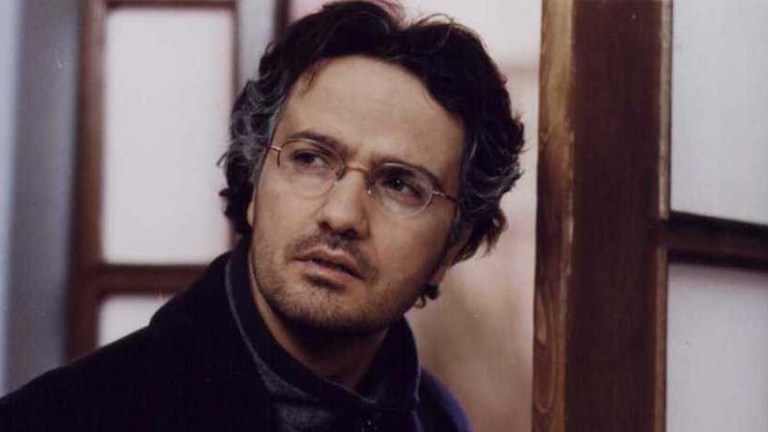
The film Yalda Night is a drama rooted in introspection, centering on a single character and a single location—the home—to explore the emotional metamorphosis of a man in solitude. A man who, by reflecting on himself and the past of his life, arrives at a fresh understanding of love—or perhaps even the belief in lovelessness.
Kiumars Pourahmad, a talented filmmaker, began his career in cinema through film criticism, screenwriting, and the production of short films, documentaries, and series in the 1970s and 1980s. He directed his first feature film, Tatoureh, in 1984, and later entered the world of children’s and youth cinema with Bibi Chelcheh, solidifying his path as a filmmaker.
His career expanded with films such as Gaviyaar, Langargah, and Silent Hunt in the 1980s, the television series Majid’s Tales based on Hooshang Moradi Kermani’s book, and four cinematic adaptations of this story in the 1990s, enriching his cinematic repertoire.
In 2001, after directing For Hanieh, Strange Sisters, and the mystery-crime series Sarenakh, Pourahmad created a unique film in his career that functioned as a form of introspective narration, reflecting his lived experience, which cemented his legacy in Iranian cinema.
Yalda Night, based on Pourahmad’s own screenplay, is, according to the director, one of the few films that he and audiences equally cherish. Over time, its popularity and enduring appeal have grown.
The film earned Mohammad Reza Foroutan the Best Actor award at the Fifth House of Cinema Celebration and also won Best Leading Actor and Best Visual Effects from the Writers and Critics Guild of Cinema.
Yalda Night opens at an airport with a farewell scene in which Hamed (Mohammad Reza Foroutan) parts from his wife, Mahnaz (Elham Charkhandeh), and his daughter, Nazi (Maryam Pourahmad). At first glance, it seems the passengers are written out of the story under the pretense of travel.
However, the real “passenger” in the film is Hamed himself, who must embark on an inner journey to confront the truth about his life. In other words, he must decide whether to face reality or remain in self-deception through the long night of his life, as vast as Yalda Night itself.
This inner journey requires specific conditions and tools, which the filmmaker, with his experience of such tragic situations and intimate knowledge of their nuances, has carefully created to dramatize the painful transformation of the character.
Hamed moves alone through an empty house, relying on memories, family photos, and home videos to uncover the truth that has been hidden beneath the surface of his seemingly loving life with Mahnaz.
This excavation of the past is facilitated by certain present-day triggers, most importantly the subtle presence of the divorced neighbor, Paria (Hilda Hashempour), and an accidental phone conversation between Hamed and her. These interactions function as a form of therapy, preparing his mind and spirit to accept the truth.
Through subtle nudges, Paria encourages Hamed to revisit past family films and photographs, allowing him to meticulously detect the hidden truths of Mahnaz’s emotions in her facial expressions, sorrowful gaze, stifled sighs, and unreleased tears, ultimately realizing that her heart was never truly with him.
More importantly, Paria confronts him with a decisive insight: love and hatred do not occur instantaneously, and understanding their causes requires looking further back—sometimes much further. This insight acts as a guiding light, illuminating Hamed’s analytical journey and perhaps mercilessly casting the light of truth and awareness on the shadows and darkness, leaving him no escape.
To achieve this isolation and inescapability, a cocoon forms around Hamed, taking on an external manifestation. This is achieved through the design of the house, whose doors, windows, curtains, and all openings are closed to the outside, gradually emptied of objects, furniture, and even emotions, moving toward darkness, decay, and emptiness to allow rebirth.
Even the pomegranate squeezed on the first night of Hamed’s solitude begins to rot, and the home’s radiator erupts during the dramatic revelation of Mahnaz’s possible betrayal with Sharif, Hamed’s longtime friend abroad. This explosion, captured with precision, leaves the truth hidden behind a veil for both Hamed and the audience to interpret, creating one of the film’s most brilliant sequences.
This is the same intelligent approach that, in parallel with the dramatic exploration of the past through memories, films, and photos, provides clues in the present narrative to discover and track developments, intensifying the process of emotional collapse.
Present-day events—Hamed’s phone calls with Mahnaz, who has ended up in a Swedish refugee camp instead of Frankfurt, his contact with Sharif, and Mahnaz’s seemingly unavoidable suggestion that he must divorce her to proceed with residency matters—drive this drama both externally and internally.
The arrival of Hamed’s mother (Parvindokht Yazdaniyan) and her heartfelt conversations with him about the past, Mahnaz, and Nazi provide the audience with information about the couple’s history, answering previously raised questions.
Ultimately, even his mother falling into a coma and the ensuing emergency that grips Hamed serve as crucial dramatic devices, forcing him out of the long “Yalda night” of his life, which has lasted a year.
Dramatically, the film requires a point of stability, hope, and motivation for the central character to emerge from this painful inner journey. This is achieved through the carefully introduced neighbor, whose presence gradually develops and expands via phone conversations.
In the final sequence, the woman acquires a physical form, transforming from a warm, encouraging voice into a safe, feminine presence. Her arrival brings light, warmth, and brightness into Hamed’s dark, cold, and empty house—a stark contrast to Mahnaz, whose heart remained closed.
*Inspired by the poem “Simple Color” from Sohrab Sepehri’s collection Green Volume:
I take a pomegranate,
I tell it heart to heart:
How good were these people,
Their hearts’ seeds were revealed…