



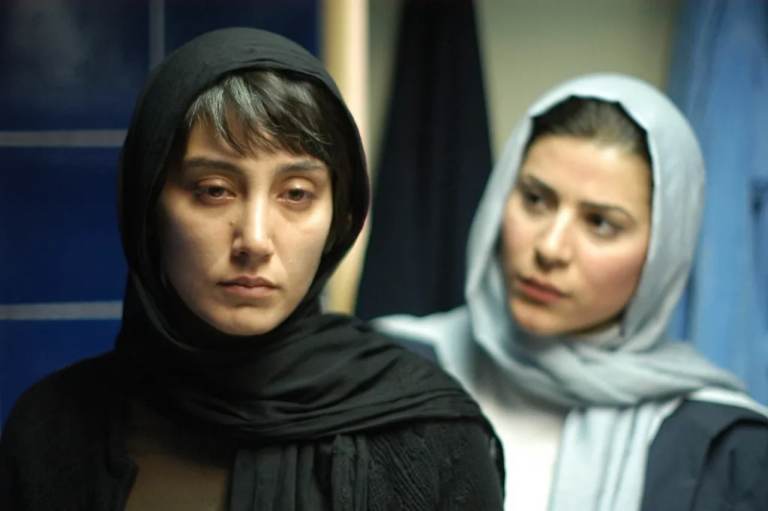
The film “Wednesday Fireworks” (Chaharshanbe Suri) tells the story of a couple’s life in crisis, where the tensions of moving house and the upheaval of the last Wednesday night of the year reveal a hidden secret beneath the surface of their relationship. Yet, deceit and self-delusion delay the family’s collapse—though only briefly, perhaps until the next Chaharshanbe Suri!
Asghar Farhadi, a distinctive filmmaker and global figure of Iranian cinema, began his artistic journey during his university years, simultaneously studying Dramatic Literature and working in theater as a playwright and director. Even as a teenager, he gained experience by making short films with the Young Cinema Association.
He started his professional writing and directing career in television, scripting and producing series during the late 1990s—a period when TV still had high prestige, wide audiences, and a fertile ground for young, innovative talents. Series such as Roozegar-e Javani, Pezeshkan, Cheshm Be Rah, Dastan-e Yek Shahr, and Yaddasht-haye Koodaki are examples of Farhadi’s collaboration in writing and directing.
His entry into cinema began with co-writing the screenplay for Height Zero with Ebrahim Hatamikia. A year later, he directed his first feature film, Dancing in the Dust, which received recognition at domestic and international festivals, earning the Crystal Simorgh for Best Screenplay from the House of Cinema Awards and Best Director at the Asia Pacific Film Festival.
Wednesday Fireworks, Farhadi’s third feature film, released in 2005 based on a screenplay co-written with Mani Haghighi, explores the crisis of couples’ relationships under the shadow of infidelity. The film provides a fresh, non-stereotypical reading of the love triangle, especially the character of the second woman or mistress.
At the Fajr Film Festival, the film received nine nominations and won awards for Best Director, Best Actress (Hedyeh Tehrani), Best Editing (Haideh Safiyari), and Audience Choice for Best Film. Additionally, it earned Best Actress and Supporting Actress (Pantea Bahram) at the House of Cinema Awards, and Best Film from the Iranian Critics and Writers Association.
Internationally, Wednesday Fireworks received accolades including the Golden Hugo at the Chicago International Film Festival, the Special Jury Prize at the Three Continents Festival in Nantes, and the Second Jury Prize at Locarno. It was also nominated for the Golden Leopard at Locarno and the Golden Shell at Nantes.
As the title suggests, the story unfolds on a uniquely significant day in Iranian culture—a festival marking the arrival of spring, bidding farewell to winter’s cold, celebrated with fire, warmth, and, in recent decades, tension and unrest across Iranian cities.
Farhadi uses the Chaharshanbe Suri backdrop to enrich the film’s central drama, linking the hidden tensions within a family to the broader unrest of the city and society, while cleverly employing tangible, external elements to drive the story.
The family, preparing for the Nowruz trip, becomes embroiled in a narrative that gradually unveils hidden secrets. The arrival of a cleaning staff member, Ruhi (Taraneh Alidoosti), mirrors familiar elements of end-of-year Iranian traditions, and her entrance and exit structure the film’s narrative.
Ruhi is introduced as a marginalized, underprivileged girl, shown trying on a borrowed wedding dress in the small bathroom mirror—a gesture highlighting her diminished social position. Her presence in the disrupted household of a middle-class family—Mojdeh (Hedyeh Tehrani), Morteza (Hamid Farrokhnezhad), and their young son Amir Ali—sets the dramatic tension in motion, revealing the couple’s conflicts.
The story unfolds over a single day, beginning with Ruhi’s arrival and ending with her departure. Through her curiosity and discreet observation, the film gradually exposes clues about the couple’s secret, offering the audience a personal reading of their relationship.
The couple consists of a suspicious, irritable woman and a talkative, hot-tempered man, whose behavior raises doubts. The audience, following Ruhi, uncovers subtle indications of Morteza’s possible affair with the divorced neighbor, a hairdresser (Pantea Bahram), which Mojdeh senses but cannot conclusively prove—relying only on intangible, seemingly trivial cues (such as scent).
As the tension escalates, the audience navigates the couple’s strained relationship through glimpses, whispers, and observations—piecing together a complex portrait reminiscent of Farhadi’s signature narrative style, where certainty is elusive, yet evidence is undeniable.
At a pivotal moment, when viewers might sympathize with Morteza as an innocent victim of Mojdeh’s paranoia, the film delivers a shock: Morteza and Simin secretly meet in a car, ending the story.
The conclusion, shaped by a non-stereotypical reading of the second woman/mistress, is guided by Simin’s choice. Unable to bear the collapse of another family, while having her own broken household and a child to consider, she intervenes carefully, managing the chaos symbolized by the firecracker underfoot, yet without delivering a final blow to another life.
Although the film ends with Ruhi’s departure and a temporary sense of calm, the seeds sown remain unharvested, and the shaky foundation of the couple’s relationship foreshadows imminent collapse.
This internal disintegration suggests that even the smallest trigger could bring the couple closer to total breakdown—a latent, inevitable ending that looms over the family-centered narrative of Wednesday Fireworks, despite some viewers’ wish for a more open resolution typical of Farhadi’s films.