



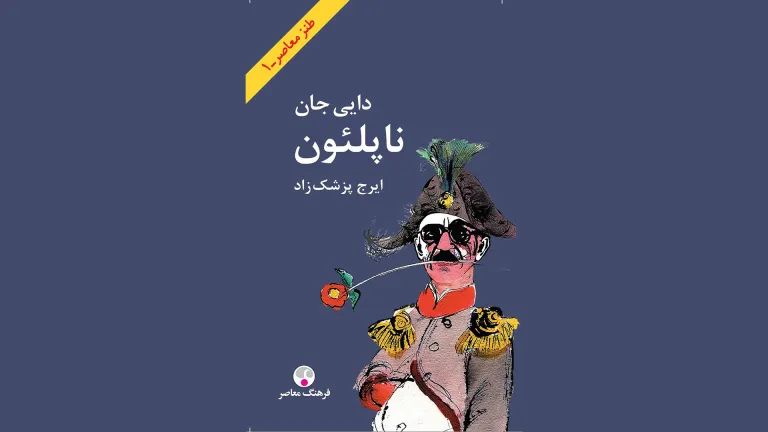
It was in 1970 (1349 in the Iranian calendar) that Iraj Pezeshkzad wrote his most important and famous novel, Uncle Napoleon, which was first published as a serialized story in Ferdowsi magazine. Six years later, in 1976 (1355), Nasser Taghvai’s famous adaptation of the novel cemented its place in Iranian popular culture. Pezeshkzad himself described the writing of the novel as follows:
“I had a friend, Touraj Farazmand, an extraordinary man with unparalleled understanding, taste, and artistic sensibility. I was stationed in Geneva as an officer at the Iranian Ministry of Foreign Affairs, and by chance, Touraj came there for a few days. He asked me what new work I had. I told him, and he listened for three full hours, giving tremendous encouragement regarding Uncle Napoleon. He carried the news to Tehran, and when I returned, at the insistence of friends, I agreed to have it serialized in Ferdowsi magazine.”
My Uncle Napoleonis one of those works that has become part of the popular culture of Iran, which is perhaps the most compelling reason to examine it further as a literary work. Pezeshkzad, a Ministry of Foreign Affairs official familiar with Western literature and culture, injected the novel with a sharply critical, humor-laden perspective that has rarely been analyzed in depth.
On the surface, the plot revolves around the love of the narrator, Saeed, for his cousin Lili. However, this is a forbidden love: Saeed comes from the middle class, while Lili belongs to the delusional, declining aristocracy of late Reza Shah-era Iran. The constant petty disputes between Lili’s father, Uncle Napoleon, and Saeed’s father, Agha Jan, provide the main source of the novel’s humor. Amid these conflicts, the protagonist Saeed strives to achieve his desire—winning Lili’s love. According to Steve Kaplan’s definition of comedy, My Uncle Napoleoncan be considered a form of comedy:
“Comedy concerns an ordinary man or woman grappling with insoluble problems; despite lacking many of the skills or resources needed to succeed, they never lose hope.”
Saeed is precisely such an ordinary character—a “non-hero.” His problems—mainly familial and class-based—are far greater than himself, yet he never loses hope and attempts to succeed with the help of Uncle Asadollah. However, the story’s ending is not a happy one, aligning it with what is known as a “coming-of-age plot.” In such narratives, a young protagonist begins in a safe environment, is struck by a disruptive event (here, Saeed falls in love), faces real-world challenges (class conflicts), and ultimately accepts harsh reality (Lili marries Puri) while experiencing personal growth. Thus, My Uncle Napoleonpresents a comedic story without a happy ending, yet one that fosters character development.
From the very beginning, the novel invites the reader to notice not only the comic situations but also the Iranian society of the time:
“One hot summer day, exactly on the thirteenth of Mordad, around a quarter past three in the afternoon, I fell in love.”
This moment of falling in love coincides historically with the Allied occupation of Iran, which fuels Uncle Napoleon’s paranoia and Anglophobia. Through the conflicts described above, the author critiques the decaying Iranian aristocracy—those who considered themselves exceptional and clung to a false sense of past glory (as recounted in Mash Qasem’s stories of the battles of Kazerun and Mamasani or the honorary medal My Uncle Napoleon received from the Qajar king). This social system ultimately undermines the love and innocence between Saeed and Lili, forcing Saeed to leave Iran while Lili marries Puri, a member of the emerging technocratic class of that era.
Over the past fifty years, My Uncle Napoleonhas received various critiques. For instance, some critics argue that Pezeshkzad drew inspiration from Don Quixote, comparing Uncle Napoleon’s delusional nature to Don Quixote and Mash Qasem’s loyalty to Sancho Panza. Others suggest that Mash Qasem was inspired by Schweik, even adopting his catchphrase “We had a fellow townsman…”. Some point to Ibrahim Younesi, translator of The Life and Opinions of Tristram Shandy, who claimed that he translated the novel out of spite to reveal Pezeshkzad’s sources. Younesi suggested that Pezeshkzad’s novel was essentially a localized adaptation of Tristram Shandy.
Other comparisons have been made: Uncle Asadollah—the novel’s arguably deepest and most modern character—is likened to Don Juan, and the overall plot has been compared to Shakespeare’s Romeo and Juliet.
In response to such criticisms, one can argue that these connections should be understood in the context of modern literary theory and comparative literature, particularly intertextuality. No author creates in isolation; all writing draws on previous texts. Half a century later, we recognize that no text exists in pure isolation, and readers inevitably interpret new works through the lens of past literature and cultural knowledge. This is not a flaw but an inevitability.
Ultimately, My Uncle Napoleondefied the dominant literary currents in Iran at the time, known as the “literature of sorrow.” In the 1940s and 1950s, Iranian literature was dominated by two main currents: the first, influenced by Soviet socialist realism, produced socially committed stories, represented by writers such as Bozorg Alavi, Ahmad Mahmoud, and Jamal Mirsadeghi. The second was accused by the first of formalism and indifference to social issues, exemplified by Houshang Golshiri. My Uncle Napoleonemerged in this literary landscape but never established a sustained movement. Many of the critiques it received were shaped by these dominant literary currents, reflecting a cultural preference for tragic works over comedies that address social issues through humor.