



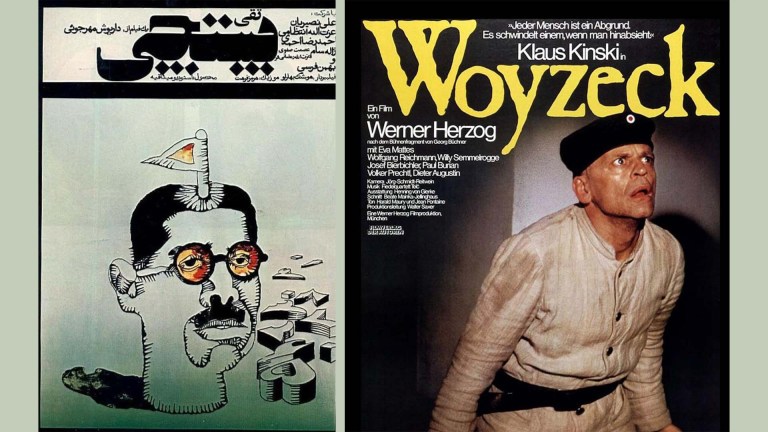
This article presents a comparative study of Georg Büchner’s play Woyzeck—the seminal work of the eminent German playwright—and two cinematic adaptations of it: The Postman (1972) by Dariush Mehrjui and Woyzeck (1979) by Werner Herzog. The main focus of this paper is the different approaches to representing the madness of the protagonist in these two films.
Madness in Georg Büchner’s Woyzeck
Woyzeck is one of the foundational texts of modern European theatre, recognized as one of the most influential plays in world drama and a forerunner of Expressionism. Although unfinished and written in the 1830s, its significance lies not only in its fragmentary and subversive structure, but also in Büchner’s radical insight into human psychology, class hierarchies, and the militarized power structures of his time.
In Woyzeck, Büchner depicts a weak, oppressed man caught in the web of class repression, military humiliation, and social injustice, ultimately descending into madness and murder. Thus, Büchner’s text is at once politically revolutionary and proto-psychoanalytic, anticipating key elements of modernist and expressionist drama. The military environment and the pseudo-scientific experiments imposed upon Woyzeck render his insanity not merely an individual condition but a social, biological, and historical product.
Woyzeck is among the first dramatic works to place its tragic hero not among the nobility or elite, but among the lower classes, thereby redefining the parameters of tragedy. The plot revolves around Franz Woyzeck, a poor soldier who toils endlessly to support Marie, his fiancée and the mother of their illegitimate child. Within the harsh and oppressive military setting, he suffers under both his commanding officer and a doctor who subjects him to dehumanizing pseudo-scientific experiments. These experiments gradually undermine Woyzeck’s mental stability, leading to hallucinations and delusions. When Marie is seduced by a drum major, her infidelity intensifies Woyzeck’s jealousy, driving him to madness and eventually to murder her by the pond. Through an expressionist yet revolutionary lens, Büchner portrays Woyzeck’s madness and violence not as personal failings but as symptoms of social oppression, humiliation, and systemic injustice. Consequently, Woyzeck emerged as a pioneering text in modern drama—open to both psychoanalytic and socio-political readings.
Madness is one of the central and multilayered themes of the play. Trained in medicine, Büchner was deeply interested in the pathology of the human mind. Before Woyzeck—his final, unfinished work—he had already explored the theme of insanity in his novella Lenz. As Nicholas J. Zyzda observes, “In Woyzeck, madness permeates both the character and the world around him. Yet Woyzeck remains primarily a piece of drama rather than a historical or institutional narrative like Lenz.” (Zyzda, 2017)
Büchner based both Lenz and Woyzeck on real historical figures. Woyzeck was inspired by the true story of Johann Christian Woyzeck, a man who, driven by jealousy, murdered a widow named Christiane Woost and was later publicly executed. According to Zyzda, although Woyzeck was written around the same time as Lenz, it is situated in a different historical and institutional context—Lenz deals with a case of mental illness in the late eighteenth century adjudicated by a Protestant pastor, while Woyzeck concerns a criminal case in the early nineteenth century. In the play, madness emerges as a symbol of dehumanization, born of poverty, inequality, betrayal, and exploitation. Woyzeck is a victim of social forces; his madness is an emblem of the erosion of humanity in a cruel, inescapable society.
The episodic and fragmented structure of Woyzeck rejects Aristotelian classical drama. The circular motion—from Marie’s joyful dancing with the drum major to Woyzeck’s dizzying frenzy and ultimate cry, “Strike, kill her!”—binds together his suffering and her betrayal, illustrating his entrapment in a cycle of obsession and despair. As Zyzda notes: “While Woyzeck is undeniably insane, jealousy also provides a strong and credible motive for the murder—perhaps intensified by madness, yet distinct from it. This suggests that Woyzeck is fundamentally a literary work.” (Zyzda, 2017)
According to Zyzda, not only Woyzeck but also other characters in Büchner’s world are touched by madness, for the entire dramatic universe resists rational order. He writes, “Even if Büchner had published a definitive scene sequence, the absence of causal coherence and logical continuity reveals how deeply madness penetrates the formal structure of the play.” (Zyzda, 2017)
Similarly, Helmut Müller-Sievers argues that numerous details justify Woyzeck’s insanity, particularly through Büchner’s historical references and his portrayal of mental collapse. Woyzeck’s gestures—bending down to the earth to listen to imagined voices, his compulsive running, urinating on walls, and failure to engage in coherent dialogue—visibly manifest his derangement. (Müller-Sievers, 2003)
As Zyzda further notes, “The Doctor and the Captain do not express clinical insanity as consistently as Woyzeck does, yet they reveal how profoundly the entire play operates outside the norms of rational thought. None conform to Kantian notions of rational subjectivity, for everything in the drama resists absorption into the order of reason. The play collapses into duality at every point; nothing is certain except this: madness lies at the heart of Woyzeck, even as Woyzeck approaches the heart of modernity.” (Zyzda, 2017)
A comparison of Büchner’s Woyzeck, Herzog’s Woyzeck, and Mehrjui’s The Postman demonstrates that all three works treat madness as a social and historical experience, though they trace it through different trajectories within distinct cultural contexts. Büchner presents it as a symptom of class oppression and military subjugation in nineteenth-century Germany, rendered in a fragmented episodic form. Herzog transforms it into an expressionist nightmare of human collapse in the modern world, while Mehrjui, blending local symbols, dark humor, and allegory, reinterprets it within a cultural–philosophical framework that reflects the existential and identity crisis of 1960s Iran—a madness born of alienation and the dislocation between tradition and modernity.
The characterization in each version also reflects these thematic differences. Büchner’s and Herzog’s Woyzeck is a victim of external pressures—a soldier crushed by authority—whereas Mehrjui’s Taghi is simultaneously a victim of indigenous feudalism and invasive modernity. Torn between two poles, he embodies rootlessness and identity rupture, and his madness mirrors this existential split. Despite stylistic differences, both Herzog and Mehrjui offer highly creative and original reinterpretations of Büchner’s revolutionary play.
Madness in Werner Herzog’s Woyzeck
Werner Herzog’s Woyzeck (1979), in close fidelity to Büchner’s text, approaches madness and isolation from an experiential, expressionist, and psychological perspective. In the film, Woyzeck’s madness is depicted in a subjective, strange, and poetic manner, emphasizing his alienation and solitude. Herzog situates Woyzeck within the same German cultural and historical context as Büchner’s play.
According to Daniel Kopp, Büchner’s Hessian Manifesto reflects the emergence of the proletariat in early nineteenth-century Germany and the widespread problem of poverty. It also addresses class struggle, the complete lack of agency among the lower classes, and the devastating effects of industrialization, themes that were not directly relevant to Herzog’s contemporary context. (Kopp, 2018) In an interview with Paul Cronin about his adaptation, Herzog stated:
“My film adaptation of Georg Büchner’s Woyzeck is perhaps my simplest connection to the greatest achievements of my own culture, even more so than Nosferatu, which had a more direct link to cinema. Although I have always worked within German culture, making a film of Woyzeck meant engaging with the most important cultural history of Germany, and therefore there is something in the film that transcends me. The film reaches the golden peaks of German culture, and that is why it shines. Yet all I did was to reach and touch those peaks.” (Cronin, 2014, p. 160)
Herzog uses cold, oppressive atmospheres and the extraordinary performance of Klaus Kinski as Woyzeck to draw a border between reality and delusion. Madness in this film is not a cultural metaphor, but a tangible and bitter experience of human deterioration under power. In this way, Herzog’s adaptation, despite the differences from the original text, remains in the tradition of Büchner, grounded in a shared German historical-cultural framework.
In terms of style, Büchner pioneered a language of modernist drama through the episodic structure of the play and sudden scene jumps, which later flourished in Expressionism. Herzog, through stark mise-en-scène, slow pacing, lighting, set design, and expressionist performances, translates the merciless world of Büchner to cinema. Klaus Kinski, with his tense, trembling physicality, transforms Woyzeck into a fragile, monstrous figure.
According to Herzog, due to the nature of the film as a German dramatic text, his task was simply to bring it to the screen and let it speak for itself, reflecting his restrained directorial approach and theatrical cinematic sensibility. Consequently, Herzog’s Woyzeck preserves nearly all of the play’s plot, dialogue, characters, and historical setting, with only minor omissions. American critic Richard Combs observes that Herzog’s film is less schizophrenic than Büchner’s play. Herzog omitted or condensed some scenes but did not invent new elements. Combs writes:
“Büchner’s archetypes—the bourgeois order, the Doctor, and the Captain, who experimentally provoke Woyzeck and mock him about Marie’s infidelity and her affair with the Drum Major, driving him toward his final madness—are portrayed as naïve rationalists in Herzog’s tradition.” (Combs, 1979, 259-60)
The camera in Herzog’s film is predominantly static, creating a theatrical spatial relationship between audience and scene. The film consists of a series of multi-minute sequences, directed as if a recorded stage play. Close-ups or notable camera movements are rare, producing a sense of distance from Woyzeck. Herzog does not attempt to induce audience empathy for Woyzeck’s inner state through cinematic techniques, but instead relies on the power of Büchner’s dramatic text. The final murder scene, where Woyzeck repeatedly stabs Marie, is presented in a long, slow-motion sequence, turning the act into an aesthetic gesture rather than eliciting audience identification with the total destruction of Woyzeck and Marie. Here, madness is a concrete and embodied experience of social and existential pressures. Herzog’s cold mise-en-scène, slow rhythm, and nightmarish composition depict human collapse under conditions of exploitation and betrayal. Faithful to Büchner, Herzog presents madness as the direct result of injustice and domination, rather than a purely internal disorder.
In Herzog’s film, Woyzeck becomes a fragile figure crushed by military authority, pseudo-scientific experiments, and emotional betrayal. Indeed, the film’s representation of madness is an extension of Büchner’s perspective: psychological collapse as a consequence of exploitation and humiliation.
Madness in Dariush Mehrjui’s The Postman
Compared to Werner Herzog’s adaptation of Büchner’s Woyzeck, Dariush Mehrjui’s cinematic adaptation, The Postman (1951/1972 in Iranian calendar), adopts a markedly different approach. Büchner’s text resonated with the political and intellectual discourse of 1960s Iran, in which Mehrjui and other New Wave filmmakers participated. The Shah’s authoritarian modernization project deepened the divide between traditional society and the state, as well as the urban–rural divide. Mehrjui, while retaining the core themes of Büchner’s play, situates the theme of madness within the social, political, and cultural context of 1960s Iran, reflecting the political crises of that era. The dominant intellectual discourse emphasized indigenization and anti-Western sentiment. Mehrjui was more flexible with his source material and added layers of meaning absent in the original text. Although many changes were made, the tragic essence of the story remains.
Mehrjui relocates the nineteenth-century German military setting of Büchner’s play to a village in northern Iran during the 1950s. The central character, Taghi, unlike Woyzeck, is no longer a conscript soldier under constant abuse, but a simple-minded postman repeatedly humiliated by his master and others. Through this context, madness is not solely the result of military and scientific pressure, but also of social humiliation, cultural conflict, and existential dislocation.
The Postman is not a mere recreation of a European text; it is a cultural translation, attempting to link a universal problem (madness arising from betrayal, jealousy, and repression) with an Iranian context (the conflict between tradition and modernity, and an existential crisis). Compared to Herzog, Mehrjui’s film remains faithful to the dramatic structure of Büchner’s play while focusing more on Iranian cultural localization. The film’s narrative engages directly in social and political critique, a dimension less prominent in Herzog’s adaptation. Mehrjui introduces local elements, such as pig farming instead of sheep husbandry by the Westernized engineer, symbolizing the clash of tradition and rootless modernity (pigs in Islamic culture signify impurity and corruption). This change in the feudal estate of Niyatollah Khan serves as a symbol of alienation and the erosion of traditional values under Western influence.
Taghi works both as a postman and as a servant for the feudal master, Niyatollah Khan, and is doubly exploited. His young and beautiful wife is seduced in his absence by the master’s Westernized nephew, who represents aggressive modernity and Westernization. In this adaptation, Büchner’s Drum Major is transformed into a Western-educated engineer. The village veterinarian parallels the role of the doctor in Büchner’s play, experimenting on Taghi like a lab rat. These changes not only adapt the story to 1960s Iran, but also entangle Taghi in broader social issues, such as economic despair, expanding social inequality, and the rural-urban divide. Symbolically, the relationship between Taghi and the Westernized nephew also represents the exploitative and destructive influence of the West on Iran and the struggle between tradition and modernity. Niyatollah Khan’s terminal illness, as head of the traditional hierarchy, serves as a metaphor for the decay of all traditional social structures.
Mehrjui portrays Taghi as a nervous, unstable man confronting a profound identity crisis. Following Foucault, he becomes a “Other”, marginalized and alienated, grappling with existential estrangement, a recurring theme in Mehrjui’s work. Taghi is so consumed by servitude that he cannot even perform his primary job as postman, relying on a friend to distribute mail, while he struggles financially to support himself and his wife. He pins his hopes for upward mobility on a lottery poster in his home, a symbol of illusory hope. In scenes where the Westernized engineer attempts to seduce Taghi’s wife, the poster appears in the background, ironically emphasizing Taghi’s social and sexual failure.
Madness in The Postman is closely tied to the pressures on Taghi, a uniquely Iranian Woyzeck. His psychological, sexual, and social crises are intensified by the socio-political conditions of 1960s Iran. Madness emerges from social injustice, class conflict, and intellectual repression, effectively serving as a psychological mirror of Iranian society in that period. The dramatization of madness is localized and more explicitly expressed through familial and social relations.
Taghi’s madness results from the intersection of class exploitation, social humiliation, and cultural–identity crises. His sexual impotence and the betrayal of his wife echo the effect of Marie’s betrayal on Woyzeck. The wife’s infidelity constitutes not only an emotional wound but also a blow to his masculine and social identity, driving him toward madness and, ultimately, murder.
Sexual impotence, a central motif in Büchner’s play, is maintained in The Postman. According to Daniel Kopp, Mehrjui interprets Büchner’s focus on Woyzeck’s impotence as a metaphor for castration, sterility, and the lack of agency among the lower social classes. Similarly, Taghi’s impotence symbolizes the deprivation of social agency among Iran’s lower classes.
The Westernized engineer, like Büchner’s Drum Major, wields sexual and social power to seduce Taghi’s wife. Taghi’s impotence, contrasted with the engineer’s sexual dominance, carries political implications within the discourse of indigenization and anti-Western sentiment. Taghi, like Woyzeck, is mocked and humiliated within the feudal household. At a party in Niyatollah Khan’s house, the engineer seduces Taghi’s wife with alcohol and poetry, representing modern, Westernized technocracy undermining rural traditional structures.
Like Büchner’s play, The Postman unfolds in a cold, somber environment, highlighting the psychological and social crises. Unlike Herzog, Mehrjui uses specific cinematic techniques to emphasize aspects of the drama. While Herzog’s film is more theatrical due to static shots, The Postman is visually dynamic and cinematic. The black-and-white cinematography amplifies the gloomy atmosphere, heightening the depiction of Taghi’s madness and the tragic murder of his wife. Night sequences, absent in Büchner and Herzog, create mystery and reinforce structural dualities: urban/rural, Western/Eastern, traditional/modern, weak/strong. For instance, while Taghi labors in the dark basement of Niyatollah Khan’s house, the master and his guests indulge above, and the Westernized nephew flirts with Taghi’s wife, symbolically highlighting class hierarchy and cultural castration.
The dominant discourse of 1960s Iran, resisting Western influence and authoritarian modernization, manifests in The Postman as social inequality, class conflict, and the clash between tradition and modernity. Mehrjui critiques both excessive Westernization and rigid traditionalism, portraying neither as suitable for Iranian modernity. The village doctor, a symbol of traditionalist, indigenizing medicine, fails to treat Taghi’s impotence, worsening his condition with purely herbal remedies.
Conclusion
The comparison of these three works shows that madness is not a biological or purely psychological condition, but a reflection of historical, class, and cultural circumstances. Büchner depicts madness as a product of military oppression, Herzog transforms it into an existential nightmare, and Mehrjui represents it as a marker of cultural rupture, the tension between tradition and modernity, and human alienation in a transitioning society. In all three works, madness occurs when the subject is expelled from social order, collapsing the boundaries between rationality and irrationality, individuality and otherness.
In The Postman, unlike in Woyzeck, the line between external pressures and internal crisis is blurred. The protagonist gradually fractures internally due to his inability to adapt to modern order and the loss of his traditional role. Another key difference is the ending: while Büchner’s play and Herzog’s film have open endings, The Postman concludes with Taghi’s arrest and probable institutionalization. The townspeople judge him, calling him a thief, fool, and madman—an element absent in Büchner and Herzog. Nevertheless, both Mehrjui and Herzog depict protagonists descending into inner crisis and madness. Thus, The Postman is not only a creative adaptation of a non-Iranian play but also a radical recontextualization of a universal problem—madness caused by oppression and humiliation—within 1960s Iranian society. The film demonstrates how creative, cross-cultural adaptation can preserve the dramatic structure of the original while addressing local social, cultural, and intellectual crises, showing that a nineteenth-century European drama can acquire new vitality and critical significance in a different cultural context.