



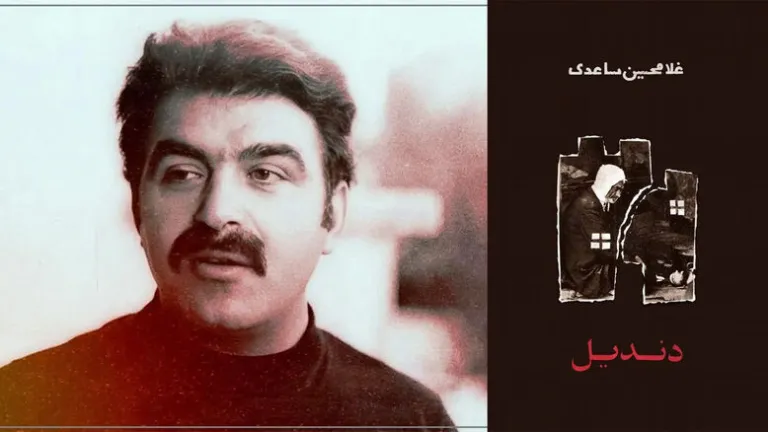
Filicide and Anti-Americanism inDandil by Gholam-Hossein Sa’edi
Dandil tells the story of a village girl named Tamara, whose father, for the price of a mere loaf of bread, sells her to the owner of a brothel.
“Filicide” is a profoundly significant and recurrent motif in Iranian literature. Its most striking example appears in one of the oldest and most celebrated works of Persian epic, Shahnameh, when Rostam unwittingly kills his son Sohrab. In many texts, the term pesarkoshi (“son-killing”) is used, yet it is possible—and perhaps more fitting—to broaden its scope to farzandkoshi (“child-killing”). Gholam-Hossein Sa’edi’s short story Dandil is also built upon the notion of filicide. In this tale, filicide occurs on two interwoven levels: the individual and the socio-political.
Dandil narrates the story of a village where a new girl named Tamara is brought into a brothel. She is very young, still a virgin, and brought there by her own father. The townspeople and the brothel’s madam decide to sell her first sexual encounter to an American sergeant, hoping to profit handsomely. Yet the plan collapses when the American takes what he wants and leaves without paying.
From the outset, the manner of Tamara’s arrival in Dandil reveals much:
“Mamili asked, ‘Who brought her here?’
Zeinal replied, ‘Ayoob. The girl’s father came too.’
Mamili asked, ‘Her father?’
Zeinal said, ‘Yeah, some old fool… he hasn’t a clue. He thinks they’ve brought his daughter here to marry her off. And he eats like a bottomless pit. Just like our own Kashmat. But the girl—she’s something else, more than words can say. Damn it, her father planted a good seed.’”
It becomes clear that Tamara’s father has effectively sold her for “a loaf of bread that never satisfies.” Later, he is depicted as a pitiful, almost mindless figure:
“Tamara went inside. The doorman, wielding a stick, chased Kashmat and the children to the far side of the alley. Tamara’s father hunched himself over, raised his hands, and began to weep. The doorman barked at him: ‘Step closer and I’ll smash your head. Stay right there. Don’t move an inch.’”
Through such behavior, devoid of reason or responsibility, Tamara’s father becomes the very embodiment of filicide—not by physically killing his child, but by destroying her future. By delivering her into a foul, garbage-strewn town where, as the story bluntly puts it, most people live by pimping, he transforms her into a prostitute without her consent or even comprehension. This constitutes the first level of filicide, the individual.
But the story expands this theme to a second level, that of collective and political filicide. The people of Dandil are steeped in superstition and backwardness, and when the American sergeant enters the scene, the gulf between them and him is made explicit:
“Asadollah said: ‘I’m not talking about myself. I mean him. Those folks aren’t starving beggars like us. They roll in money. Wherever they go, they throw it around like pebbles, spending freely to enjoy themselves. But one thing’s certain: when he comes here, everything has to suit his taste. Money’s no issue for him. Think about it—the man’s only a sergeant, yet he earns three times as much as our own chief…’”
Tamara, in this sense, becomes a metaphor for Iran itself: a child readied and adorned by her own people for submission to America’s appetite. She is dressed up, painted, and perfumed as if for ritual sacrifice:
“Tamara had been to the barber, painted her eyelids green, stuck a large white flower in her carefully wound hair. She wore high-heeled shoes with straps, and a sleeveless red dress.”
Thus the second, broader act of filicide unfolds. The American sergeant arrives, indulges himself, and leaves without paying—an allegory for exploitation. The townspeople, like Tamara’s father, are complicit, offering up their child for profit, only to be cheated and left empty-handed.
The parallels between Tamara’s father and the people of Dandil are unmistakable. Both play the role of parent, both sell their child for survival, and both end up betrayed. The father receives no money from the brothel; the townspeople receive nothing from the American. Exploitation, in this story, is a cycle endlessly reproduced within society.
In Dandil, then, filicide appears in a new guise, diverging from the classical epics. Here it intertwines with themes of American domination in Iran under the Shah, articulating a powerful discourse of anti-Americanism. It is no accident that Sa’edi, a leftist and outspoken critic of imperialism, penned this tale.
Dandil was published in a short story collection of the same name. Issued before the Revolution by Amir Kabir Publications, it remains, to this day, denied reprinting permission in Iran.