


The Realm of Bodily Resistance and Women’s Voices | Woman, Life, Freedom, the Point of No Return: Maryam Palizban
“Woman, Life, Freedom, the Point of No Return” is a collection of interviews with Iranian women in cinema. These are women who, after the Woman, Life, Freedom movement, because of their solidarity with protesting people and removing the mandatory hijab, could no longer continue their careers and were banned from working.
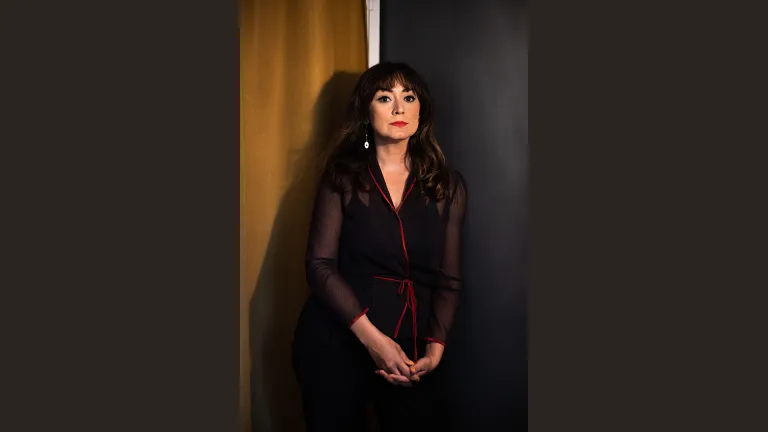
I first became acquainted with Maryam Palizban as a poet when I was in charge of the theater pages at Haft magazine in the early 2000s, publishing several of her poems. However, most people recognize her from Parviz Shahbazi’s brilliant film Deep Breath. This film marked her first acting experience in one of the most significant post-revolutionary Iranian films. Palizban plays Ayda, a curious and courageous student girl—a character rarely seen in Iranian cinema. She embodied Ayda with grace and strength, a persona that resonates with Palizban herself. She studied theater at the University of Fine Arts in Tehran and holds a PhD in Philosophy and Humanities with a focus on Theater Studies from Freie Universität Berlin. From the outset, Palizban has been selective in her acting career, appearing in avant-garde and distinct films such as Mohammad Shirvani’s Fat Shaker and Reza Dormishian’s Lantouri, leaving memorable performances. Though residing in Berlin, before the Woman, Life, Freedom movement, she actively participated in various artistic projects during her visits to Iran. Palizban was among the first artists to post unveiled photographs of herself in protest against the murder of Mahsa Amini.
From the beginning, you’ve been highly selective in Iranian cinema, acting only in independent, avant-garde, and experimental films. In recent years, Iran has witnessed significant protests—from June 2009 to 2017, and again in November 2019—where thousands were killed, injured, imprisoned, or tortured. What was different about Mahsa Amini’s death that led you, living in Germany, to join other Iranian women filmmakers in posting unveiled photos?
Maryam Palizban: Mahsa Amini’s death was not just news for me—it was an explosion, a continuation of a history of oppression. It was the moment when years of fear, silence, and lived experiences of pressure and coercion suddenly broke at a single point. From childhood, since the early school years during the war, I confronted limitations and control over women’s bodies and lives. Even in independent and avant-garde films, censorship and coercion were always present. But Mahsa’s killing crystallized all those years into a single moment—a moment where rebellion in personal, social, and political life, and all hidden and overt violence, converged.
When the news reached me, I felt I could no longer remain a bystander. Living between Germany and Iran, I had always sought to maintain the right to travel, to be, and to work in Iran. Protecting this right came at a heavy price—a contradiction I could no longer bear. Posting my unveiled photo was a personal act, but also a political statement: confronting my deepest fears, my fear that the right to see my family and work alongside people I cherished in theater and cinema would be taken from me. While in Germany, I was engaged in academic research, yet whenever an independent cinematic or theatrical project arose in Iran that I could support, I suspended my work in Germany entirely and returned to Iran. Teaching in Iran also frequently occurred in recent years, and I deeply valued my students.
After Mahsa Amini’s murder and the initial actions by women in cinema, I had hoped more would stand together—but unfortunately, that did not happen. This decision emerged from a long path, years of living between two worlds and confronting mandatory hijab. It created deep psychological pressure—a sort of existential split. Posting the photo combined anger, grief, and hope; it was an act of connection… a connection among women near and far who share a common experience with me: resistance.
Did you know you were losing the possibility of working in Iran—or even returning there? How did your family and close ones react? What was the initial response from colleagues in cinema? Did you lose any contracts or projects as a result?
Maryam Palizban: I knew that this decision, at the very least, meant losing the possibility of returning to Iran. I understood that no official institution, and many semi-independent or independent projects, would collaborate with me, closing off my professional paths. Yet amidst the fear and despair, I felt closer to a sort of inner honesty.
My family’s initial reaction was concern—for my fate, consequences, and dangers. But when they saw the decision was unavoidable for me, they ultimately supported it. Reactions from artistic colleagues varied: some expressed admiration and solidarity, others remained silent or distanced themselves. This is natural, as such a decision could entail serious costs for many. But for me, it marked the end of half of my life. Subsequently, in my political activities, I faced even more severe threats and anxieties—unforeseen in scale.
Why do you think many actors and filmmakers who did not personally believe in the mandatory hijab did not join those who removed it?
Maryam Palizban: Fear is a structural reality. Artists know that openly taking a stance could lead to imprisonment, work bans, or threats to their families. Many stayed silent to protect themselves and their loved ones. I do not judge this silence; everyone must make decisions within their own circumstances. But even a small act, even breaking personal silence, can inspire others. That is precisely what the Woman, Life, Freedom movement demonstrated: every voice, every image, every individual act can create a collective wave.
What is the most significant change this movement has brought to artists, and what role do you see for them going forward?
Maryam Palizban: This movement was a turning point for Iranian art; a historic moment with no return. Even after three years, it may be too early to fully grasp its deep impact. We are still grappling with defining our stance toward the movement and re-evaluating our positions. This period will not be brief. Today, with the ongoing struggle, the connection between the Woman, Life, Freedom movement and the current situation raises fundamental questions, as resistance, struggle, and opposition to war intersect.
How has your personal experience been working in Iranian cinema amid limitations and censorship?
Maryam Palizban: I have always worked in independent and avant-garde cinema in Iran. Though seemingly an artistic choice, it was deeply political as well. Acting in films outside government standards always carried risk and pressure. I faced interrogations and scrutiny that often halted projects. Yet these experiences prepared me for the day I could no longer hide part of myself. Every film was a form of resistance, a recreation of truth. Ultimately, this conflict between my real self and censored self led to a decisive choice: removing the hijab and openly declaring my political stance.
What are your thoughts on independent Iranian cinema and its future?
Maryam Palizban: Despite pressures, independent cinema in Iran is still alive. Censorship and limitations are more intense than ever, yet these conditions have driven a new generation of filmmakers to pursue fresh languages—a language of resistance itself. Independent cinema is wounded, but alive; under pressure, but creative.
Have you ever regretted joining the Woman, Life, Freedom movement?
Maryam Palizban: Never… never. It was the strangest moment of my life: seemingly simple, yet profoundly giving me a sense of freedom and closeness to my true self. This is invaluable. Were I in that position again, I would make the same choice.
How do you see the future for Iranian women artists?
Maryam Palizban: Full of hope and faith. They are growing up courageous, aware, and inspired by the Woman, Life, Freedom movement. They understand that their bodies and voices are realms of resistance, not tools of oppression. The future belongs to them. I believe art in Iran will never return to its previous state. Something in this movement has been broken and is irreversible. Women artists will write, create, and stand.