



Danny Boyle’s 28 Years Later is less a conventional horror sequel and more a daring meditation on civilization’s denial of death. While it preserves the surface elements of the genre — fast zombies, gore, and dread — it pivots from sheer survival to something more meditative: a reflection on how communities cope with loss, memory, and the fear of disappearance.
Set decades after the original outbreak, the film introduces us to Holy Island, a small, isolationist community cut off from the rest of a ravaged Britain. The setting is more than just backdrop — it functions as metaphor. With its tide-locked causeway and absence of power or external contact, the island reveals a society built around emotional containment as much as physical survival. Death here is not confronted, but kept at bay — over “there,” across the water — a distant phenomenon never fully integrated into communal life. But Boyle’s point is sharp: the further a society pushes death out of sight, the more it risks emptying life of meaning.
Boyle and screenwriter Alex Garland smartly evolve the zombie trope to match our desensitized age. Gone is the raw shock of the fast-running infected; in its place is a quieter horror, rooted in the disturbing ease with which these creatures — and the violence they provoke — have become familiar. The subcategories of the infected (the sluggish “Slow-Lows,” the grotesque “Alphas”) are grotesque, but even they can’t command the same primal fear as the original film. Boyle knows this. Instead of trying to replicate it, he leans into weariness — into a sense that the apocalypse has long since passed, and all that remains is the moral and emotional detritus.
The cinematography by Anthony Dod Mantle reflects this tonal shift beautifully. Building on his lo-fi work from the original, Mantle shoots much of the film with hyper-anamorphic lenses and iPhones, creating a look that feels at once gritty and lyrical. The imagery alternates between the rawness of decay and the strange beauty of survival. Boyle lingers on violent moments with an aestheticized slow-motion that is both thrilling and unsettling — a kind of poor-man’s bullet time that seduces the eye while quietly indicting it. We are made to see the violence not as chaos, but as choreography — an artful arrangement of decay.
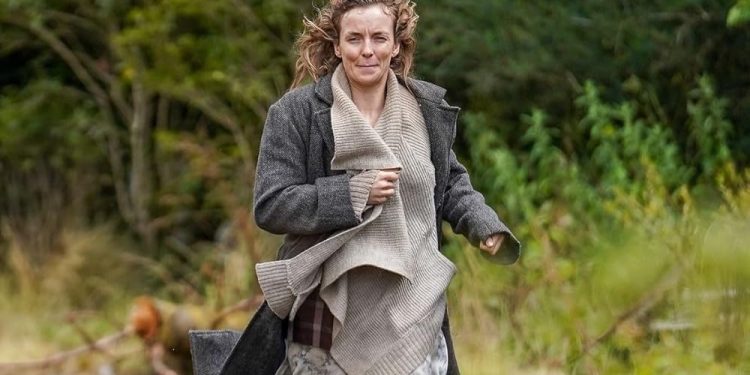
At the film’s emotional center is young Spike, a boy born into a world defined by loss he doesn’t understand. His desire to cure his ailing mother — and his defiance of the community’s silent rules — drives the narrative. But more than that, it opens up space for the film to explore inherited masculinity, delusions of control, and the tragic costs of naïveté. First-time actor Alfie Williams brings an astonishing naturalism to the role, balancing bravado and vulnerability with remarkable precision. Jodie Comer, as Isla, is equally affecting, gradually evolving from a disoriented background figure into a haunting emblem of memory’s fragility.
Their bond deepens the film’s central concern: how societies cope with death, and what happens when that reckoning is indefinitely postponed. Isla’s illness — at first appearing as generic movie dementia — becomes layered with emotional and symbolic weight, particularly as she begins to mistake her son for her long-dead father. This doubling of generations, of life and death, reflects Boyle’s larger vision: that identity itself becomes unstable when history is buried rather than processed.
In the final act, Ralph Fiennes appears as Dr. Kelson, a mad doctor with equal parts mystic and mad scientist energy. His strange philosophical musings — delivered with disarming comic timing — add an almost mythic dimension to the film’s conclusion. What could have been a rote final battle becomes something closer to a parable, in which Spike’s survival depends not on outpacing the infected, but on accepting death as a necessary — even redemptive — part of life.
Ultimately, 28 Years Later isn’t about zombies. It’s about what happens when we build entire societies on the refusal to grieve. The film closes not with catharsis, but with the realization that the true sickness may not be the virus itself, but the moral rot that allowed a nation to become an unmarked graveyard. The horror, in the end, is not that the dead walk among us, but that we’ve forgotten how to honor them — or worse, that we’ve stopped caring altogether.
Boyle has crafted a sequel that dares to use genre conventions for philosophical ends. It may not deliver the adrenaline highs some audiences expect, but its deeper currents — meditations on mortality, memory, and moral failure — make it one of the most haunting entries in the zombie canon. 28 Years Later proves that horror, when done right, can still carry the weight of tragedy, and remind us of the thin, fraying line that separates a human from a husk.