



There is a fine line between imitation and inspiration. Imitation is like a clumsy copy of a hardworking classmate’s homework who is always the top of the class, and usually, the imitator refuses to admit to cheating. Inspiration, on the other hand, is several steps ahead of imitation. To achieve this, one not only has to memorize the work of that classmate word by word but must also master it to the point where, whether intentionally or not, their own knowledge is fused with the classmate’s in the next assignment. If we step out of the classroom and return to cinema, the fundamental difference between imitation and inspiration can be summarized in the presence or absence of the filmmaker’s spirit in the work. Inspiration is captivating because not only does it bring a smile to our face by invoking the greats of cinema and literature in the film, but it also excites us to experience the filmmaker’s own creations.
Magnus von Horn bases his film on the story of a serial killer; a nurse named Dagmar Örbay, who between 1913 and 1920 killed more than nine children (with estimates reaching twenty-five) in Denmark. However, von Horn’s brilliance is not limited to the choice of an exciting subject. In fact, the Swedish-Polish director doesn’t allow the killer to victimize the film; instead, he uses her as a tool to tell his own story. The Girl with the Needle focuses on a poor girl named Caroline (played by Vicky Carmen Son) whose husband disappeared during World War I, leaving her to deal with numerous struggles.
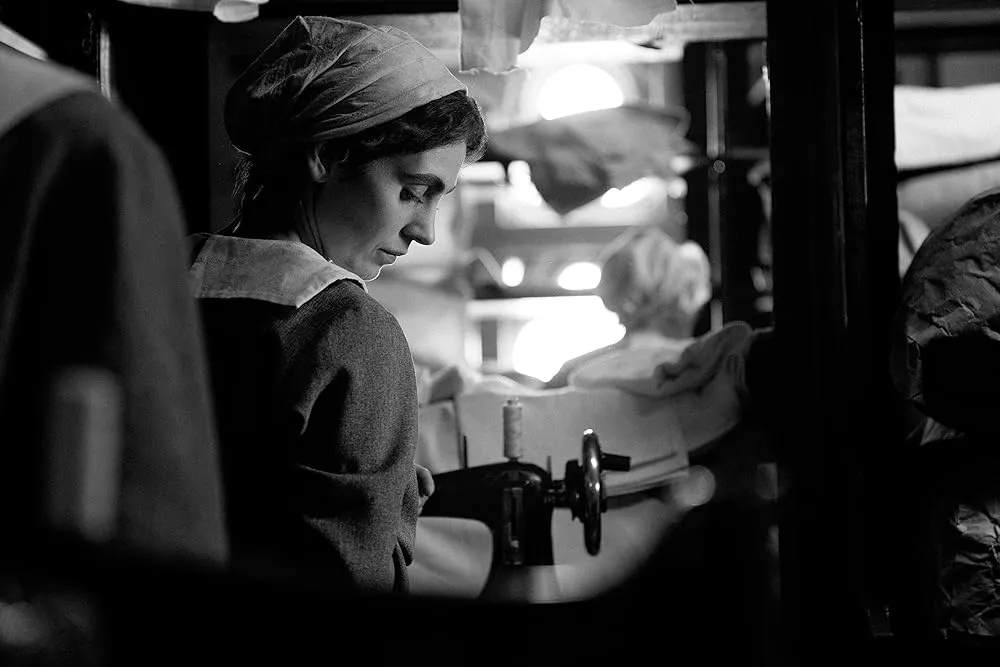
The film can be divided into two halves: the first half as a tribute to cinema legends such as Chaplin, Murnau, and Fassbinder, and the second half as Magnus von Horn’s own. The Girl with the Needle initially seems indebted to German expressionist cinema and the Kameraspiel movement; the shadows, the depth lent by the film’s black-and-white style, the exaggerated acting, the focus on the lower class, and a killer who sacrifices infants—all seem to transport us back to the glorious era of Lang, Murnau, and Pabst. In this first half, the film meanders through the history of cinema; from Murnau’s “The Last Laugh,” it takes us to Chaplin’s “Modern Times,” and soon after, we find ourselves at Fassbinder’s “The Marriage of Maria Braun,” only to encounter Hans Becker’s “M” by Fritz Lang. Surely standing atop a mountain higher than these masterpieces is an impossible task, unless a genius emerges who conquers seven heavens. Yet, The Girl with the Needle at least succeeds in gloriously honoring this half. Despite the obvious focus on connecting important films from cinema history, von Horn never loses sight of telling his own story. He cruelly drags his protagonist from one suffering to another, without giving her a single moment to breathe. Caroline is repeatedly assaulted throughout the film: first when she has an affair with her boss, Jörgen, on a rainy street; do you see any love in this relationship? Then there is the doctor’s examination, devoid of any comfort, as though Jörgen’s mother and the doctor are slowly crushing both her body and soul. Finally, Dagmar (played by Trine Dyrholm) commits a poetically horrific murder; she strangles the child between her arms and Caroline’s, and once again, Caroline’s desperate struggle seems to be a painful attempt to escape this violation. These scenes showcase the director’s mastery in portraying the story he wants to tell. The Girl with the Needle progresses with a relentless pace toward the birth of a child, only to suddenly pause, and it is at this point that von Horn steps away from the shadow of cinema greats and takes control.
Everything starts with the sound of a child crying behind Dagmar’s shop door. Caroline abandons the little girl, but her heartbreaking cry captivates her. This is how the next day, she returns to find the child. Entering Dagmar’s life is an opportunity for comfort, albeit a fragile one, and for warming up with the devil, who soon reveals her true face. The Girl with the Needle could have deeply shocked its audience by detailing the infant’s murder and showing a close-up of Dagmar’s crime, but instead, this horrific event is depicted with just two or three minutes of footage. What more could we expect from a post-apocalyptic world in the film where the circus leader refers to an old soldier as “animal”? Perhaps we’ve forgotten that moments before, Caroline had attacked this very baby with a needle. Thus, the murder of an innocent child is not an extraordinary event in the hellish world of The Girl with the Needle. Von Horn wisely avoids the temptation to create a distressing scene, instead crafting a pervasive suffering. At the trial, Dagmar reveals truths that mothers are afraid to speak, as though she is the embodiment of the collective hatred of these despondent women, who, as ghosts, descend upon their own infants. The birth of this ghost is the inevitable result of the anger of women who gave birth to their children on the cold factory floors. In fact, the film directs its accusatory finger not at the killer but at the judge.
Michał Dymek’s camera is no less ruthless than Dagmar, nor any more delicate. The havoc Dymek wreaks on the poor, unfortunate soldier in that stairwell is no different from the circus master’s humiliation. In the stairwell, the camera transforms a broken man into a creature engulfed in darkness. The play with shadows and the creation of terrifying creatures from the characters in The Girl with the Needle makes it a work in which one can get lost in its frames and praise them. This is perhaps one of the few films that knows why it uses the 1:1 aspect ratio and doesn’t exploit it merely as an intellectual gesture. The music also occasionally falls upon the audience like a hammer, reminding us that the gates of hell are open.
Vicky Carmen Son and Trine Dyrholm may not be the film’s main selling points, but both manage to breathe life into these complex characters without any excess, which we may dismiss naively.
In the end, The Girl with the Needle is a heart-wrenching film that, with its cinematic references, brings a few delightful moments, only to hurl us back into the depths of darkness. Magnus von Horn’s creation is like a blessing in a year when many films are slaughtering cinema.