



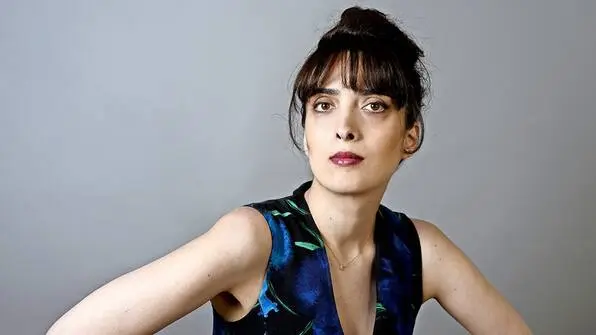
Dear Nana, where were you born and what did you study in university?
I was born in Tbilisi, which at the time was part of Soviet Georgia. I grew up in the capital with my mother and sister, and I started writing from an early age. I completed my studies at a journalism school in Tbilisi and later began studying philosophy. Shortly after, I moved to Germany and studied screenwriting and dramaturgy at a film school.
In the film My Happy Family, the character Manana repeatedly faces criticism from her family for not providing a clear reason for leaving home. This challenges the social expectation that women must justify their desire for independence. How did you explore this aspect of the narrative to highlight societal pressures on women and society’s inability to understand their yearning for autonomy?
There are two perspectives on this. One is what society expects from a woman, logical explanations, reasons, or even evidence to justify her right to seek independence. The other is the woman herself and her ability to connect with her inner voice. After experiencing systemic injustice, expressing one’s thoughts or acting independently can be extremely challenging. Many elements are at play here. I was interested in a character who has a deep yearning for freedom and pursues it, not in terms of accomplishments that society typically praises in women, but in the efforts of those who fight quietly and persistently.

How do the cultural and religious influences, particularly from the leader of the Georgian Orthodox Church, affect the lives of women in Georgia—especially in terms of social expectations that compel women to sacrifice their personal happiness for the well-being of the family?
Christian culture often portrays suffering as a noble path. In Christian teachings and traditions, suffering is often regarded as a meaningful or valuable experience. In our culture, many individuals are praised for self-sacrifice in pursuit of a greater goal. Georgian culture, in particular, imposes this expectation of selflessness on women: the mother must ensure her children’s well-being, and the woman must endure everything for the sake of the family. The Soviet era did not reduce these cultural traits; on the contrary, it halted progress in Georgia. During that time, women were encouraged to work, which led to the Soviet government establishing many kindergartens to facilitate this. However, encouraging women to join the workforce was not about supporting women’s rights but about increasing labor resources. As a result, discussions around women’s rights were largely absent for decades in this stagnant atmosphere.
In the many projects you’ve collaborated on with your husband Simon Groß, what is your working dynamic like in the directing process? How do you divide responsibilities and creative decisions in filmmaking?
This is a process that is challenging with anyone. You do it because your life is deeply intertwined with this person. Your life partner, a family member, a sibling, or perhaps a very close friend could be someone who can handle this kind of collaboration. We did everything together, from preparation and casting to shooting. During filming, we always saw eye to eye. We shot long takes and, before reshooting, often had the same perspective. Shared understanding, cinematic taste, and common values facilitated this partnership.
You’ve mentioned the importance of achieving natural and believable performances from your actors, including Shugliashvili in My Happy Family and the young female actors in In Bloom. What is your approach to casting, and how do you help actors authentically and powerfully portray their characters?
Casting is a vital part of the process. During casting, our goal is to understand all essential aspects of production. The connection and mutual understanding between filmmaker and actors take precedence over complete familiarity with the script and rehearsing every scene. Casting is about discovering the creative possibilities of the story alongside the actors and understanding the space in which they operate. This process is also a key step in achieving authentic performances.
The cinematography in My Happy Family drew much attention for its long takes and portrayal of real spaces. How did you and Simon Groß arrive at this visual approach? And how did other cinematic styles, especially Romanian cinema – as critics have noted—influence your decision?
Keeping the camera close to the characters was an essential part of our approach. The camera is positioned very close to the characters so that the audience doesn’t merely observe from afar but is immersed in their experiences. The story required this method. Using long takes enriches the presence and authenticity of the actors, allowing them to perform more freely and feel their emotions and actions more fully.
Shot-reverse-shot techniques, which typically involve cutting between two characters (often during a conversation), can disrupt the natural flow of a scene and the actors’ performances. In contrast, using a moving camera and long takes allows actors to perform more freely. New dimensions emerge—ones that can be seen on screen. Thus, long takes and close proximity of the camera give actors the freedom to fully inhabit their characters, without directors overly imposing their own vision, resulting in a livelier and more realistic portrayal.
We also asked ourselves: what kind of world do we want to depict cinematically? Long takes enable subtle, in-depth exploration of the social framework and the post-Soviet world—still unfamiliar to many outside the country, and even to us, though we know it well, but not cinematically. This strangeness affects the characters and underscores the need to portray the environmental background.
How is Georgia’s younger generation confronting gender stereotypes? Are many of them choosing to emigrate?
Right now, regardless of age, we’re fighting against a pro-Russian government and completely rigged elections to protect our country as a fledgling democracy. Women in particular long for justice and democracy. The outdated patriarchal mindset is often supported by the Church as well as by right-wing pro-Russian politicians. Femicide is frequent, and minority communities face discrimination. Recently, one of Georgia’s most successful transgender women, Kesarija Abramidze, was murdered by her partner just a day after the so-called anti-LGBTQ+ bill was passed. In such circumstances, more and more people are looking to leave the country.

Which books or films have had a deep impact on your outlook on life?
I read Kafka’s The Trial when I was a teenager, and it profoundly influenced my worldview. After reading it, I realized I could write about anything, any feeling, any confusion. Despite my limited experience, I felt I had enough to say. The Knight in the Panther’s Skin by Shota Rustaveli – the most important poem in Georgian literature – was part of our school curriculum and likely influenced me as well. But as I go through life, I discover how deeply the philosophy of that poem shapes my identity and awareness. Vazha-Pshavela, another Georgian poet and great 19th-century humanist, was also an inspiration. Georgian poetry has certainly shaped me.
In cinema, Italian Neorealism and the French New Wave were very influential. As a teenager, I watched Fellini’s La Strada and Truffaut’s The 400 Blows, they had a huge impact on me. Discovering the films of Yasujirō Ozu was also a powerful experience. My favorite Georgian director is Lana Gogoberidze, who, at 96, is still active in filmmaking and writing. My favorite film is Some Interviews on Personal Matters (1978).
How familiar are you with Iranian cinema? Which films have been your favorites?
Fortunately, thanks to directors like Asghar Farhadi, Jafar Panahi, and Mohammad Rasoulof, Iranian cinema still has a strong presence at major festivals. I love films like A Separation, Offside… and I especially love Abbas Kiarostami’s works, particularly Taste of Cherry.
Are you currently working on any projects or ideas that focus on women’s empowerment or social change?
At the moment, I’m writing my second novel, which also explores these themes. My next film is entirely focused on this topic as well.
Dear Nana, thank you so much for participating in this conversation.
Thank you!