



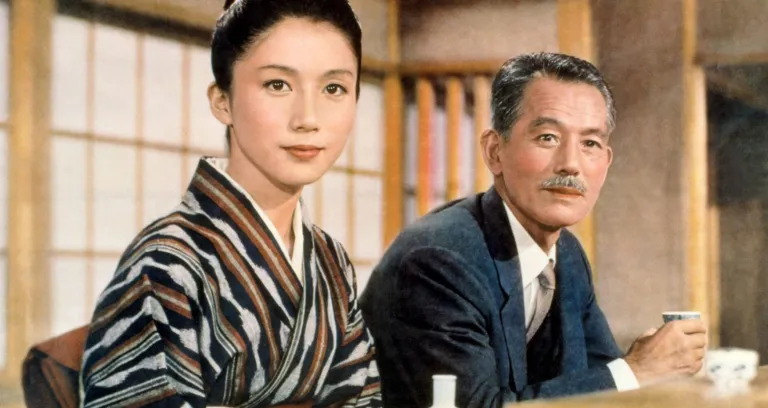
In cinema, “waiting” is usually a narrative concept. A character awaits the occurrence of an event, while the film holds the viewer in the interval between the present moment and that event. Waiting is, in fact, one of the principal devices of suspense: something has not yet happened, and by delaying its occurrence, the film turns time into a source of tension. The cinema of Yasujirō Ozu, however, stands almost in direct opposition to this narrative model.
Classical cinema uses “waiting” to raise questions. What is going to happen next? What is the character waiting for? Will the protagonist succeed and achieve their goal? Will the secret at the heart of the film be revealed? Will the protagonist manage to overcome the obstacles in their way? In classical cinema, waiting is a force that turns the future into the engine and driving force of the narrative. Ozu’s cinema, however, stands almost at the opposite end of this narrative spectrum. His films strip the future of its eventful, suspenseful, and thrilling charge, compelling viewers instead to attend to the present itself. “Waiting” is no longer simply a matter of waiting for what is to come; it becomes a condition of inhabiting the present.
Ozu’s cinema is fundamentally built on an aesthetics of time, stillness, patience, and “waiting.” Whereas Hollywood cinema emphasizes action and kinetic movement, in which one action directly triggers the next, Ozu focuses on the extended intervals in between. In his films, waiting is not a narrative engine or a driving force behind dramatic progression or suspense. Rather, it consists of moments of subtle change within the ordinary rhythms of everyday family life. An analysis of his formal techniques reveals how Ozu creates a distinctive temporal experience of waiting for the viewer.
In his quiet, secluded world, life unfolds at a measured pace. Through his simple, static mise-en-scène, we observe Japanese families eating, talking, and performing other social rituals. Within this world, the same stories are told again and again (Ozu even remade several of his early silent black-and-white classics as sound and color films). Major events, including deaths and marriages, often take place offscreen in his films or are omitted altogether. As a result, the minor dramas and emotional upheavals, when they finally come into view, acquire the force of a grand spectacle. When Setsuko Hara, Ozu’s iconic leading actress, asks near the end of Tokyo Story, “Isn’t life disappointing?”, the effect of the line is staggering and almost vertiginous.
In Ozu’s films, elements such as sliding doors and objects like vases and teapots function just as much as human characters do as points of orientation and compositional organization within the overall frame. Consequently, no character’s gaze or point of view is privileged over another’s. The characters are positioned within the frame as though gazing into the distance, beyond the camera itself. Although Ozu’s cinema is often described as “slow cinema,” his dramatic scenes unfold through rapid editing, while the dialogue is brisk, concise, and impactful. In his early films, Ozu’s camera was more mobile, and he made greater use of fade-outs, dissolves, wipes, and other optical effects. Gradually, however, he abandoned everything incompatible with the essential nature of his cinema, eliminating external flourishes until he arrived at a form of minimalism and purity of cinematic expression.
In his plots, Ozu avoids conventional dramatic crises and instead focuses on the passage of time in everyday and family life, such as a daughter leaving home to get married, as in Late Spring and An Autumn Afternoon. As a result, the overall narrative trajectory of his films is minimal and predictable. Time exerts a heavy, oppressive presence within the domestic space, reflecting the characters’ loneliness, concerns, and anxieties about the future. Formally, the stillness of the shots, particularly the use of tatami-level shots (with the camera positioned at a low angle), conveys to the viewer a sense of time passing heavily through the domestic space. Ozu consistently places his camera at the eye level of a Japanese person seated on a tatami mat. This fixed perspective, from the viewpoint of someone sitting down, places the viewer in a receptive state, attuned to the stillness that governs the film. We do not move actively through the film’s space; instead, like Ozu’s characters, we sit and wait for time to pass.
The static camera and delayed cuts are further formal characteristics of Ozu’s cinema. He rarely uses pans, tilts, or tracking shots. The camera remains completely still, lingering on spaces or faces longer than convention would normally allow. This mise-en-scène and rhythm create a temporal void. The viewer waits for a cut, a camera movement, or a character to move, but Ozu withholds these developments, compelling us to become conscious of the passing seconds.
Narrative ellipsis is another of Ozu’s formal devices. By omitting certain events or intervals of time, this technique sometimes shifts the viewer’s attention away from the action itself and toward the temporal and emotional effects of its absence. Major life events, such as weddings, funerals, and final farewells, often take place offscreen, beyond the viewer’s sight. Ozu builds an immense emotional sense of anticipation around a particular event, only to bypass it altogether. We experience only its aftermath, and in this way, the nature of waiting shifts from the event itself to its emotional reverberations.
Perhaps Ozu’s most famous formal device is the use of negative space, which often takes the form of what are known as “pillow shots.” These shots typically consist of images of exterior landscapes, architectural details, household objects and furnishings, or empty rooms that interrupt the flow of the narrative. When Ozu cuts to a corridor before a character enters it, or keeps the camera fixed on an empty room after a character has left, he creates a profound sense of waiting. The empty frame retains traces of someone’s previous presence while keeping the viewer in anticipation of someone else’s arrival. These shots detach time from human action, presenting it as an independent and seemingly eternal flow.
“Pillow shots” in Ozu’s cinema are not merely beautiful, decorative, or poetic images. Shots of trains, chimneys, corridors, rooms, skies, buildings, and everyday objects may appear superfluous and unnecessary, often occurring at moments when the narrative could have continued without them. Yet it is precisely their apparent lack of necessity that gives them their significance. Within the structure of Ozu’s cinema, they offer an alternative way of experiencing time. When a character leaves a room and the film lingers for a few moments on the empty space, the room ceases to be merely a location; it becomes a sign of the time during which the character was present and from which they are now absent. In Late Spring, after Noriko leaves the frame, the camera remains on the vase. If we interpret it merely as a metaphor for the feelings of the father or daughter, we miss the shot’s temporal experience. The vase remains in the same room that, only moments earlier, was occupied by the characters. What has changed is not the vase itself, but the temporal condition of the space. A presence has turned into an absence.
In many of Ozu’s films, the central event is clear to the viewer from the very beginning. In Late Autumn (1960), we know that Noriko’s marriage is the central concern; in Tokyo Story (1953), we know that the parents have traveled to Tokyo to visit their children; and in An Autumn Afternoon (1962), the question of Hirayama’s daughter’s marriage becomes apparent very early on. Ozu’s question, then, is not “What is going to happen?” but rather: “If something does happen, what effect will it have on the characters’ lives?” In this sense, waiting in Ozu’s cinema shifts from a narrative condition to an existential and psychological one.
One of the most important characteristics of Ozu’s cinema is that, in his films, the future is rarely concealed at the level of narrative.
The characters await the future, but in these films the future is not simply something lying ahead of them. It is already approaching in the present, and its arrival takes something away from the existing order of things. In Late Spring, it is clear from the outset that Noriko’s marriage will become the central concern of her and her father’s lives. Others speak of the necessity of her getting married, and gradually circumstances are arranged for her to leave home. Unlike classical romantic narratives, therefore, the film does not frame the matter as a mystery to be solved. The viewer does not wonder whether Noriko will get married. The central question is what this marriage will change in her relationship with her father.
Hirayama’s daughter’s marriage in An Autumn Afternoon marks the beginning of a new life for her, but simultaneously brings an end to a particular form of family life. The parents’ journey to Tokyo offers them an opportunity to visit their children, yet at the same time reveals that the family no longer exists in the same form as before. The death of a character, too, is not simply the end of a life; it marks the beginning of a different condition for those who remain.
Thus, waiting in Ozu’s cinema must be understood in relation to the question of everyday life. Woojeong Joo, author of The Cinema of Ozu Yasujiro: Histories of the Everyday, emphasizes that everyday life in Ozu’s cinema is neither an empty nor an ahistorical space. Rather, it is the realm in which social, historical, and generational changes become visible. According to Joo, everyday life becomes the subject of Ozu’s cinema precisely because change does not appear as an exceptional event; instead, it takes place within repetitions, daily habits, family relationships, and the ordinary arrangements of life (Joo, 2017, pp. 1–20).
Therefore, waiting in Ozu’s cinema cannot be understood simply as the characters waiting for a marriage, a journey, or a reunion. Rather, waiting is a quality of temporal experience: a moment in which an individual continues to inhabit their present circumstances while knowing that those circumstances will not last.
This perspective moves us away from one of the simplest clichés about Ozu: the idea that his films are merely slow or uneventful. Slowness in cinema does not necessarily result from the elimination of time; rather, it emerges when time is released from the demands of narrative and the continuous progression of dramatic action. In his analysis of Ozu’s cinema, Andrew Klevan demonstrates how shots that seemingly do not advance the story can play an essential role in organizing the narrative and altering our perception of human events. Transitional and landscape shots, for instance, place everyday events within a broader temporal horizon (Klevan, 2000, p. 144).
We can therefore ask: if waiting in Ozu’s cinema is not waiting for the story to progress or for an event to occur, what, then, are we waiting for? In my view, at its deepest level, waiting in Ozu’s cinema is waiting for time itself: waiting to see what the passage of time will do to relationships, homes, generations, and human lives. Late Spring may be the most appropriate starting point for understanding this question.
Noriko is an unmarried woman who lives with her father. From the early stages of the film, it is clear that those around them consider her marriage necessary, and gradually circumstances are arranged for her to leave home. The film, then, is not a mystery built around the question, “Will Noriko get married?”—not least because Noriko herself speaks about marriage in several conversations. The real issue is how this marriage will affect the relationship between her and her father.
In one of the film’s important scenes, Noriko says of marriage: “I want things to stay just as they are. I don’t want to go anywhere.” This line expresses the film’s temporal condition with remarkable clarity. Noriko’s desire is not to move toward the future, but to remain in the present. She does not want anything to change, because the present she shares with her father is enough for her. Her father’s response, however, runs directly counter to this wish. He tells Noriko that her life must enter another stage, and that happiness is not something we can simply wait for; it is something we must build in a new life. This conversation is significant because it shifts the film’s central concern from marriage to “time.” Noriko wants time to stop; her father knows that time cannot be stopped and that one cannot remain in the present forever.
Late Spring, therefore, is a film about the conflict between two experiences of time. For Noriko, the desirable form of time is one in which the present situation continues indefinitely. For her father, time follows a historical and generational order: his daughter must marry, leave home, and build a life of her own. Between these two perspectives lies a future that has not yet arrived but whose presence is already felt in the present.
This can be explained through Paul Schrader’s concept of “transcendental style,” particularly what he calls “stasis.” In Schrader’s model, stasis is the stage at which, following the accumulation of everyday contradictions and the occurrence of a decisive action, the film preserves those contradictions in a static, contemplative form rather than fully resolving them. For Schrader, the famous vase shot in Late Spring is not merely the depiction of an object in a room; it is an image that crystallizes conflicting emotions within a form of stillness (Schrader, 1972, pp. 49–51).
At the end of the film, after Noriko’s marriage and her father’s return home, Shūkichi is left alone, peeling an apple. The film then cuts to an image of ocean waves before coming to an end. The significance of this ending for our discussion of time and waiting lies in the fact that Noriko’s marriage, as the narrative’s decisive event, does not bring the experienced passage of time to an end. Even after this event, the film shows us a moment of the father’s solitude before finally arriving at the image of the waves. This image neither sets a new narrative consequence in motion nor resolves the preceding emotional contradiction. What matters, then, is no longer the marriage itself, but the time that continues beyond it.
Yet this is where one of the most significant disagreements between Schrader and other readings of Ozu’s cinema emerges. In Ozu’s Anti-Cinema, Kijū Yoshida distances himself from interpretations that associate Ozu’s cinema with transcendental or unifying meanings. In his analysis of the vase shot, the image’s significance lies not in its translatability into Noriko’s emotions or some transcendent meaning, but in the rupture it introduces into the flow of the scene. Yoshida argues that the sudden presentation of the vase compels the viewer to gaze at the image itself and search for its meaning. This interruption disrupts the usual process of identifying with Noriko and imagining her desires (Yoshida, 2003, p. 80).
This rupture is, in fact, the moment when the narrative is no longer the sole determinant of the viewer’s attention. Waiting here is not waiting for the next event, but remaining within the interval that the image opens up between the narrative and the viewer.
In terms of narrative waiting—that is, waiting for information to be revealed or an event to occur—the shot gives us nothing. The vase is not going to do anything. Nor are we going to receive any new information about the story. And yet the film is not over. The viewer is therefore placed in a condition that might be called “waiting without a promise”: waiting for something that is not necessarily going to arrive. This is an absurd form of waiting, reminiscent in certain respects of the waiting experienced by the characters in Beckett’s Waiting for Godot.
Gilles Deleuze, in his discussion of the “time-image,” situates Ozu in relation to the concept of “pure optical and sound situations.” According to Deleuze, Ozu’s cinema had already explored the possibilities of the time-image before it emerged more extensively in postwar cinema (Deleuze, 1989, pp. 13–16). Deleuze also writes about empty spaces in Ozu’s films, arguing that they acquire a certain autonomy in his cinema and are no longer merely by-products or marginal elements of narrative action (Deleuze, 1989, p. 13). He distinguishes between empty space and “still life,” identifying the shot of the vase in Late Spring as a particularly significant example of the latter (Deleuze, 1989, pp. 17–18).
The relevance of this discussion to the question of waiting in cinema lies in the fact that Deleuze does not understand time as something that merely takes place between two actions. When action comes to a halt, time can reveal itself. An image of a vase, an empty room, or a cityscape does not tell us what is going to happen; instead, it allows us to experience the passage of time, even when nothing happens. This is precisely where we can establish a connection between waiting and everyday life. In Ozu’s cinema, everyday life is not merely a backdrop against which events unfold; it is itself a bearer of time. Drinking tea, going to work, boarding a train, sitting at home, or talking about marriage are all forms of inhabiting time. From precisely this perspective, Woojeong Joo also examines everyday life in Ozu’s cinema in relation to Japanese social history and generational transformations (Joo, 2017, pp. 1–20).
For this reason, waiting in Late Spring is not simply waiting for Noriko to get married. The characters are experiencing a passage of time that transforms one form of life into another. Noriko wants things to remain “just as they are,” but time will not allow it.
If Late Spring is a film about waiting for separation, Tokyo Story expands this question from the relationship between a father and daughter to the relationship between generations. Shūkichi and Tomi Hirayama’s journey from Onomichi to Tokyo might initially seem like an opportunity for a family reunion. Gradually, however, the film reveals that the family can no longer reproduce the form it once had.
One of the film’s subtleties is that Ozu does not portray the children as monsters or cruel people. They are caught up in their own work and lives. The son, who is a doctor, and the daughter, who runs a hair salon, are each constrained by their own schedules. What creates distance between parents and children is not so much an absence of affection as an absence of shared time. The parents travel to Tokyo to spend time with their children, but the children no longer inhabit the same temporal world. This is what distinguishes the tragedy of Tokyo Story from a moral tale about ungrateful children. The question the film raises is not who is to blame. It is that the family’s shared experience of time has entered a state of crisis.
Life in this film is disappointing not because something catastrophic has happened, but because time reshapes what people “expect” in ways they could not have anticipated. The parents expected their children to spend more time with them. The children, too, probably did not expect their relationship with their parents to change so soon. Yet time, without anyone having made a conscious decision, has created this distance.
Consequently, waiting in Tokyo Story becomes waiting for something that can no longer return. In Tokyo, the parents are, in fact, searching for the family’s past. They want to experience family togetherness once again, but that togetherness no longer exists. In this way, waiting shifts from the future to the past. The character is no longer waiting for the future, but waiting for the return of something that time has taken away.
This structure is connected to the Japanese concept of mono no aware, usually translated into Persian as “an awareness of the impermanence of things” or “a gentle melancholy at the transience of the world.” The concept refers to an emotional and aesthetic sensitivity to the transience of existence, the impermanence of things, and the fleeting nature of life’s experiences and moments. It is a sensibility in which an awareness of decay and impermanence evokes not only sadness but also a deeper appreciation of the fleeting beauty of things.
In Late Spring, father and daughter are together, yet their very presence together signals their future separation. In Tokyo Story, the parents reunite with their children, but the reunion reveals that their relationship no longer exists as it once did. In An Autumn Afternoon, a father arranges his daughter’s marriage, yet the fulfillment of this arrangement leaves his home emptier than before. Waiting thus becomes a form of awareness of impermanence. What matters in Ozu’s films is the recognition that every situation is transient. The present, the moment it is experienced, is already exposed to the possibility of becoming the past.
This is why empty shots acquire particular significance in Ozu’s films. After a character leaves, the camera remains for a few moments in the empty room. After a train passes, the camera lingers on the tracks and the surrounding space. The image does not repeat what has happened; rather, it allows us to experience the temporal residue of that event.
According to Deleuze, Ozu’s filmmaking introduces seemingly “idle periods” from the very beginning, gradually increasing their number as the film unfolds (Deleuze, 1989, p. 14). The significance of these periods lies not merely in their function of surrounding an important action, or in their use of an extended shot, silence, or emptiness to emphasize the importance of another event. Deleuze explicitly challenges this interpretation. He also rejects the distinction between “the everyday” and “the moment of decision,” a distinction in which an exceptional moment appears to break the ordinary order of life. For Deleuze, even death and moments of intense emotion in Ozu’s cinema remain within the ordinary flow of life and are not granted a privileged status over supposedly insignificant periods. Thus, seemingly empty stretches of time should not be understood merely as pauses along the trajectory of dramatic action. They are part of a cinematic approach through which the very flow of life and cinematic time become experiences for the viewer.
Thus, in Deleuze’s reading, the point is not that everyday life comes first and is then disrupted by a major event. On the contrary, the everyday itself carries differences, changes, and time. This understanding also converges with Woojeong Joo’s historical reading of Ozu’s cinema. For Joo, everyday life is not something that stands in opposition to history; rather, history unfolds within the everyday.
This is demonstrated with remarkable completeness in An Autumn Afternoon. Hirayama, a widowed father who lives with his daughter Michiko, initially does not take the question of her marriage particularly seriously. But the story of an elderly man who has kept his daughter at home to look after him and now suffers from loneliness makes Hirayama confront his own future. His decision to arrange his daughter’s marriage is therefore, in effect, a decision about his own future.
One of the film’s key lines is spoken by Sakuma (Gōdō): “In the end, we spend our lives alone.” This sentence functions as a kind of premonition within the film’s structure. Hirayama tries to save his daughter from the fate that Gōdō has brought upon himself, but this very decision sets him on a path toward loneliness. Here, Ozu constructs an exceptionally subtle temporal structure. Hirayama takes steps to arrange his daughter’s marriage, yet the viewer knows from the outset that the fulfillment of this wish will mean the emptiness of his home. The future he wants for his daughter is simultaneously a future in which he himself will be alone. In this way, “waiting” for the future becomes indistinguishable from “waiting” for loss.
The film continues even after Michiko’s marriage. We do not see the bride and groom; the wedding ceremony itself is also omitted. What we see are its consequences. In the final scene, Hirayama is alone at home. His daughter’s marriage, which should resolve the narrative conflict, gives rise to a new problem: how is a father to come to terms with time and loneliness after his daughter marries and leaves home? Here, one of the most fundamental characteristics of Ozu’s cinema becomes apparent: the end of the narrative does not necessarily mean the end of “waiting.” Indeed, one could argue that in Ozu, the end of the narrative is often the moment when “waiting” assumes a new form. In An Autumn Afternoon and Late Spring, after the daughter’s marriage, “waiting” becomes the father’s loneliness. In Tokyo Story, after the mother’s death, “waiting” comes to mean the survivors’ continuation of life. Within this structure, the event is no longer the endpoint of time; it is merely the point at which time changes direction.
Therefore, in analyzing the concept of “waiting” in Ozu’s cinema, we must distinguish between two forms of “waiting.” The first is narrative waiting: both the character and the viewer await the occurrence of an event, and once it takes place, the suspense comes to an end. The second, which assumes greater significance in Ozu’s cinema, is temporal waiting: the character and the viewer remain in a state in which a change has not yet fully unfolded, or its consequences have not yet run their course. Ozu removes “waiting” from the domain of narrative suspense and transforms it into an experience of time, change, and loss. In his films, “waiting” remains connected to the future, but the future does not become the engine of dramatic suspense. Instead, it is present as an invisible pressure exerted upon the “now.” Noriko’s marriage has not yet taken place, but it already shapes the present. Michiko has not yet left, but Hirayama is already confronting the loneliness of his future. The mother’s death in Tokyo Story has not yet occurred, but the structure of family relationships is already undergoing a process of erosion. For this reason, Ozu’s cinema can be understood as a cinema of “waiting” for a change in circumstances, rather than one of “waiting” for an event to occur.
In this cinema, time is not something that simply moves from one event to another. It settles into objects, houses, trains, empty rooms, and the repetitions of everyday life. The vase that remains in the frame after Noriko’s departure in Late Spring is a clear example of this logic. Schrader associates it with stasis and transcendence; Yoshida emphasizes its narrative rupture; and Deleuze analyzes it within the framework of the time-image. These divergent interpretations demonstrate that the vase cannot be reduced to a single meaning. What the different readings of Ozu’s work share is their recognition of the importance of the moment in which the film asks us to remain. This act of remaining is the primary form of “waiting” in Ozu’s cinema. The viewer is not waiting for the vase to do something. They are not waiting for the train to reveal something. Nor are they waiting for the empty room to be filled again. They are simply exposed to a time that continues even after the action has ended. In this sense, despite its outward serenity, Ozu’s cinema is radical in its treatment of time. He pushes narrative so far into the background that time itself can become visible. What might appear as “dead time” in classical cinema becomes living time in Ozu’s films: a time in which loss, change, and transition are experienced not as exceptional events, but as part of everyday life.
The difference between Ozu and Tarkovsky is that Tarkovsky often gives time a theological dimension through memory, dreams, the past, and the future, whereas Ozu reveals time through the simplest movements of everyday life. In Tarkovsky, “waiting” may be connected to the possibility of salvation, faith, or transformation. In Ozu, however, it comes closer to an awareness of the fact that every state of affairs, even the most desirable, is temporary. Ozu’s characters are usually waiting for something to change. Yet the tragedy and beauty of his films lie in the fact that when change finally comes, they must live in a time that is no longer the same as the one they knew before.
Thus, “waiting” in Ozu’s cinema is not suspense between the present and a future event, but the experience of the interval between two states of life: an interval in which the present still exists, even as we already know that it will become the past. And perhaps this is why Ozu’s cinema asks us to wait for time to reveal itself.
© 2026. Phoenix Review