



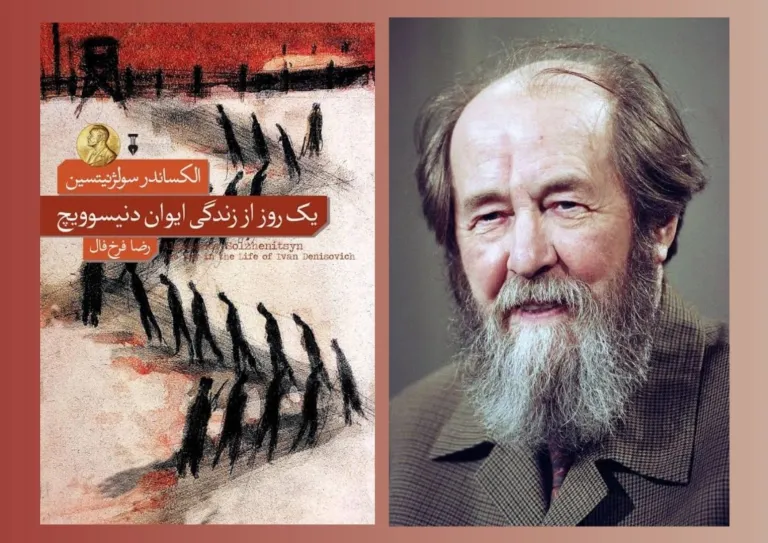
I read One Day in the Life of Ivan Denisovich in the very midst of the forty-day war. I had fled Tehran and, unemployed and penniless, taken refuge in Mehrshahr, Karaj. Every day was exactly like the one before it, something resembling Ivan Denisovich’s existence in a forced-labour camp.
At the time, I had jotted down a number of scattered notes. The text you are reading now is, in fact, an edited version of those handwritten pages. This essay may seem somewhat fragmented, perhaps even excessively reliant on the personal experience of its reader. Given that there is no shortage of academic literary criticism and analysis of this novel, I decided to retain these personal dimensions in my account.
In One Day in the Life of Ivan Denisovich, Aleksandr Solzhenitsyn recounts an entirely ordinary, unexceptional day in the life (if it can even be called a “life”) of a prisoner in a Soviet forced-labour camp. It is a day of relentless cold and exhaustion. For the protagonist, simply staying alive and finding ways to survive becomes a constant struggle. This is a novel about existence under inhuman conditions, where a hot meal, a piece of bread, or a few minutes of respite can amount to a victory.
Form and Life
I had a small, empty notebook. I had received it as a gift in the winter of 1404. On 11 Bahman, I wrote “11/11/04” on its cover with a marker, opened it, and wrote the same date on the first page. It was a Sunday. I began like this:
“They say millions of dollars have been wagered on our lives. That America is going to attack today. We have been waiting for a long time. There has still been no attack. A building in Bandar Abbas has exploded, and internet speeds have immediately been throttled. They say it was the home of so-and-so, a commander.”
Of course, at that point I had no idea that more than a month remained before the assassinations, or that twenty-eight days separated me from the beginning of the war between Iran, the United States, and Israel. I wrote in my notebook every day. Then the war began. From 9 Esfand, the first day of the war, until 13 Esfand, I wrote every day. And then came a break. A pause. All the days had begun to look alike. We had taken refuge in some corner, passing the night until morning, then getting up to find out who had been assassinated and who had not. In those days, attacks on infrastructure had not yet become a talking point, and Trump was still regarded as the saviour of the Iranian people.
As I write these words, it is the second day of a temporary ceasefire. A man is shouting slogans into a microphone, his voice clearly audible from my room. And, to be honest, although not much time has passed, I can no longer distinguish those repetitive days from one another with any precision. They were so much alike. Why should I have written down those long, repetitive hours of anxiety? They had no value. Or perhaps it would be more accurate to say that the account of those days of my life had no value as a narrative. After all, countless people experienced the most devastating events of their lives during those same days.
Despite its somewhat deceptive title, One Day in the Life of Ivan Denisovich is about a day much like those supposedly “narratively worthless” days of mine. This is no special day. There is no plot, no dramatic rise or fall, no singular or extraordinary event. Just like my own life in those days. Even Ivan Denisovich himself is neither a particularly distinctive nor an especially compelling character, much like me. Shukhov wakes up and does the things he has to do, keeps himself alive, goes to sleep, and waits for it all to be over.
The novel ends with these sentences:
“Three thousand six hundred and fifty-three days like this were to be his sentence from bell to bell. The three extra days were for leap years.”
And yes, the novel does not end with a decisive, forceful full stop on the final blank page of the book, but with an ellipsis. An ellipsis whose meaning I understand more deeply today than ever before. An endless, ambiguous state of suspense and waiting. A sentence without a verb.
Perhaps the only difference between me and Ivan Denisovich is that he knows how to keep himself going, how to endure, whereas I do not. He possesses a degree of agency, however inhuman and degrading its conditions may be. I, on the other hand, sit in my house, entirely devoid of agency, with no guarantee that I will not simply die by sheer chance.
Cold, Watered-Down Soup, and Systematic Dehumanisation
If we were to sum up One Day in the Life of Ivan Denisovich in a single phrase, we could say that it is a novel about “dehumanisation” as a means of control. In order to dominate another person and do whatever one wishes to them, the first step is to strip them of their humanity. This is why, in the novel, the guards do not address the prisoners by their names but instead read out the identification numbers printed on their uniforms. They have been stripped of their humanity and identity, or at least this is what the camp seeks to accomplish in order to control them. (Your skin is darker than mine, therefore I am more human than you, and I have the right to dominate you—and all the other variations of this logic with which we are so familiar.)
If we consider the unheroic Shukhov the protagonist of Solzhenitsyn’s novel, then its antagonistic forces are ordinary, largely indistinguishable, and collective in nature. These forces can be listed as follows: the cold, food, the guards, and certain fellow prisoners. The protagonist’s objective is nothing more than to contend with these forces, stay alive, and get through his days in the camp. This survival is hardly oriented towards the future. Rather, it is an everyday struggle. Our unheroic protagonist is not trying to save the world or defuse some enormous bomb. He simply wants to endure for one more day. To get an extra bowl of watery soup, one more cigarette, and, at the same time, to keep a little more of the cold from seeping through the hole in his boot and reaching his toes.
These desires are mundane and degradingly basic. Yet what matters in the novel is how he manages to fulfil them. Although Shukhov depends on the goodwill of others, he never begs. In fact, he has come to accept a certain minimal degree of dehumanisation, and all his efforts are directed towards preventing himself from being dehumanised any further. At one point in the novel, Shukhov recalls that he once used to feed his horse the very same kind of gruel he now eats and longs for. Now he has fallen even lower than that horse. But he continues to struggle. To put it humorously, and using a familiar colloquial expression, Shukhov is trying to remain at least at the level of a “horse” rather than sink into sheer “donkeyhood”!
Perhaps the character who stands in direct opposition to him in this respect is Fetyukov. Unlike Shukhov, Fetyukov had actually been something of a big shot before the Gulag. Now, however, the camp has reduced him to picking cigarette butts out of other prisoners’ phlegm just to salvage whatever tobacco remains unburnt. As the narrator also observes, he will collapse long before the others.
It is almost as though it is not hunger, cold, or illness that kills the people in the camp—as Shukhov initially feels sick but is perfectly well by the end of the day—but rather dehumanisation itself that wears them down. In a forced-labour camp, the sooner you lose your humanity, the sooner you die.
Of course, the camp has apparently provided other ways of escaping dehumanisation, too. Shukhov could have become an informer, greasing other people’s palms to get what he wanted, but he never does so. He earns his bread through his own labour and receives his full four-hundred-gram ration. He looks out for others, and when the time comes, they return the favour. He works not only to resist the dehumanising antagonistic forces and escape the cold, but also to give meaning to his suffering. A profoundly earthly meaning, grounded in humanity rather than in heaven.
Why Don’t You Pray to God, Ivan Denisovich?
I read this novel after finishing Job, by Joseph Roth. While reading Roth, I found myself constantly grappling with the conflict between evil and divine justice. Yet this question seems to resurface in Solzhenitsyn’s novel as well, albeit less prominently than in Job, emerging quietly here and there, almost in passing.
In the novel’s final pages, after the prisoners have been counted, Shukhov returns to “home” (the camp barracks) to go to sleep. There, Alyosha asks him why he does not pray to God. A simple, rather unsophisticated exchange unfolds between the uneducated Shukhov and the devout Alyosha. Eventually, Shukhov explains why he does not pray:
“Because those prayers are like lodging complaints with the authorities. Either nobody hears them, or, if they do, they tell you your complaint is unjustified.”
On the following page, he also tells Alyosha that he does not believe in heaven or hell—the embodiments of divine justice. In effect, here the ordinary, uneducated Shukhov simultaneously questions both divine justice and political justice. In the face of what we might call natural evil, one can at least devise ways of protecting oneself. We can build levees to hold back floods and construct stronger, more resilient buildings to withstand earthquakes. But unnatural evil is far more inhuman and terrifying, and Shukhov, despite his lack of education, seems to understand this all too well.
Poetry After Auschwitz
One of the most interesting characters in the novel is Caesar, a wealthy Muscovite whose world revolves around Eisenstein’s cinema and the latest theatrical productions in Moscow. He is a highly knowledgeable man, yet, in Shukhov’s eyes, he “knows nothing about real life.” His body is in the camp, but his mind remains in Moscow’s theatres. If we were to remove this character from the novel, or transfer his function in relation to Shukhov—the protagonist—to someone else (after all, Caesar gives him food and helps him contend more effectively with the antagonistic forces surrounding him), the novel would lose very little.
Solzhenitsyn is no longer alive, and even if he were, it would seem rather pointless to approach him and ask why he created Caesar and included him in the novel. I prefer to answer this question in my own way: I believe Solzhenitsyn created this character as a response to his critics, whom he knew would reproach him for writing a novel with neither a plot nor any real appeal, a work consisting entirely of boredom and monotony. It is not even an explicit denunciation of Stalinism of the kind that might have earned applause from critics of the regime.
Throughout this essay, I have tried to demonstrate the subtleties and nuances of Solzhenitsyn’s novel. Yet the answer he offers directly within the text itself can be found in a debate between Caesar and another prisoner. Addressing Caesar, who is defending Eisenstein, the prisoner says:
“Stop calling him a genius! He was just someone who went along with the prevailing winds. A true artist doesn’t compromise the value of his work to please tyrants.”
Caesar responds by arguing that, in art, it is not what is presented that matters, but how it is presented. The prisoner’s reply to Caesar is precisely the response Solzhenitsyn might have given to his hypothetical critic:
“No! If it can’t stir the right feelings in me, to hell with its how!”
A Human Comedy in the Gulag
Ultimately, we can ask one final question and bring this essay to a close: Were we reading a tragedy or a comedy? At first glance, this might seem like an insignificant question. One could simply respond: What difference does it make? Call it whatever you like. But it does make a difference.
The novel, from beginning to end, is nothing but misery, dehumanisation, and the struggle to resist both. On the surface, we are dealing with a tragedy: the erosion of humanity (I am not concerned here with the academic definitions of dramatic genres). But if we compare the beginning of Ivan Denisovich’s day with its ending, we find ourselves facing a comedy—a novel with a happy ending.
At the beginning, Shukhov is hungry and ill. He has absolutely no desire to get out of bed and go anywhere. He has no hope and feels utterly broken. By the end, however, things have changed. He is no longer cold. He feels perfectly healthy. He has managed to get several extra portions of food. He has smoked some good cigarettes and helped the other members of his work gang. He has even managed to get hold of some sausage. Now he calmly slips his legs beneath the blanket and, in the torpor of the night, closes his eyes.
He is no hero. He has no intention of rebelling. Nor is he particularly eloquent, and he will not put himself in danger for nothing. But he is hopeful. He tries, little by little, to endure the dehumanising forces around him without losing himself. Perhaps he does so unconsciously, instinctively. And he succeeds. One might even argue that what we have here is a novel with a happy ending: a human comedy in the Gulag.
© 2026. Phoenix Review