



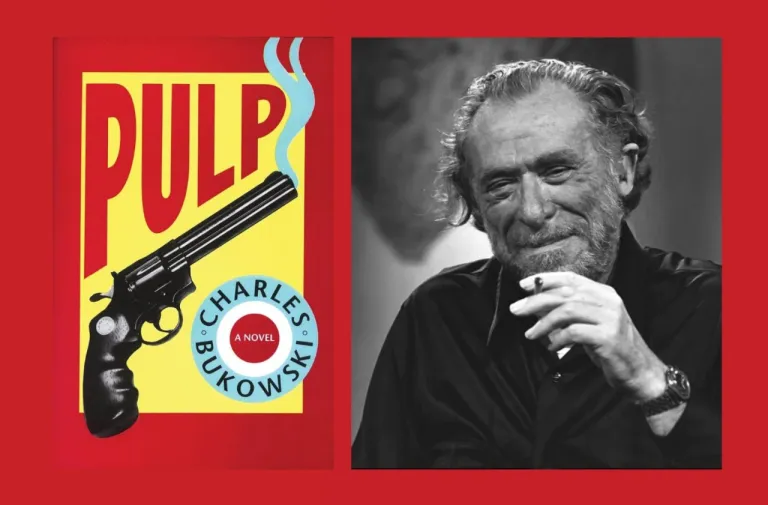
I reread Bukowski’s swan song, Pulp, immediately after reading Mario Vargas Llosa’s The Time of the Hero, and this is the central idea behind this essay: what kind of experience is it to read Bukowski’s final novel after reading Llosa’s first? Does comparing the two lead us anywhere at all?
I had previously read the butchered version published by Cheshmeh. It was anything but a novel written by Bukowski. This time, I read the novel in a translation that has been circulating freely on the internet. We do not know the translator, but for greater security, they have chosen the pseudonym “Arash Yeganeh.”
Holding Water in the Palm of Your Hand
Pulp is a novel Bukowski was halfway through writing when he discovered that he had leukemia and was going to die. We can never know what kind of psychological state Bukowski was in while writing it. Of course, we can make educated guesses, as his most devoted fans have done. Some have interpreted the red sparrow as a symbol of Black Sparrow Press, which published Bukowski’s work; others have speculated about the presence of John Fante and Céline in the novel and discussed Bukowski’s indebtedness to these two writers. I will not repeat those arguments here.
In any case, Bukowski cannot be separated from his state of mind or his lived experience, just as we cannot read him independently of our own mental horizons. As I mentioned at the beginning, I read this novel immediately after The Time of the Hero—a more accurate translation of the English title of Vargas Llosa’s La ciudad y los perros (literally, The City and the Dogs).
Reading Llosa’s novel was like looking at a solid, imposing sculpture full of intricate details. You had to keep examining this beautifully carved sculpture from different angles to appreciate Llosa’s craftsmanship. But the metaphor I want to use for the experience of reading Pulp is holding water in the palm of your hand.
Imagine you are standing in a queue. Suddenly, the person in front of you turns around and says, “Cup your hands!” You do as you are told. They bring over some water (hopefully, it really is water!) and pour it into your cupped palms before leaving the queue. You are left holding this shapeless liquid. Formless. Structureless. If you open your hands even slightly, the shapeless liquid slips through and spills away.
In that sculpture—in Llosa’s novel—everything was organically and meaningfully connected. Everything revolved around a central force. The novel had several narrators and multiple themes, yet it remained cohesive. Pulp, however, is not like that. Its primary force derives not from a gravitational core that holds every narrative element in orbit around itself like a sun, but from a kind of fragmentation, decay, and disintegration. And this decay is entirely deliberate.
Everything in Pulp is falling apart. Nothing has a definitive meaning. If we removed Bukowski’s name and biography and handed the novel to his most devoted fans, they would struggle to find a reason for the presence of many of its elements in the story (although, of course, you can always invent a reason for anything).
For instance, if we removed the entire Céline episode from the novel, how much would its plot structure actually suffer? You might say that the novel would never get started in the first place. But the point is that any reader could propose alternatives for beginning this disjointed novel—whose disjointedness is an intrinsic quality—and it seems that doing so would cause little damage to its structure, assuming it has a structure at all. At least, that is my belief.
It is as if you have taken a sip of the water in your cupped hands. When you look at the liquid again, nothing seems to have changed. It remains the same shapeless, transparent, slippery, unstable substance it was before.
Now imagine removing the character of Boa from The Time of the Hero. It would be like taking a small hammer to that magnificent sculpture and chipping away one of its corners.
My aim is not to claim that one novel is better than the other or to make any kind of value judgment. I want to explore the difference between the two in terms of their artistic sensibilities and the kinds of effects they produce. The difference between them is much like the difference between their authors. Can you imagine Bukowski running for president of the United States, for instance? I certainly can’t.
The Search for the Red Sparrow and the Holy Grail
One of my favorite passages in the novel is the moment when Detective Belane, its antiheroic protagonist, has all but given up hope of finding the red sparrow. As usual, he is drunk and helpless, sitting in a bar somewhere between “space and death.” He has no idea what to do. He does not even know what the hell he is doing there. The narrator asks himself: “Why couldn’t I just be a regular guy who sat around watching baseball and cared about the score?”
I think we sometimes sit around like Belane, asking ourselves the same kinds of questions. We search for our own red sparrow, our own truth. We devote the rest of our lives to finding this truth without ever being certain that it exists outside our minds.
Sometimes, too, when we are alone with ourselves in the depths of despair and misery, purveyors of false hope appear on the scene. They claim they can hand us the truth, and they exploit us in return—emotionally, temporally, financially, and physically.
Bukowski has no idea of liberation to offer. Perhaps this is also his greatest difference from the idealistic Llosa. For Llosa, literature is fire. Literature is rebellion against the status quo. In his essay “Why Literature?”, he argues that literature has nothing to offer those who have made their peace with the existing order. Bukowski, by contrast, has said and demonstrated the opposite. In a way, Bukowski seems to be saying that the only truth, the only red sparrow, is death itself.
The Semantic Structure of the Detective Novel
What, ultimately, does the detective novel mean?
I remember once asking this question of the first professor who taught me literary criticism during my master’s degree. At the time, I was deeply immersed in Arthur Conan Doyle and his extraordinary Sherlock Holmes, but something inside me kept asking: What is the point of reading these novels?
I know the answer now, but back then, when I did not, I received no satisfactory response. My professor told me that literature was what it was; if I was unhappy with it, I should go back to studying mechanical engineering. He was a diligent man, though not particularly intelligent.
The detective novel is a product of the Enlightenment’s faith in reason and its optimism about human rationality. At its deepest and most fundamental level, its structure rests on a certain faith in human “justice” and “reason.”
An exceptionally intelligent murderer has violated justice and committed a crime. His psychological motives are irrelevant. He has disrupted human society and the existing order, and he deserves punishment. Unfortunately, the ordinary police are unable to catch the criminal, or they have identified the wrong person, thereby compounding the injustice. But somewhere in the city there is a detective endowed with extraordinary, almost divine intelligence and insight. He arrives. He makes his appearance. The savior of all the suffering and wronged emerges, restores order and justice through a thoroughly scientific, mathematical, orderly process of deduction—two plus two equals four, the very ideals of the Enlightenment—and then retreats to his solitary den.
Now, wouldn’t it be absurd for an American writer in the late twentieth century, after the experience of two world wars, to write a detective novel?
By the late twentieth century, the detective novel had become a debased and “used-up” form, one that, in John Barth’s words, had reached a state of exhaustion and saturation. Its underlying assumptions had also come under serious suspicion. After Hiroshima and the concentration camps, who could remain so optimistic about Enlightenment reason?
For years, people had been looking at the philosophical foundations of the Enlightenment with skepticism, sometimes even derision. So in their detective novels, there would be no logic, no rationality, and no justice.
Bukowski’s Pulp works in much the same way. It is akin to Richard Brautigan’s Dreaming of Babylon or Friedrich Dürrenmatt’s The Pledge, whose subtitle is Requiem for the Detective Novel.
© 2026. Phoenix Review