



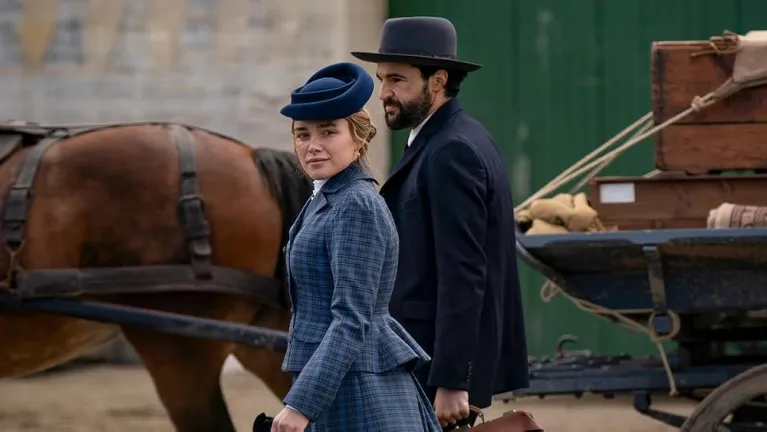
The history of cinema and literature has always been a battleground for unconscious struggles among myth, original sin, and ancient archetypal complexes. Yet the new television adaptation of John Steinbeck’s monumental novel, East of Eden (2026), is more than a straightforward literary reimagining. It is a site where trauma, the familial Oedipus complex, and a historical confrontation between two opposing visual perspectives converge. At the helm of the project is Zoë Kazan, a screenwriter and playwright who is the granddaughter of Elia Kazan, the towering figure of classical cinema who, in 1955, made a brilliant adaptation of the novel and introduced James Dean to audiences, creating one of the most enduring portraits of rebellion and castration anxiety in Hollywood history. What transforms this new work into a formal and psychoanalytic statement, however, is the granddaughter’s bold confrontation with her grandfather. If Elia Kazan’s 1955 film was a manifesto of the established “male gaze,” affirming the Name-of-the-Father and the sons’ need for validation from patriarchal law, Zoë Kazan’s series makes a radical turn toward the “female gaze,” a genealogy of the repressed maternal, and a return to the neglected roots of Steinbeck’s novel as a whole.
To understand the psychoanalytic structure of the series, we must first examine the novel’s mythological and theological references and their connection to Freudian and Lacanian psychoanalysis. Steinbeck builds his story around the foundational allegory of Genesis: the tale of Cain and Abel east of Eden. Within this symbolic universe, the father, Adam Trask, embodies Yahweh himself, or what Jacques Lacan’s theory calls the “Name-of-the-Father”: an impenetrable law, an immaculate judge, and the symbolic arbiter of good and evil. The two brothers, Cal and Aron, in turn, recapitulate the biblical dyad of Cain and Abel: one brother whose offering is accepted, and another whose desire and yearning to be seen are rejected by the father. In Elia Kazan’s interpretation, the entire weight of the tragedy rested on the shoulders of the rejected son, Cal, played by James Dean, and his Oedipal traumas. The 1955 film was a masculine lament for a son whose gift had been refused by a cold, moralistic father. Cathy, the mother, was reduced in Elia Kazan’s film to a passive monster, an embodiment of absolute evil and demonic prostitution who had to be removed from the frame lest the purity of the masculine domain be contaminated. Elia Kazan adapted only the second half of the novel, cutting the entire prehistory of the preceding generation from the frame. Zoë Kazan, however, rightly understands that the psychosis of the present cannot be comprehended without dissecting the genealogy of the past. Steinbeck had first established the compulsive repetition of fate through the relationship between the two brothers of the previous generation, Adam and Charles. Charles, the violent, isolated, rejected brother who bore the mark of Cain on his forehead, lived in the shadow of paternal discrimination and remained trapped in that same condition until the end of his life. The roots of guilt and hereditary suspicion begin here, feeding the dark secret that hangs over the twins, Cal and Aron: the poisonous suspicion that they were conceived not by the immaculate Adam, but through Cathy’s secret sexual encounter with Charles. By restoring this genealogy, Zoë Kazan reveals how the Cain-and-Abel complex is not an isolated event but a hereditary cycle of blood, jealousy, rejection, and guilt passed from one generation to the next.
In this reinterpretation, Zoë Kazan shifts the dramatic center away from the brothers’ struggle to capture their father’s gaze and toward the dark, repressed void of the “mother.” Cathy is no longer simply an evil woman without motives or a depraved monster. She is the archetype of Lilith, the mythical first woman who refused to submit to Adam, fled the Garden of Eden, and sought refuge in the realm of demons in order to preserve her subjectivity and bodily freedom. Through the female gaze, Zoë Kazan frees Cathy from the labels of hysterical woman and sinful prostitute, dissecting her instead as a traumatized subject whose belief in the authenticity of evil and depravity is both profound and terrifying. Cathy’s logic of survival is naked, sadistic, and preemptive: “Hurt them before they hurt you.” She sees the world as a den of wolves and builds a defensive wall around her fragile psyche by violating the boundaries of others, determined not to become prey to the laws of men. In her eyes, motherhood is not an “obvious natural condition” but a field of terror, threatening engulfment and the erasure of identity. During pregnancy, she saw her body not as a temple for the birth of a new generation, but as a cage in which she was being possessed by something alien. In her scene composition and choice of lenses, Zoë Kazan replaces the accusatory distancing employed by her grandfather with extreme close-ups and subjective angles that register Cathy’s fear of dissolving into the symbolic order: a woman whose shooting of her husband and abandonment of the twins in their cribs constitute the terrible price she pays to escape enslavement in Adam’s artificial paradise.
This existential dread of reality drives Cathy toward a world of fantasy and metaphor. In private, she invokes Lewis Carroll’s Alice’s Adventures in Wonderland: the obsessive desire to become smaller, descend into the rabbit hole, and escape the suffocating discipline imposed by the adult world. This metaphor is intertwined with her debilitating morphine addiction, a drug whose name derives directly from Morpheus, the ancient Greek god of sleep and dreams. For Cathy, morphine is not merely a means of relieving the physical pain in her hands; it is Alice’s shrinking potion, a means of disappearing into the fog of oblivion and escaping the nightmares of waking life. The tragedy reaches its climax in Cathy’s suicide scene. In the final moments of her life, before sinking into eternal sleep, she embraces the wounded child within herself with a melancholic tenderness. This final embrace is a return to an untouched innocence that existed before the violent intrusion of the masculine world: an injured child who put on the mask of a monster to protect herself and who, on the threshold of death, seeks refuge only in her own small, defenseless body.
Cal’s journey to find this mother in a Salinas brothel is no longer merely an act of curiosity. It becomes a Jungian encounter with the shadow, a meeting with the “terrible mother” whose place in his psyche he must reckon with before entering adulthood. Cal and Cathy’s confrontation in the half-dark rooms is an encounter between two wounds: a son who believes himself to be the fruit of sin, and a mother who sees in him a mirror reflecting the pain of her past. In these scenes, the female gaze refuses to reduce the brothel to a tableau of masculine debauchery or a site for the humiliation of women. Cathy’s brothel is a liminal realm in which women, by controlling their capital and their bodies, have wrested a measure of independence from the grasp of hypocritical masters.
At the opposite pole of this familial geometry, Zoë Kazan transforms one of the great absences from her grandfather’s film into the work’s moral and philosophical center: Lee, the wise Chinese servant. As Adam retreats into a deathly isolation after Cathy’s escape, Lee assumes the dual role of mother and father to the twins. Beneath the guise of a simple laborer, and through his playful subversion of racial stereotypes, Lee becomes the silent psychoanalyst of the household. His profound, unsentimental understanding of the human psyche is reflected in this striking observation: “The most honorable man I know has lived his entire life on stolen money.” With this barb, Lee dismantles Adam’s rigid morality and false moral purity, reminding us that genuine humanity emerges from the complexities of action, not from the inflexible dictates of sacred books.
It is from this same Eastern wisdom that the Hebrew keyword timshel emerges. By studying the word’s etymology alongside elderly scholars, Lee demonstrates that God’s address to Cain in Genesis means neither “Thou shalt rule” (moral determinism) nor “Thou wilt rule” (fatalism), but rather “Thou mayest rule.” Timshel is a declaration of liberation from the compulsive repetition of trauma: an affirmation that human free will can interrupt the bloody cycle of inherited guilt, from Charles’s suffering and Cathy’s flight to Cain’s resentment.
This possibility of overcoming is embodied most fully in Abra. In the 1955 film, Abra was merely the object of desire between two brothers and a submissive woman. Zoë Kazan, however, transforms her into a figure of consciousness and visual agency. Abra is the first to recognize Aron’s rigid hypocrisy and Cal’s wounded innocence. Through her distinctly female perception, she persuades Cal that he does not need to reproduce his father’s idealized image in order to be authentic. The bond between Abra and Cal redefines eros as a healing force and a reconciliation with the darkness within.
The series’ visual form completes this transformation. Whereas Elia Kazan’s CinemaScope frames, Dutch angles, and harsh lighting sought to capture the hysterical turmoil of the male protagonist, Zoë Kazan’s camera is patient, organic, and attuned to the textures of earth, wind, and skin. It seeks to register the material reality of suffering within the Salinas Valley.
Zoë Kazan’s East of Eden is a historical response to her grandfather’s film. It demonstrates that history can be reread not through the tears and rebellions of sons, but through an understanding of mothers’ suffering, the wisdom of marginalized servants, and the courage of young women who shatter outdated patterns. The return to east of Eden in 2026 is not an elegy for the death of innocence, but a triumph of timshel over historical determinism: a moment in which human beings stand at the edge of the abyss of sin and choose to rewrite their own destiny.
© 2026. Phoenix Review