



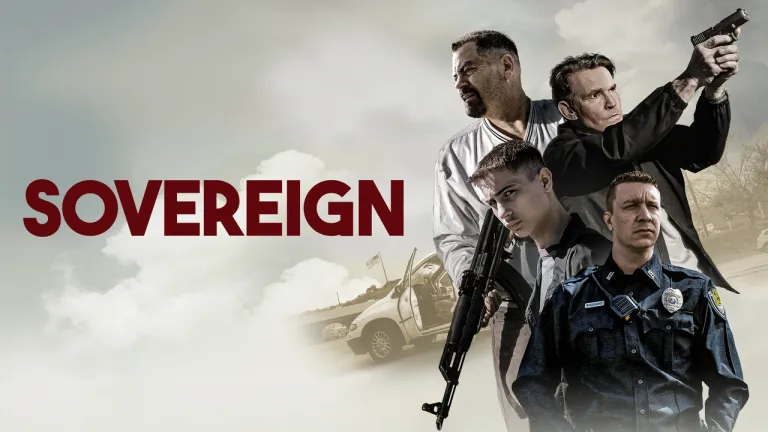
More than simply a crime thriller about the Sovereign Citizen Movement, Christian Swegal’s Sovereign is a bleak study of how ideology is passed down from father to son. While addressing citizens’ distrust of the government, economic crisis, and a sense of social abandonment, the film shows how resistance to structures of power can become a new instrument of domination within the family. The Sovereign Citizen Movement, which lies at the heart of the film, is a decentralized and heterogeneous anti-government movement in the United States. Its adherents believe that the federal government and official institutions—from courts and the tax system to the police and motor vehicle departments—have no lawful authority over them. They therefore consider themselves exempt from paying taxes, complying with certain government regulations, accepting court rulings, or presenting official identification documents. They regard themselves as separate from the state and “sovereign over their own destinies,” rejecting the legitimacy of modern governmental institutions. According to the movement’s adherents, there are two types of citizens: “sovereign” or “original state citizens,” who enjoy the full protections of the Constitution, and “federal citizens,” who have traded away their freedom by accepting services such as a national identification number or Social Security number. Followers of the movement attempt to regain their sovereign status by revoking their official documents.
According to reports by the FBI, some violent branches of the movement are classified as a domestic terrorist threat. The movement’s early roots are deeply intertwined with white supremacist and antisemitic beliefs. Its adherents maintained that the highest level of lawful authority in the country resided in local county sheriffs, while the federal government was an illegitimate usurper. The movement’s ideological origins can be traced to tax-protest movements of the 1960s and, in particular, to Posse Comitatus, an extremist, racist, far-right group led by William Potter Gale in the 1970s. Drawing on pseudo-legal interpretations, the group privileged “common law” and the authority of county sheriffs over federal law; some of its branches were also associated with antisemitism, white supremacy, and Christian Identity ideology. Although the movement has neither a central organization nor a unified structure, in recent decades it has increasingly overlapped with militia movements, anti-government conservatism, gun culture, and sections of the American far right. Nevertheless, not all its supporters necessarily belong to far-right groups or endorse violence and armed action. Its significance in contemporary America stems from the way distrust of government, economic crisis, anger at the judicial system, and a sense of political disenfranchisement can, in today’s polarized climate, give rise to conspiracy theories and extreme forms of political individualism. For this reason, Sovereign portrays the movement not merely as a collection of bizarre legal claims, but as part of the longer history of the American anti-government right and a symptom of the erosion of public trust in democratic institutions.
Christian Swegal’s feature-length directorial debut, which he also wrote, is based on the true story of Jerry and Joseph Kane, a father and son who shot police officers in West Memphis in 2010. Promoting sovereign-citizen theories and organizing legal seminars and meetings, the two men come into conflict with banks, the police, and the government, ultimately meeting a tragic fate. Jerry Kane, played by Nick Offerman, is a law-defying man who sees himself as existing outside the jurisdiction of official authority. He believes that a particular interpretation of the Constitution allows him to refuse to pay debts, provide vehicle documentation, or recognize the jurisdiction of the courts. The film’s significance, however, lies not in the information it provides about the movement, but in showing how an ideological framework infiltrates everyday life and family relationships, shaping a teenager’s perception of the world. Jerry sees himself as an enemy of state authority, yet gradually reproduces that same authoritarian logic in his relationship with his son, Joe. In this sense, Sovereign is not about civil liberty, but about the transformation of freedom into a closed system of blind obedience.
From the outset, the film does not portray Jerry simply as a madman or a criminal. He is a widower, unemployed and angry, who has transformed his experience of economic failure and distrust of official institutions into a coherent ideological system. He is informed that he has thirty days to repay his debt to the bank or face eviction from his home. This detail allows viewers, at least in the early stages, to understand the psychological and social roots of his behavior. At his meetings and seminars, Jerry speaks to people struggling with debt, foreclosure, and economic insecurity. These people are not necessarily fanatical followers of a political cult; many are ordinary citizens who feel that no official institution is responding to their problems. In this respect, the film examines radicalism not as something wholly alien, but as a product of a vacuum of trust and social despair.
Yet while Sovereign empathizes with the roots of discontent, it also distinguishes between social grievance and ideological violence. At a certain point, Jerry is no longer merely a critic of the government; he comes to believe that he alone possesses the truth. This logic of exclusivity makes his theory immune to any external reality: if the police enforce the law, they are corrupt; if the bank sends a warning, it is attempting to steal what belongs to him; and if his son wants to attend school, he is falling under the influence of “the system.” The scenes involving bank notices, particularly those in which Jerry evades actually receiving or acknowledging them, exemplify this logic. Through verbal games and a formalistic, highly personal interpretation of civil rights, he attempts to undermine the prevailing order and governmental system. These scenes reveal how legal language, ostensibly employed to defend freedom, can become a tool for escaping reality. The house Jerry is trying to defend is, in effect, an image of his own mind: a dilapidated structure on the verge of collapse, riddled with cracks that he tries to conceal with words.
Although Jerry is the film’s more prominent and theatrical character, its emotional center is Joe, a boy forced to choose between his love for his father and his desire for intellectual independence. He is a teenager who witnesses his father’s anger and humiliation at the hands of law enforcement officials and responds to what he sees. At first, Joe is largely a listener and an observer, with little agency of his own. Gradually, however, he changes, finding himself in conflict with both his father’s authority and the authority of the law. Having lost his mother, Joe lives with his father and follows his instructions and teachings. He attends Jerry’s meetings and speeches, repeating his father’s words. To Joe, Jerry is a powerful man, an embodiment of authority. Yet his silences do not necessarily indicate obedience or complete acceptance of his father’s ideas. He continually oscillates between admiration, fear, and confusion. He loves his father, but he is also afraid of his unpredictable future. Jerry tells his son to be independent, but his definition of independence requires Joe to believe precisely what he himself believes.
Still from Sovereign
Joe’s request to attend public school is one of the film’s turning points. The desire seems simple, even typical of a teenager, but to Jerry it carries ideological significance. For Joe, school offers the possibility of experiencing the social world, encountering different kinds of people, and building an independent identity. For Jerry, however, it is an institution intent on taking possession of his son’s mind. Jerry’s angry reaction reveals how his opposition to state authority has become absolute authority within his own home. He insists that Joe must not allow others to brainwash him, even as he is doing precisely that himself. A fundamental conflict thus emerges between Jerry’s wishes and those of his son. Jerry claims to be teaching Joe freedom and independence, but in practice he deprives him of every opportunity to choose for himself. Homeschooling, shared road trips, and attendance at public speeches initially appear to signify a close and intimate father-son relationship. Gradually, however, it becomes clear that this unconditional companionship has led to Joe’s complete isolation. Joe is free only so long as he remains within the confines of his father’s worldview and control.
One of the film’s narrative devices is the creation of a parallel between Jerry Kane’s family and that of the town’s police chief. On one side are Jerry and Joe, a father and son who regard the law as an instrument of oppression. On the other are John Bouchart, played by Dennis Quaid, the police chief, and his son Adam, a family that represents lawful authority. This parallel allows the film to avoid reducing the conflict to a simple opposition between criminal and police officer. Both families are structured around a vertical relationship between father and son, and both sons define themselves in the shadow of their fathers’ identities. Yet the film rightly shows that these two forms of authority are not equivalent. Bouchart’s authority is at least connected to a public institution and a body of official rules, whereas Jerry’s is personal, emotional, and entirely beyond oversight. Within his own home, Jerry can change the rules at will and erase any reality that conflicts with his worldview. In confronting the state, he invokes individual rights; in dealing with Joe, he refuses to recognize even his son’s right to doubt.
The police chief’s relationship with his son is built around affection, discipline, and an ideal of police masculinity. Bouchart tries to mold his son into a responsible and self-controlled officer, exposing him to the same culture of obedience and professional violence through police training. Their relationship, however, is not entirely intimate. The father functions more as a commander and an authoritative role model than as a parent who openly expresses paternal feelings and emotions. Narratively, Adam serves as Joe’s counterpart. Both teenagers are under the influence of powerful fathers, but one grows up within the formal structure of the police, while the other is raised in an anti-government environment. The film’s tragedy reaches its culmination when these two worlds collide in the final confrontation, and disaster ensues.
The confrontation between Jerry and Joe and the police is the film’s tragic climax. As Jerry resists the officers and the situation escalates, Joe gets out of the vehicle and opens fire on the police with a machine gun, killing them. This moment reveals that Jerry’s ideology has moved beyond rhetoric and legal noncompliance into actual violence. Joe, who has spent years under his father’s influence and instruction, becomes its ultimate executor. The scene’s tragedy lies in the fact that Joe does not act as an autonomous killer, but as a teenager who has translated his father’s language of the “strong man,” the enemy, and resistance into a deadly act. Through this shooting, the film exposes the ultimate consequences of combining paternal authority, gun culture, and anti-government extremism.
Rather than relying on a succession of dramatic incidents, Swegal builds the film’s atmosphere through a gradual accumulation of suspense. Much of the tension emerges in conversations, silences, and situations that have not yet escalated into violence. In his speeches, Jerry speaks in a calm, even seemingly reasonable tone. This calmness is more dangerous than shouting or aggression because it demonstrates that extremism does not always manifest itself through hysterical behavior. At times, it speaks through orderly sentences, a confident voice, and claims to be defending individual and civil rights. Swegal’s direction in these scenes depends heavily on Offerman’s performance. Offerman draws on his imposing physical presence and deep voice without turning Jerry into a one-dimensional monster. In one scene, he can be a kind and humorous father; moments later, he can become a violent and dangerous man. These abrupt shifts make Jerry seem not so much complex as profoundly unstable and unpredictable. His tenderness is never entirely separate from his violence; both spring from the desire to control.
Joe has fewer opportunities to explain the world in words, so the film uses his face and body as surfaces on which psychological pressure is registered. His expressions during the meetings, his pauses when answering his father, and his hesitation in formal settings gradually construct the film’s subtext and hidden narrative. Jerry’s verbal declarations and sermons about freedom and rights are also set against Joe’s silent narrative of fear and dependence. Visually, the house and the road reinforce this condition. The Kane home is enclosed, oppressive, and suffocating, while the road offers father and son the possibility of movement and escape. Yet their journeys ultimately lead them back to the same closed world. Each new town and each new meeting becomes another version of the same speech, the same anger, and the same denial. Instead of opening up the possibility of freedom, the road becomes a route for evading confrontation with reality.
Another of the filmmaker’s narrative strategies is to tell the story from Joe’s point of view. The film does not fully explain his inner world, but it places viewers in a position where they experience Jerry’s contradictions alongside him. At first, we may be drawn to Jerry’s self-confidence and eloquence, but gradually we realize that his appeal resembles the charisma of a cult leader. This choice allows his character to remain enigmatic and threatening. Joe himself does not fully understand his father. To him, Jerry is a combination of father, teacher, protector, and preacher. Had the film explained Jerry’s past in excessive detail, it would have diminished some of the ambiguity and anxiety that define Joe’s experience of him. The limits of the information available also place viewers in the position of a teenager who must interpret his father’s behavior without access to the full truth.
The scene in which the vehicle is pulled over serves as another turning point. Jerry presents a personal document and insists on his right to sovereignty and independence, refusing to provide the police with the vehicle documentation they ordinarily require. The situation quickly escalates into a crisis. What makes the scene significant is the confrontation between two systems of meaning. For Jerry, the law is valid only if an individual chooses to accept it; for the police, the law is precisely what even those who oppose it are required to obey. Swegal does not rush through this confrontation. The violence is not the result of a sudden explosion, but of a series of small refusals: refusing to provide documentation, refusing to listen to an order, refusing to accept the existing order, and defying the law. In this way, the film shows how political violence often begins when an individual leaves himself no possibility of retreat.
The interrogation scene following Jerry’s arrest is one of the film’s most subtle moments, because for the first time, Jerry’s ideology is subjected not to his own impassioned speeches, but to the calm, direct questions of an official authority: a police officer. At the police station, Joe sits without his father and faces John Bouchart, the police chief, alongside a social services representative. The film has already established that Jerry is both a father and a teacher to Joe, as well as his interpreter of the world. His absence from the interrogation room therefore separates Joe from the authority he has always relied upon for answers. Nevertheless, Joe continues to speak his father’s language and tries to defend his position as a “sovereign citizen,” as though Jerry’s voice continues to echo in his son’s mind even when he is not physically present.
The conversation reaches its pivotal moment when Bouchart tries to make Jerry comprehensible to Joe, not through complicated legal arguments, but through the concept of the “strong man.” At first glance, the exchange may resemble an educational conversation between a police officer and an anxious teenager. Thematically, however, it is a confrontation between two opposing definitions of masculinity. Jerry has taught Joe that a strong man is someone who never submits, fears no authority, and resists every official command. Within this worldview, backing down, admitting a mistake, or asking for help are all signs of weakness. As a police chief and the father of a family, Bouchart is no stranger to the concept of power. Yet he attempts to separate it from Jerry’s theatrical and violent conception of masculinity. In Bouchart’s interpretation, a strong man is not necessarily someone who speaks the loudest or stands up to others. Rather, strength can be expressed through self-restraint, the acceptance of responsibility, and the ability to protect another person without destroying them.
The discussion of what it means to be a “strong man” should be regarded as the film’s ethical core. The film shows how Jerry equates strength with defiance, lawlessness, the use of firearms, and the rejection of every form of external authority. The tragedy is that Joe never gets enough time to test his father’s worldview against an alternative. His conversation with the police chief briefly opens up another possibility, but his emotional bond with his father, Jerry’s ideology, and the social circumstances surrounding them suppress that possibility before it can become a genuine choice.
The importance of Joe’s interrogation scene lies in the fact that Bouchart never directly tells him, “Your father is wrong.” Had he done so, Joe would probably have become immediately defensive, because an attack on Jerry would also have felt like an attack on his own identity. Instead, Bouchart draws on his own experience and language of authority in an attempt to redefine what power means. At one point in their conversation, he explains how the police seek to gain cooperation, control a dangerous individual, or render that person incapable of causing harm. Narratively, this moment serves two purposes. On the one hand, it reveals that police authority is also founded on control and coercion, meaning that the film does not portray the police as entirely innocent or free of violence. On the other hand, Bouchart tries to distinguish between an organized form of power that claims to restrain violence and Jerry’s individual violence, which is driven by a man who regards himself as the law.
The film avoids turning the police into uncomplicated saviors. From the filmmaker’s perspective, however, although the institution of law is neither neutral nor infallible, it represents at least a form of collective order in the face of Jerry’s chaos. The outcome of this confrontation is not the complete triumph of the law, but the exposure of the limitations of both sides. The law cannot easily repair the ideological damage inflicted on Joe, while Jerry cannot legitimize his own violence through the language of freedom.
Joe’s reactions in this scene matter more than his answers. He is not fully convinced, but for the first time, he encounters someone who challenges his father’s narrative without shouting at him or humiliating him. His silences, averted glances, and pauses suggest that the conversation continues on an internal level. Joe is caught between two images of his father: a father who demands that he be “strong,” and an officer who asks whether this particular kind of strength has actually protected him.
The scene presents radicalization not as the sudden acceptance of an ideology, but as the gradual occupation of a child’s language and imagination. Joe may not yet believe everything his father teaches him, but he no longer possesses an independent vocabulary with which to explain his fears and doubts. Bouchart is not merely an officer trying to obtain information from a teenager. He is also a father whose own son, Adam, will later become a victim of the violence at the heart of the story. The film is therefore structured from the outset around a tragic lack of knowledge. Bouchart is trying to make Joe understand the danger he faces, unaware that his own son’s life will soon become entangled with those of Joe and Jerry. Although Bouchart creates a small crack in Jerry’s narrative, that crack does not yet lead to liberation. Even after the conversation ends, Joe remains within his father’s orbit. Jerry is later released with the help of one of his supporters and takes Joe with him once again.
After his release from prison, Jerry no longer speaks at his meetings with members of the movement merely about the illegitimacy of the government, banks, or courts. His speeches become direct threats and justifications for resorting to violence. To legitimize his position, he invokes the Bible, drawing on accounts of warfare in the Old Testament to tell his followers that their conquerors or enemies must be completely destroyed—not only the enemies themselves, but also their women, children, goats, and chickens. Within the film’s logic, this reference is neither a neutral quotation nor a theological discussion. It marks the moment when Jerry turns religious language into a political and ideological instrument for normalizing mass killing.
The scene’s significance lies in the gradual shift in Jerry’s tone. In his earlier speeches, he presented himself as a defender of individual liberty and a victim of the state. After prison, however, his rhetoric shifts from defense to aggression. Rather than prompting self-doubt, his arrest intensifies his sense of being under siege and his desire for revenge. The government is no longer merely a corrupt institution in Jerry’s eyes; it has become an existential enemy that must be eliminated. Religious interpretations thus begin to function like political myths in his speeches. Jerry’s followers occupy the position of a “chosen people,” while their opponents become absolute enemies. Once the enemy is defined in absolute terms, violence against them ceases to be regarded as a crime and instead takes on the appearance of a sacred duty.
By invoking religious narratives involving the killing of women and children, Jerry erases the boundary between resistance and a genocidal vision of annihilation. He reveals that the movement’s real objective is no longer the reform of the law or the defense of property, but the elimination of everything that exists outside its worldview. Through this scene, the film exposes the mechanisms of political radicalism and extremism. Jerry speaks before a group, and the other members contribute to the reproduction of this violence by listening, remaining silent, and accepting the atmosphere of the meeting.
Joe is also present, and his presence transforms the scene from a political speech into an episode of ideological instruction. Jerry is not speaking only to the adults gathered around him; he is constructing a model of masculinity and power for his son, one in which a “strong man” is someone who fears neither threats, firearms, nor revenge. The scene echoes the earlier shooting-range sequence, in which Jerry teaches Joe to aim more carefully at the police officers’ heads because they wear bulletproof vests.
Jerry had already introduced signs of violence into his language and teachings, but now he provides that violence with a sacred and historical framework. This connection between the Bible, anti-government politics, and gun culture demonstrates that his radicalism is no longer merely a personal reaction to economic hardship or the experience of imprisonment. It has become a system of belief capable of justifying any act of violence in advance. The scene should therefore be understood as the final collapse of the boundary between the pursuit of freedom and authoritarianism. Jerry claims to oppose tyrannical governments, yet by calling for the “conquest” and destruction of the “enemy,” he reproduces the very totalitarian logic he ostensibly opposes. In his vocabulary, freedom no longer means the right to choose; it becomes a license to eliminate others. By placing Joe in the audience, the film shows that the greatest danger lies not only in the destruction of his and his father’s future, but also in the transmission of this language to a generation that has not yet had the opportunity to develop an independent language or identity of its own.
Still from Sovereign
Another important dimension of this scene is the distinction between the movement’s historical antisemitism and its selective use of passages from the Old Testament. Jerry’s invocation of the Old Testament does not signify respect for Judaism or acceptance of Jews as a religious community. He extracts passages from Hebrew scripture, strips them of their historical and theological context, and uses them as a collection of commands for warfare and a model for annihilating enemies.
Far-right movements such as Christian Identity have employed a similar strategy. Their adherents presented themselves as the “true Israel” and white Anglo-Saxons as the genuine heirs to the promises of the Old Testament, while regarding Jews as usurpers or enemies. This form of antisemitism, therefore, does not rest on the outright rejection of the Hebrew Bible; it rests on the appropriation of it. An antisemitic individual or group can claim that the Old Testament belongs to “us,” while arguing that contemporary Jews have strayed from its true meaning or usurped it. Within the racist theology of Christian Identity, it was even claimed that the biblical chosen people had originally been white Europeans and that Jews had appropriated their historical position. For this reason, appeals to the Old Testament can coexist with hatred of Jews.
Jerry’s words and his quotations from the Old Testament should therefore not be understood as evidence of a coherent theological system, but as an example of the eclectic, instrumentalized readings favored by extremists. He selects passages from the Old Testament that align with anger, warfare, revenge, and the destruction of enemies, while ignoring other aspects of Jewish and Christian traditions, such as moral responsibility, social justice, and restraints on violence. This selective approach is also consistent with the logic of the Sovereign Citizen Movement. Just as its adherents cherry-pick passages from the Constitution, common law, and legal texts that appear to reject the authority of the state, they isolate biblical verses that seem to legitimize their own authority and violence against their enemies.
Research on the movement suggests that “law,” in its worldview, is an amalgam of personal interpretations of scripture, English common law, the US Constitution, and notions of divine law, rather than a coherent and recognized legal system. Jerry is thus the product of a tradition that can be antisemitic, self-consciously Christian, and Old Testament-oriented all at once: it rejects Judaism while appropriating the Old Testament for its own purposes. By placing these words in Jerry’s mouth, the film shows how extremism turns history and religion into a storehouse of quotations ready to be deployed. For Jerry, the issue is neither divine truth nor interpretive accuracy. What matters is that sacred scripture can transform his violence into a command that stands above human law.
In parallel with Jerry’s speech, the scene in which John Bouchart trains police officers reveals another dimension of the logic of power and violence. The sequence begins with the word “compliance” and continues through a series of brutal physical exercises in which officers learn how to restrain, disarm, and incapacitate a resisting individual. In this respect, the film does not establish an absolute or simplistic distinction between Jerry’s violence and that of the police institution. Jerry invokes individual liberty and the defense of civil rights to justify violence, while the police invoke public order. The important difference, however, is that police violence is legitimized through organized training, an administrative hierarchy, and the maintenance of public safety, whereas Jerry’s violence arises from personal anger and an arbitrary interpretation of the law.
The placement of the word “compliance” at the beginning of the training session is also thematically significant. It suggests that official authority, despite its professed commitment to freedom, rests on the control of bodies and the compulsion to obey. Consequently, when Bouchart speaks to Joe about the “strong man,” his words are heard in the shadow of this very sequence. He wants to distinguish police violence, as a controlled and professional practice, from Jerry’s violence. Yet the film reminds us that both worlds demand obedience from human beings before anything else.
Jerry appears in court to face charges relating to driving without a valid license, vehicle registration, and the required legal documentation. When he was stopped by the police, he had claimed that he was not “driving” but merely “traveling,” and therefore did not need a driver’s license or vehicle registration. This is a familiar form of verbal maneuvering within Sovereign Citizen ideology, which invents distinctions between “driving” and “traveling,” or between a “motor vehicle” and a “means of transportation.” The judge finds him guilty because such pseudo-legal arguments have no legal validity. Jerry drove without the necessary license and documentation, and his refusal to recognize the court’s jurisdiction does not invalidate the charges.
Beyond adjudicating the driving offense itself, Jerry’s appearance in court condenses the film’s central conflict between his conception of “individual sovereignty” and the formal legal order. Jerry expects to escape the law by denying or redefining its terminology, but the court insists that changing the name of an act does not change its legal nature.
In the end, the collision between the two families, and the fact that both are placed in the worst possible circumstances, completes the film’s tragedy. The film refuses to turn violence into a heroic or liberating moment. The shooting and its aftermath are less the result of a free choice than the culmination of years of isolation, anger, ideological indoctrination, and an inability to communicate. By the end, Joe is neither a triumphant rebel nor a completely powerless victim. He is a teenager whose choices have already been constrained by his father’s ideology and worldview.
At its best, Sovereign is not simply a film about radicalism and extremism, but about the mechanisms through which extremism becomes normalized. Jerry does not begin with a gun. He begins by talking about debt, the law, the government, and individual rights, before turning those very concepts into a barrier against reality. His greatest danger lies not merely in his violation of the law, but in forcing his son to see the world through that same barrier.
Swegal shows that opposition to authority, if it does not lead to self-criticism and collective responsibility, can become another form of authoritarianism. The film’s political and social commentary occasionally becomes overly didactic, particularly in its second half. Nevertheless, it succeeds in its portrayal of the father-son relationship, its choice of perspective, and its gradual construction of suspense.
Terrified after the killing of the police officers, Joe tries to distance himself from his father. His decision to stop and feed a dog is symbolic. He remains attentive to a vulnerable creature outside the logic of violence, while Jerry thinks only of survival and the continuation of his resistance. Jerry’s blow to his son’s head at this moment reveals that his capacity for tenderness has all but disappeared, and that he can no longer tolerate even the slightest hesitation or disobedience. Their eventual encirclement and deaths in a parking lot do not constitute a heroic ending, but the conclusion of a moral deadlock. Jerry wanted to escape the law, only to become trapped in the very violence he had created.
In its final section, the film emphasizes the collision between two competing narratives by showing how both groups of victims are simultaneously honored. On one side, the local community commemorates the police officers as martyrs to law and public safety. On the other, the Sovereign Citizen Movement celebrates Jerry and Joe as heroes of resistance against an oppressive state. This bitter symmetry reveals how political violence is sanctified on both sides, with each community turning its own dead into symbols of collective identity.
Against the backdrop of these competing narratives, the film’s final scene takes on a different meaning. The police chief carries Adam’s infant child—his grandchild—onto the porch and gazes at the night sky with a look of despair. He represents an order founded on obedience and control, yet ultimately unable to protect his own son. His gaze toward the sky is not a sign of redemption, but a silent admission of defeat: the defeat of a father, the defeat of authority, and the defeat of both narratives that sanctify violence.
© 2026. Phoenix Review