



Fifty years after the first screening of Todo modo, directed by Elio Petri and released on April 30, 1976, the film deserves to be revisited not merely as a controversial work about the political structure of Italy’s Christian Democratic Party, nor simply as a film that seemed to anticipate the political murder of Aldo Moro, Italy’s prime minister, but as one of Petri’s most important political statements and one of the most radical reflections in Italian cinema on the relationship between political power and moral collapse.
Fifty years after its premiere, Todo modo remains one of the most disturbing films ever made about political power because it refuses the consolations that political cinema so often provides. There is no heroic resistance here, no trustworthy investigator, no innocent institution, and no final revelation capable of restoring moral order. The political class has not been corrupted by an external evil; it has corrupted itself by internalizing corruption as its own way of functioning. This is why architecture plays such an important role in the film’s dramatic structure. The Eremo di Zafer is not merely the setting of a political thriller; it is the political system itself made visible. Its corridors are circuits of power; its rituals are mechanisms for reproducing legitimacy; its darkness is the opacity and ambiguity of institutional life; and its murders are violence concealed within political competition.
Todo modo was released on April 30, 1976, but roughly a month later it was withdrawn from circulation following complaints from political and Church authorities on the grounds of religious offense. It was subsequently allowed to return to theaters, but the kidnapping and political murder of Aldo Moro in 1978 transformed the film’s political meaning so profoundly that its distribution effectively collapsed. The fiftieth anniversary therefore offers an opportunity to move beyond the notion of Todo modo as a prophetic film and restore it to the more difficult position of a major political work. Its diagnosis and pathology are more important than its prophecy. Petri did not tell Italy what was going to happen; he showed what a political system looks like when its institutions have begun to devour their own moral foundations. Todo modo occupies the point where political investigation turns into political nightmare; where Sciascia’s rational inquiry becomes Petri’s infernal theater; where the structure of Christian Democratic politics becomes a grotesque anatomy of power; and where the language of religion becomes inseparable from the language of political survival and expediency.
Elio Petri and the Crisis of Italian Political Cinema
Elio Petri occupies an exceptional position in the history of Italian cinema because his political films cannot be understood simply as political statements translated into cinematic language. Petri’s cinema is inherently political at the level of imagination, visual structure, and his understanding of human behavior. From The Assassin (1961) to Investigation of a Citizen Above Suspicion (1970), The Working Class Goes to Heaven (1971), Property Is No Longer a Theft (1973), and Todo modo (1976), Petri repeatedly examines institutions not as rational structures but as psychological environments in which individuals internalize authority, reproduce hierarchies, and become accomplices in the very mechanisms that dominate them.
What distinguishes him is the way he combines the analytical ambition of Italian political cinema with elements of the grotesque, Expressionism, Surrealism, black comedy, the psychological thriller, and, at times, even science fiction. The result is a cinema in which political reality appears exaggerated and abnormal. This transformation and exaggeration are Petri’s way of reaching a deeper form of realism. By exaggerating the gestures, spaces, and rituals of institutional life, he exposes contradictions that conventional realism might render natural and self-evident.
This is why a profound coherence exists among Petri’s seemingly disparate films. The police investigator in Investigation of a Citizen Above Suspicion and the factory worker in The Working Class Goes to Heaven appear to inhabit two entirely different political worlds, yet both are trapped within systems that have shaped their identities before they themselves become conscious of it. In Todo modo, Petri extends this principle from the individual to the ruling class as a whole. The film does not merely depict corrupt political elites; it creates a world in which corruption has become the very atmosphere of existence.
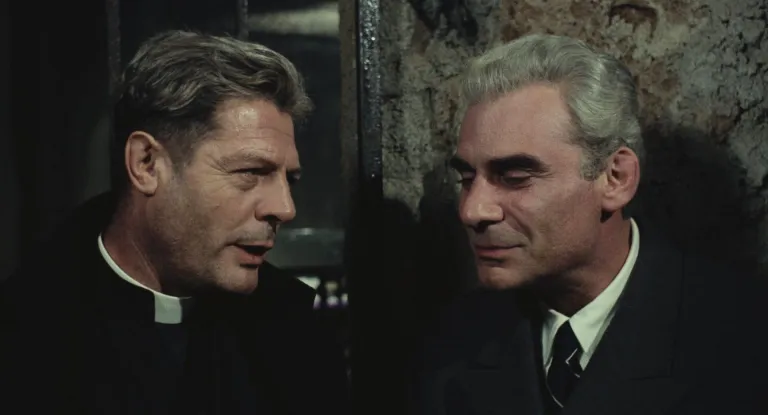
The ruling political class has taken refuge in an enclosed, monastic, isolated space—the retreat known as the Eremo di Zafer—where politicians, businessmen, and representatives of the established order gather under the supervision of a mysterious priest, Don Gaetano, played by Marcello Mastroianni, to engage in spiritual exercises. But here, religion, political negotiation, personal ambition, and ultimately murder become so thoroughly intertwined that no clear boundary can be drawn between them.
The film’s exaggerated aesthetic, therefore, is not merely a matter of formal excess. Darkness, grotesque bodies, labyrinthine architecture, and the characters’ theatrical performances all become instruments of political analysis. Petri’s aim is not simply to construct an allegory of an already existing political reality; he incorporates the distortions and contradictions of that reality into the very structure of the film.
The position of Todo modo within Italian political cinema becomes clearer when it is placed alongside Francesco Rosi’s Illustrious Corpses (Cadaveri eccellenti), released in the same year and likewise adapted from a novel by Sciascia. The two films represent two different models of political knowledge.
Rosi’s cinema is realist, non-symbolic, investigative, and grounded in political and legal facts. Institutions, evidence, testimonies, and historical causal relationships are presented to the viewer so that reality can be reconstructed in the mind. Petri moves in the opposite direction. He does not reconstruct the political system through evidence; instead, he compresses it until its contradictions become visible in the form of a nightmare.
This difference is not merely stylistic. It reflects two different conceptions of what political cinema is capable of doing. Rosi’s method assumes that reality, however dark and complicated, can be investigated and understood. Petri is more pessimistic. His political reality is not merely hidden; it is distorted. The problem, therefore, is not simply that citizens lack sufficient information. The problem is that the political system produces a reality in which appearances, rituals, and representations themselves become part of the machinery of power.
From this perspective, Petri’s cinema comes close to the political cinema of Pier Paolo Pasolini, even though their methods are profoundly different. Pasolini attacked Italy’s ruling class through essays, journalism, poetry, and film, emphasizing the country’s moral and cultural transformation. Petri shares his conviction that political corruption cannot be separated from cultural corruption, but translates this argument into the language of cinema. Where Pasolini often adopted the language of accusation and indictment, Petri constructs the scene of the crime itself.
The significance of Todo modo lies in the fact that Petri refuses to separate the political from the aesthetic; the film’s form becomes an image of the very political system it seeks to criticize. Although Todo modo is deeply rooted in the Italy of the 1970s, it extends beyond its historical framework and acquires a distinctly contemporary resonance, because the mechanisms it dissects—including the protection of personal interests within political structures, institutional corruption, the theatricalization of authority, the appropriation of moral language, and the transformation of collective life into a closed competition for power—are not confined to any particular historical period.
From Literary Adaptation to Petri’s Infernal Theater
The point of departure for Todo modo is Leonardo Sciascia’s novel, published in 1974. Yet Petri’s relationship with the book is more complicated than the conventional notion of literary adaptation suggests. The film does not simply transfer Sciascia’s narrative from literature to cinema; it radically transforms its spatial, political, and symbolic possibilities. According to Tullio Kezich, Todo modo is not a straightforward visualization of the novel but a transformation of it, particularly through the conversion of the Eremo di Zafer into a subterranean, claustrophobic, hellish, Dantean space.
Leonardo Sciascia, in defending the film, compared Todo modo to the political trial that Pasolini had intended to stage against Italy’s Christian Democratic ruling class—a trial that, in Petri’s film, becomes something resembling an execution. This comparison is important because it demonstrates that Todo modo belongs to a historical moment in which Italian artists increasingly viewed political power as a question of morality, language, and representation, rather than merely as an institutional structure. The film’s grotesque is therefore historically specific, but intellectually far more expansive.
Sciascia’s novel contains the work’s fundamental political idea from the outset: the retreat becomes a miniature world in which the political class and the Church gather under the guise of a kind of spiritual purification. The murders gradually reveal that those present are not merely victims of an external conspiracy; they are members of a system whose internal relationships have already been shaped by suspicion, rivalry, and violence.
Petri, however, intensifies this idea by constructing an intensely artificial and grotesque space. In the novel, the retreat can still be understood as a literary setting for a political mystery whose meanings emerge through the process of investigation. In the film, by contrast, the space itself seems contaminated and poisoned. The viewer does not enter a real place in which unusual events happen; instead, they enter a nightmarish, surreal world in which unusual events appear to be the natural consequence of the environment.
This is one of Petri’s most important transformations. He pulls the viewer out of the safe distance of political observation. We are not invited to stand outside corrupt politicians and judge them according to a stable moral framework. We are forced to inhabit their world.
The space and architecture of the place are designed to trap us within this closed world. The rituals repeat themselves; the characters move through corridors and rooms whose functions become increasingly unclear; and the boundaries between a place of worship, a hotel, a political headquarters, and a prison gradually disappear. Politics is no longer an activity taking place within society; it has become a closed system governed by rules of its own.
The political significance of this transformation is profound. The Christian Democratic system had governed Italy for decades, and its durability depended in part on its ability to absorb seemingly contradictory forces: Catholic morality, anti-Communist political pragmatism, social reform, traditional authority, and modern mass politics. Petri does not attempt to explain this complexity sociologically. Instead, he compresses it into a nightmarish space.
The Eremo becomes an image of a political system closed in upon itself. The ruling class has literally become separated from the people it claims to represent, while continuing to perform the religious, political, and communicative rituals through which its legitimacy is produced. The society outside is facing crisis, while the political elite remain inside a luxurious, enclosed, ritualized environment.
This separation is not merely geographical; it is epistemological. Those inside the Eremo inhabit a reality different from that of the society outside. Their attention is directed toward internal relationships, succession, influence, loyalty, and survival. The country’s crisis becomes secondary to the crisis of the political system itself. The film thus produces a fundamental inversion: rather than presenting politics as a means of organizing social reality, it depicts a political class that has become detached from social reality and is entirely preoccupied with preserving its own structure of power.
The “Eremo” as Dante’s Inferno
The aesthetic axis of Todo modo is its architecture. Dante Ferretti’s production design and Luigi Kuveiller’s cinematography create a space that seems to have been excavated from beneath everyday reality. The Eremo is simultaneously magnificent and claustrophobic; its corridors seem unnaturally long, its rooms appear to have no fixed relationship to the outside world, and its subterranean character produces a sense of descent.
The spatial organization of the film is therefore inseparable from its political meaning. The characters are not merely trapped inside a building; they are trapped within a structure of power embodied by the Eremo itself.
The film’s Dantean dimension becomes especially significant here. An intertextual examination of the relationship between Sciascia’s novel, Petri’s adaptation, and Dante’s Divine Comedy suggests that the Eremo can be understood as a political microcosm of Italy’s Years of Lead and as a cinematic version of a descent into hell.
This interpretation is more than an elegant literary analogy. The film continually inverts the traditional symbolic vocabulary of spiritual retreat. A spiritual retreat should involve an inward journey toward revelation and spiritual knowledge; here, however, the journey inward leads not to revelation but to collapse. As the characters physically descend deeper into the Eremo, they simultaneously descend morally and politically.
The Eremo, therefore, does not merely stand for Italy’s Christian Democratic system. Petri’s use of space goes beyond conventional political symbolism. The corridors, subterranean passages, ritual spaces, and dark rooms create in the viewer a physical sensation of political confinement. The viewer feels what the characters experience: that there is no way out of this infernal condition and that salvation is impossible.
At many moments, the camera observes the characters from angles that make them appear small, ridiculous, or trapped within their surroundings. Petri uses wide-angle lenses and moves the camera close to the characters’ faces, distorting and deforming them. A stark contrast emerges between the monumental architecture and the grotesque bodies.
Institutions appear immense, while the people who operate them appear simultaneously powerful and pathetic. In this way, Petri strips them of their aura of sanctity and authority. But he is not saying that the powerful are simply ordinary people like everyone else. He is showing that political power produces a particular kind of human type—one that is grotesque.
The politicians appear exaggerated and almost inhuman because power and the system itself have made them exaggerated and inhuman. From this perspective, the Eremo is the political unconscious. What is normally concealed by parliamentary institutions, public ceremonies, and political language becomes visible in the architecture of the Eremo. The building reveals what the political system conceals: fear, rivalry, isolation, surveillance, and dependency.
The Grotesque Body and the Destruction of the Aura of Authority
The grotesque is the central aesthetic category through which Petri dismantles the authority of his characters. His politicians are not dignified representatives of the state; they are grotesque bodies. They eat, sweat, pray, stare, tremble, whisper, perform, and eventually die. Their political identities are constantly interrupted and disrupted by their physical existence.
This is particularly significant in relation to the political culture of the Christian Democrats. The legitimacy of the postwar political system rested to a considerable extent on the performance of seriousness, moderation, and moral authority. Petri systematically dismantles this performance. The politicians may continue to speak in elevated language, but the camera repeatedly returns them to the physical and ridiculous dimensions of their existence.
The grotesque therefore has an expositional function: it strips political authority of its aura of sanctity. But Petri goes beyond simple satire because his characters remain powerful. That is precisely the contradiction. Those who appear ridiculous possess enormous institutional power, through which they can determine the fate of millions of people.
This is where the film’s distinctive emotional instability emerges. The viewer laughs, but the laughter is immediately contaminated by anxiety and fear. We recognize the absurdity of these characters, but we cannot dismiss them as insignificant, because their absurdity is bound to power. Petri thus transforms comedy into a form of political knowledge. The joke becomes frightening because we realize that it is the joke itself that governs the institution.
The grotesque also erases the distinction between the public and the private. Political cinema has traditionally relied on the contrast between the public politician and the private individual. Petri disregards this distinction. There is no authentic self behind the political mask waiting to be discovered. Political performance has penetrated all the way into the politicians’ bodies.
This is why Gian Maria Volonté’s performance as the President becomes so crucial. His performance in the film is one of the most complex and demanding performances in twentieth-century political cinema because it simultaneously combines imitation, caricature, and abstraction.
Although his character is not literally the President of Italy but rather the leader of the ruling political party, Petri based the character on Aldo Moro, the assassinated Italian prime minister. To create the role, Volonté carefully studied Moro’s gestures, mannerisms, and public presence. By removing Moro’s name and transforming him into “the President,” Petri turns a historical figure into a political archetype. Yet everything from his manner of speaking and bodily gestures to his position within the structure of power points toward Aldo Moro. No discussion of Todo modo can be separated from the discussion of Moro’s assassination.
At the same time, reducing Volonté’s character to Moro diminishes the complexity of his performance. Volonté is not simply imitating a famous politician; he turns political representation itself into a theatrical problem. His calculated gestures, hesitant tone, controlled facial expressions, and elaborate political rhetoric create a character whose political identity is almost entirely constituted through performance and display.
This character embodies Petri’s conception of political power. He does not merely communicate ideas; he constructs a persona through which power becomes acceptable. Public gesture, pauses, ambiguity, apparent humility, and controlled emotion are all political instruments.
Volonté’s performance therefore operates on two fundamental levels. Historically, it allowed an Italian audience in 1976 to recognize the obvious political reference. Formally, however, it uses that recognition to produce a kind of defamiliarization. We know whom we are looking at, but the actor’s exaggeration makes the familiar face unfamiliar. Moro, as a historical politician, becomes a theatrical type.
This was one of the principal reasons for the difficulties the film encountered after the events of 1978. When Aldo Moro was kidnapped on March 16, 1978, and murdered on May 9 of the same year, Volonté’s fictional character acquired a horrifying historical life of its own.
The relationship between the film and history must be understood carefully here. Todo modo did not, strictly speaking, predict Moro’s kidnapping. The film’s importance does not lie in the power of its prophecy, but in the fact that, before the historical catastrophe of 1978, it had already presented an image of a political system in which the boundary between power and violence had become profoundly unstable.
From this perspective, Petri’s film was not a prophetic film about Moro’s death; it was a metaphor for a historical catastrophe.
Don Gaetano and the Theology of Power
If “the President” embodies the political institution, Don Gaetano embodies its theological dimension. Marcello Mastroianni’s casting in the role is highly significant, since his cinematic persona had long been associated with sophistication, modernity, eroticism, and a certain intellectual melancholy. Petri pushes these qualities toward something darker. Don Gaetano is charismatic without being reassuring; cultured without being liberal; spiritual without being innocent. His role is not simply to represent the corruption of the Church. Don Gaetano’s power derives from his ability to create a ritualistic environment in which political actors are compelled to reveal themselves while believing they are engaged in the purification of their own souls. Religion here becomes a technology of power.
The film’s title itself contains this contradiction. Todo modo is taken from the famous Ignatian phrase meaning the use of every method and means in the search for the divine will. Petri transforms the phrase into a political principle: if any means can be justified by an ultimate end, morality becomes infinitely malleable. The political class can confess, repent, negotiate, deceive, and kill without ever abandoning the language of morality. This is one of the film’s most devastating themes. Corruption does not necessarily entail the disappearance of moral language; at times, it requires its preservation. Politicians continue to speak of sin because the language of sin remains useful to them. It provides a vocabulary through which guilt can be ritualized without necessarily leading to genuine moral responsibility. Confession becomes yet another performance; repentance becomes a political gesture. Religious ritual does not challenge the political order because the political order has already learned how to absorb it. Hence, the “Eremo” is a space in which the Church and political power are not merely allies but structurally dependent upon one another. This is why Petri’s attack goes beyond an accusation of corruption against a handful of priests or politicians. He is examining the institutional entanglement of moral authority and political power.
The Detective Narrative as a Means of Exposing Political Corruption
The film’s narrative structure initially resembles that of a detective story. Crimes occur one after another. One person is killed, then another, and then another. The characters search for explanations; suspicion circulates among them; political alliances shift. Yet the conventional structure of the detective story gradually collapses, because the question “Who is responsible for these crimes?” loses its significance in the face of the larger question: “What does responsibility mean in a system in which everyone is implicated?” At this point, Petri’s adaptation becomes philosophically darker than a conventional political thriller. In a detective narrative, identifying the killer is supposed to restore causality. A crime has a specific origin, and once that origin is uncovered, the world can return to order. But in Todo modo, the murders do not restore order because order itself is the problem. The mystery therefore shifts from the individual perpetrator to the political system.
The film’s refusal to provide an explanatory structure is consistent with Petri’s broader political method. His cinema rarely assumes that exposing the truth will automatically lead to liberation. Knowledge can reveal the nature of a system without necessarily destroying it. The spectator may understand the mechanisms of political power and still remain trapped within them. Political cinema often assumes that its task is to clarify reality and expose the hidden causes behind visible events. Petri’s method, however, is different and more unsettling. He suggests that political cinema must also represent the distortions, contradictions, and irrationalities that shape political experience. The failure of the detective story in Todo modo, therefore, is itself a political statement. There is no final explanation capable of neutralizing the system.
Form and the Aesthetics of Suffocation in Todo modo
The film’s formal unity becomes most apparent when its various artistic elements are considered together. Dante Ferretti’s production design creates an underground labyrinth; Luigi Kuveiller’s cinematography transforms this space into a world of light and shadow; Ruggero Mastroianni’s editing controls the movement between ritual, dialogue, and violence; and Ennio Morricone’s music adds another layer of anxiety and unease. The result is a kind of claustrophobia—a spatial suffocation, but not merely a physical one. It is also a suffocation of meaning. The characters are constantly talking, yet their language offers no way out. They move through rooms, but movement never leads outside or toward liberation. They perform religious rituals, but the rituals do not lead to transcendence. They investigate the murders, but the investigation does not produce moral illumination. Everything moves within a closed circuit. This circularity may be the film’s most precise formal representation of political power. A closed political system does not necessarily need force to imprison its members; it is enough for it to absorb every possible form of movement within itself. Opposition, negotiation, confession, ambition, and rivalry can all become mechanisms for reproducing the very system they appear to challenge. In this sense, the “Eremo” resembles a political machine that devours its own inhabitants.
Italy in the 1970s witnessed an unprecedented convergence of political crisis, social conflict, and ideological transformation. The Christian Democratic establishment remained dominant, while the Communist Party had achieved unprecedented electoral strength, and the question of whether the country’s two major political forces could coexist within a new political framework had become one of the central issues of Italian political debate. Yet Petri does not make a conventional film about the Historic Compromise. Instead, he imagines a political world in which ideological differences have become secondary to a shared logic of power. Politicians may disagree, compete, or conspire against one another, but they all belong to the same closed structure. The film’s target, therefore, is not the corruption of a handful of Christian Democratic politicians. Petri is examining the transformation of politics into a self-perpetuating system. The political class no longer sees itself as a temporary representative of society; it experiences power as its natural habitat. The outside world, and the society confronted by illness and crisis, can barely penetrate this environment. This separation between the inside and the outside may be the film’s most devastating political theme. The ruling class is not merely corrupt; it has become detached from, and insulated against, the real society.
This also demonstrates that political films do not possess fixed meanings. Historical events can fundamentally alter the conditions under which a film is seen. Gian Maria Volonté’s attempt to draw inspiration from Aldo Moro was itself provocative and controversial, and after 1978 it acquired a ghostly dimension. A fictional political murder in the film could no longer be understood simply as satire, because a real political assassination had taken place within the same political world. The central question is not whether Todo modo remains relevant to our own time in the superficial sense of whether political corruption and scandal still exist in Italy. Almost any political film can be declared “contemporary” on those grounds. The more important question is what remains of Petri’s film after the political system it targeted has historically disappeared. The answer lies in the film’s conception of politics as enclosure. The Christian Democratic system belonged to a specific historical moment. Its relationship with the Church, its organizational structure, its place within the Cold War, and its dominance over postwar Italian politics cannot simply be transferred unchanged into another context. What can be transferred is the film’s structural question: what happens when political institutions become primarily concerned with preserving themselves? Petri’s answer is that political language becomes ritualized, morality becomes an instrument, representation becomes spectacle, and institutions grow increasingly detached from the society they claim to represent. This is why the film’s grotesque retains its power. The grotesque does not belong to any particular political party. Whenever the public language of legitimacy becomes detached from the private mechanisms of power, the grotesque emerges. The film therefore remains alive not because it predicted today’s politics, but because it gave cinematic form to a recurring political problem.
To place Todo modo within the history of Italian political cinema is not merely to add another title to the list of films about corruption, terrorism, and institutional violence. The film’s significance is more fundamental. Petri demonstrates that political cinema does not have to choose between formal experimentation and political seriousness. On the contrary, in his cinema, formal transformation becomes the most precise form of political analysis. This is the fundamental difference between Todo modo and a conventional political thriller. The political thriller usually assumes that political reality exists outside the film and that cinema’s task is to expose it. Petri, however, shows that political reality itself has become theatrical, grotesque, and irrational. Realistic representation, therefore, may itself result in a distortion of reality. The film’s aesthetic exaggeration is thus its very realism.
In fact, Todo modo’s endurance stems from an inverse movement. The further we move away from its immediate political context, the clearer its formal achievement becomes. What remains is not merely the memory of an Italian ruling class, nor even simply the shadow of Aldo Moro; what remains is Petri’s fundamental proposition: when power becomes a closed and self-sustaining system, reality itself begins to turn grotesque. This is Todo modo’s achievement. The film does not merely depict a political crisis; it gives that crisis an aesthetic form. Fifty years on, Todo modo remains every bit as devastating, bitter, disturbing, and powerful.
© 2026. Phoenix Review