



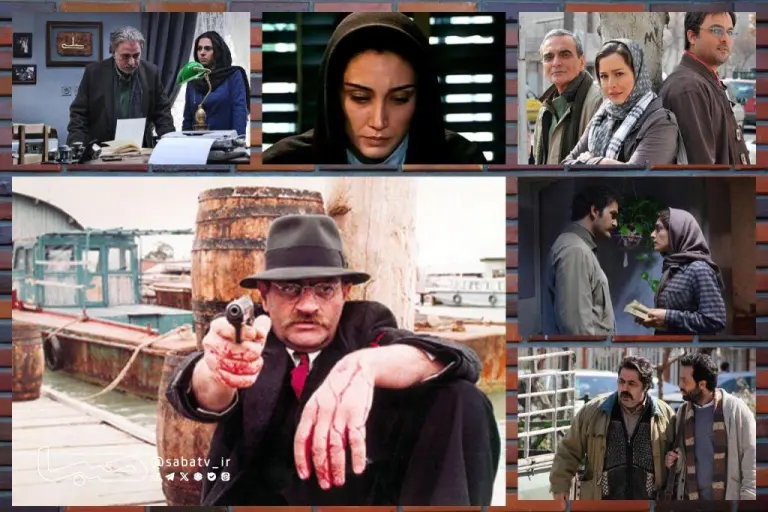
In cinema, a reporter is more than just a profession; it is a dramatic position. Someone whose job is to observe, ask questions, investigate, and tell stories inevitably becomes entangled with hidden realities, power structures, politics, and social relations. This is why journalists and reporters have long been among the most compelling and frequently used characters in world cinema. They can be heroes or antiheroes, observers or active participants. From Citizen Kane to Spotlight, All the President’s Men, and countless others, journalism has served as the foundation for stories about truth, power, and responsibility.
Iranian cinema, however, has made comparatively limited use of this character. In most Iranian films, the reporter appears as a secondary figure—someone who makes a phone call, conducts an interview, delivers information, or briefly enters the margins of a larger story. Rarely has journalism itself become the central concern of a film, allowing the journalist to emerge as a cinematic protagonist shaped by the ethical and professional demands of the profession. Even so, a number of Iranian films have given reporters and journalists roles that extend beyond mere supporting functions.
Efrit: Reporters in the Early Post-Revolutionary Years
One of the lesser-known examples is Efrit, directed by Esmail Khalaj. Produced in the years immediately following the Iranian Revolution, the film places a group of reporters at the center of a political thriller. The story follows four Iranian journalists who are connected to Palestinian refugees and fighters. When they decide to publish a book containing the names of Iranian Zionists, they find themselves drawn into a dangerous conflict.
What makes Efrit significant is that the reporter is not simply recording events. The very act of publishing information becomes the engine of the narrative. Because of what they know, the journalists are pulled into networks of power, and that knowledge itself becomes a source of danger.
That said, the film’s understanding of journalism differs substantially from the image of the independent journalist that would later emerge in Iranian cinema. Efrit is less a film about journalism as a profession than a film that uses journalists as carriers of information and participants in a political struggle. Nevertheless, its early appearance demonstrates that Iranian cinema recognized the dramatic potential of the profession from the very beginning.
Party: Journalism Confronts Power
If there is one film in which a journalist truly occupies the heart of the narrative, Party, directed by Saman Moghadam, is among the most important examples. Released in 2000, the film tells the story of a young journalist who is imprisoned after publishing an article in his magazine, while his friends attempt to secure his release.
In Party, journalism is no longer a peripheral occupation; it is the direct cause of the central conflict. What places the protagonist in danger is neither a personal decision nor a family matter, but an act performed in his capacity as a journalist: publication.
This makes Party one of Iranian cinema’s most overtly political engagements with the press. The film was produced during a period when reformist newspapers and the political atmosphere surrounding them played a significant role in Iranian public life. In such a context, the journalist could stand as a symbol of a generation determined to question what was happening around it.
The journalist’s imprisonment is therefore more than a plot device. It represents a confrontation between the public’s right to know and the mechanisms of power. For this reason, Party is less about an individual than about the position of journalism in a society where publishing a single article can have consequences that extend far beyond the newsroom.
Mina’s Option: Journalism Between Love and Politics
Fifteen years later, Kamal Tabrizi once again placed a journalist at the center of a political drama with Mina’s Option. Mehran, played by Milad Keymaram, is a reporter for a major newspaper whose profession keeps him closely connected to political developments and wartime events. Unbeknownst to him, his wife Mina is secretly linked to the Mojahedin Organization and exploits information she gains through her husband’s work.
Here, journalism takes on a more complex function. Mehran is not merely a reporter; he stands at the intersection of private life and political history. Information that constitutes part of his everyday professional routine acquires an entirely different significance for his wife. As a result, journalism becomes a defining element in the relationship between husband and wife.
What is particularly striking about Mina’s Option is that it moves journalism out of the newsroom and into the domestic sphere. In many films, journalists become interesting when they are investigating a case. Tabrizi, however, demonstrates how the profession itself can shape emotional and familial relationships.
Mehran is trapped between two worlds: the world of news and the world of life. As a journalist, he strives to uncover reality, yet in his personal life he is confronted by a reality he has failed to perceive. This contradiction forms one of the film’s most compelling dimensions: a man whose profession is the pursuit of truth becomes the victim of hidden truths within the most intimate part of his own life.
A Line of Reality: When the Press Becomes the Subject
Perhaps the most direct Iranian film about the contemporary condition of journalists is A Line of Reality, directed by Ali Vazirian. The film follows Kasra and Forough, a married couple who work for a literary and cultural publication. The closure of newspapers, economic hardship, and external pressures make it increasingly difficult for them to continue their professional lives.
The significance of A Line of Reality lies in the fact that it is concerned not merely with a journalist, but with the lived experience of journalism itself. The question is not simply what report a journalist produces; it is whether the conditions exist for someone to remain a journalist at all.
Kasra and Forough face a double challenge. On one hand, they must contend with the economic crisis affecting the press; on the other, they confront professional restrictions. Financial difficulties and regulatory pressures threaten the survival of their publication, turning journalism into an increasingly difficult choice.
What makes A Line of Reality important is its refusal to reduce the journalist to a stereotype. Instead, it presents a human being with professional, familial, and economic concerns. The journalist here is neither an invincible hero nor an unwavering idealist. He is someone forced to choose between staying and leaving, perseverance and surrender, truth-telling and the preservation of a personal life.
The Reporter as the “Eye of Society”
Beyond these major examples, Iranian cinema has frequently used journalists as witnesses or investigators. Even when they are not central characters, their presence is usually associated with seeing and narrating. The reporter is the person expected to see what others cannot—or what others would prefer remain unseen—and to tell the story.
This characteristic gives the profession enormous narrative potential, yet Iranian cinema has rarely taken full advantage of it. Studies of the representation of journalists in Iranian film and television have repeatedly pointed to this absence, often highlighting works such as Party, Mina’s Option, A Line of Reality, and the appearance of a reporter character in films like The Outcasts 2 (Ekhrajiha 2).
In The Outcasts 2, Leila Bolukat appears as a reporter, though the film is not fundamentally about journalism and her character serves the broader narrative. This distinction is important: the presence of a journalist does not necessarily make a film about journalism. A reporter may function simply as a narrative device, conveying information or providing the audience with access to an event. In films such as Party and A Line of Reality, however, journalism itself becomes the central subject.
Why Are There So Few Memorable Journalists in Iranian Cinema?
Part of the answer may lie in the difficulty of the profession itself. A journalist is a character whose primary function is to ask questions, whereas cinematic drama often demands a character capable of finding answers. Journalists pursue truth, but truth in Iranian cinema—particularly when politics and power are involved—is a sensitive and multilayered subject.
Moreover, Iranian cinema has often preferred to explore social and political crises through the lenses of family, romance, class, or interpersonal relationships. As a result, journalists have rarely been given the opportunity to become fully realized dramatic protagonists.
Yet whenever Iranian cinema approaches journalism, it also approaches a larger question about truth itself. In Party, truth carries a cost. In Mina’s Option, truth threatens to destroy private life. In A Line of Reality, truth-telling collides with economic and professional hardship. In Efrit, information can become a matter of life and death.
The Absence of a Definitive Journalistic Hero
Perhaps this is the most important point: Iranian cinema still lacks a truly enduring journalist-hero—a character whose cinematic identity is inseparable from inquiry, the pursuit of truth, and social responsibility in the way that some of world cinema’s most celebrated journalistic protagonists are.
Journalists in Iranian cinema have often been present, but they have rarely been the subject. They have appeared in the frame, advanced the plot, or become victims of larger crises, yet few films have built their entire worlds around the lived experience of a reporter.
This is especially striking given how rich the profession is in dramatic possibilities, particularly in Iran: encounters with crisis, pressure, censorship, danger, the lure of fame, ethical conflicts, relationships with sources, mistakes in reporting, social responsibility, and the impact of professional life on family and personal relationships.
Perhaps the time has come for Iranian cinema to take journalists seriously not merely as people who ask questions in front of a camera, but as individuals searching for answers themselves. The reporter is potentially one of cinema’s most compelling protagonists because the profession is inherently tied to the essence of drama: venturing into the unknown and striving to uncover the truth.
From Efrit to Party, from Mina’s Option to A Line of Reality, each of these films has explored part of that path. Yet there remains a vacancy for the film that transforms the journalist into a truly memorable, complex, and multidimensional character—a film in which the camera does not simply observe the reporter, but looks at society through the reporter’s eyes. Perhaps then the journalist in Iranian cinema will cease to be merely a profession and become a genuine cinematic character.
© 2026. Phoenix Review