



“Do not imagine the Magi’s work has come to an end;
A thousand untasted wines still flow within the vine.”
— Muhammad Iqbal, Payam-e Mashriq, “Eternal Life,” Section 172
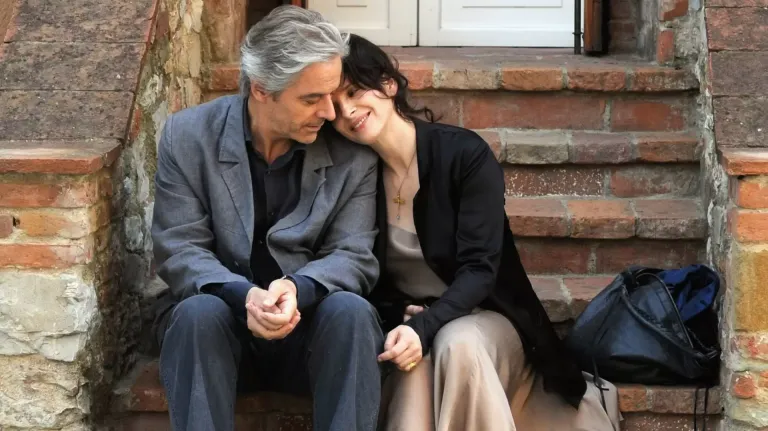
This brief essay explores the philosophy of existentialism in Certified Copy (2010), directed by the renowned Iranian filmmaker Abbas Kiarostami. Existentialism is a philosophy grounded in individual freedom and human responsibility in discovering the meaning of life. Although it is most commonly associated today with thinkers such as Jean-Paul Sartre and Simone de Beauvoir, existentialist ideas have long occupied a distinguished place in Persian culture and philosophy, finding expression in the poetry and thought of figures such as Hafez of Shiraz and Omar Khayyam of Nishapur.
To illuminate the existential dimensions of Certified Copy, I examine the film’s collective spaces—cafés and restaurants—and the ways in which its characters relate to one another through conversation, shared tables, companionship, eating, and drinking. To understand the role of food in Kiarostami’s existential cinema, it is useful to begin with the titles of several of his films.
His first cinematic work was the short film Bread and Alley (1970). Bread—the staple of the Iranian table and, metaphorically, a symbol of livelihood—drives both the narrative and the moral growth of the young protagonist. The loaf of sangak bread remains visible in almost every shot. The story follows a boy’s attempt to bring the bread safely home while overcoming the obstacle of a stray dog. The bread reaches the family table intact, yet the breadwinner himself is never shown eating it.
In Through the Olive Trees (1994), Kiarostami invites us into a bittersweet romantic tale unfolding beneath magnificent olive trees. Standing tall and verdant in the aftermath of a devastating earthquake, the trees symbolize resilience and the continuity of life. The bitter taste of olives is evoked through Hossein’s unrequited love for Tahereh. Yet neither olives nor anyone eating them ever appear on screen. Even the glass of tea Tahereh brings Hossein remains untouched.
In Through the Olive Trees, love and the desire to live ultimately outweigh the destructive force of the earthquake, affirming humanity’s freedom to choose life despite overwhelming grief. Fulfillment and joy are imagined only in the film’s final long shot; they remain distant possibilities rather than immediate realities.
Similarly, in Taste of Cherry (1997), cherries and mulberries are neither shown nor tasted, yet they become powerful abstract symbols. One of the supporting characters persuades Mr. Badii to reconsider suicide by recalling the incomparable taste of fresh mulberries and cherries—the taste of life itself. The film’s famously open ending never reveals whether Badii abandons his plan. Yet for Kiarostami, the “taste of cherry” ultimately yielded another reward: the Palme d’Or at Cannes.
Throughout Kiarostami’s work, food often appears in similarly abstract and understated ways. Eating or refraining from eating, gathering around a table or abandoning it, and the characters’ relentless pursuit of an unattainable ideal instead of enjoying the simple pleasure of a shared meal constitute recurring existential crossroads. This treatment differs fundamentally from the food-centered spectacles of commercial cinema. In Kiarostami’s films, food assumes a philosophical—indeed existential—function.
Certified Copy is Kiarostami’s first and only European feature, unfolding entirely outside the cultural landscape with which the director was most intimately familiar. One might expect a foreign filmmaker working in Tuscany to showcase the region’s celebrated cuisine as a means of establishing a sense of place. Yet although cafés and restaurants feature prominently throughout the film, food itself is rarely foregrounded visually.
I would argue, however, that the presence of meals and public dining spaces plays a crucial role in the film’s narrative, while simultaneously expressing its existential concerns and giving meaning to the evolving relationship between the unnamed woman and James Miller. Whether the characters eat or refrain from eating, whether they remain at the table or walk away from it, becomes a means of dramatizing their choices and defining the nature of their relationship.
At Florence’s Piazza della Signoria, the unnamed French woman, who owns an antique gallery, reluctantly takes her son into a sandwich shop after yet another argument. Their quarrel continues unabated. Mother and son wound one another emotionally. Hoping to quiet his complaints, she orders him a hamburger and French fries.
Fast food, of course, belongs to the universal world of adolescence rather than the culinary traditions of Tuscany. The meal does nothing to reconcile them. The boy continues to challenge his mother, accusing her of being interested in the English writer whose book launch they had attended earlier. Exhausted by the confrontation, the woman leaves the restaurant to smoke a cigarette and strike up a conversation with a stranger. Left alone, the boy eats his meal with visible resentment.
Rather than fostering intimacy, the restaurant reinforces the emotional distance between mother and son. Ironically, the woman had already sacrificed James Miller’s book presentation for her son’s sake, only to discover that she could satisfy neither him nor herself. Later, the woman and James Miller, an English art historian visiting Tuscany to promote his book Certified Copy, stop at a small café.
Since James speaks no Italian, the woman orders a cappuccino for herself and a caffè lungo for him. Sitting together, they resume their discussion about originality and imitation in art. James argues that copies possess artistic value equal to originals; indeed, reproductions may sometimes reveal the qualities of the original work more effectively than the original itself.
The woman slowly savors her cappuccino. James, absorbed in intellectual debate, scarcely touches his coffee.
James explains that the central idea behind his book first occurred to him during a previous visit to Florence five years earlier. Looking out from his hotel window each morning, he had watched a mother and son crossing Piazza della Signoria. The impatient mother always walked briskly ahead while the boy followed at his own leisurely pace. One day, James noticed the child gazing in wonder at the replica of Michelangelo’s David, admiring it as though it were the original sculpture. The mother never corrected his mistake.
Perhaps, for James, this mother and son themselves became another kind of copy: an echo of the Madonna and Child standing beside another celebrated copy—the replica of Michelangelo’s David. The woman immediately realizes that James is describing her and her son. She stops drinking her coffee. Tears well in her eyes as she quietly admits that she had been deeply unhappy during that period of her life.
At that moment James receives a telephone call and steps outside. When he returns, the film executes one of its most brilliant narrative turns. The two strangers now begin interacting as though they are—or perhaps once were—a married couple. Their conversation becomes that of spouses burdened by years of disappointment and resentment.
The argument escalates. James never drinks his now-cold coffee. Another opportunity for shared happiness quietly slips away. Perhaps the film’s most important sequence unfolds in a restaurant overlooking a picturesque Tuscan square.
Still estranged from one another, James admits that he is hungry and suggests they eat. He gently places his hand on the woman’s shoulder as they enter the restaurant together. They order wine. The waiter uncorks the bottle.
The woman excuses herself, goes to the restroom, puts on elegant earrings, applies lipstick, arranges her hair, and returns hoping to reconcile with James.
Instead, she finds him irritated. He insists the wine has been spoiled by the taste of cork. She sips it calmly and replies that it is not nearly as bad as he claims. James disagrees. Growing increasingly irritated, he fills her glass to the brim and snaps: “Then drink all of it.”
Moments later the woman notices a newlywed couple they had seen earlier at the museum and warmly greets them through the restaurant window. James becomes even more exasperated. Hungry, frustrated, and emotionally exhausted, he leaves the restaurant. The woman follows quietly. She carries two small pieces of bread. One she offers to him. The untouched wine remains on the table. Another chance for intimacy has been abandoned.
The repeated motif of eating—or refusing to eat—in the cafés and restaurants of Certified Copy symbolizes life’s richest experiences: moments whose flavor is never fully savored and opportunities that quietly disappear. The cafés and restaurants, set amid medieval streets, Renaissance architecture, and beautiful Tuscan piazzas, offer extraordinary settings for human connection. Yet the characters repeatedly deny themselves the simple pleasures of sharing a glass of wine or a cup of coffee.
Kiarostami’s existential atmosphere emerges through this persistent tension, anxiety, and emotional uncertainty. The debate over authenticity in art naturally expands into a deeper question: the authenticity of human existence itself.
In the film’s final hotel-room sequence, James and the woman confront the fundamental existential question of who they truly are. How will they give meaning to their relationship? By remaining together—or by letting each other go? Will James respond to the woman’s unspoken desire for physical and emotional reunion? Will they seize the present moment, or will bitterness once again prevent them from embracing happiness?
For me, the untouched wine represents the film’s decisive turning point.
Throughout the narrative James assumes the role of philosopher and teacher, instructing the woman about art and authenticity. Yet it is she—not the celebrated art historian—who ultimately understands the art of living: overcoming resentment and embracing the fleeting present.
By casting William Shimell’s James Miller—a character bearing unmistakable affinities to Kiarostami himself—the director subtly critiques his own intellectual position. In the film’s final movement, the seemingly naïve and superficial woman gradually emerges as its true moral and existential center.
Although she fails to repair her relationship with her son, she continually creates opportunities for joy, companionship, and celebration with James. She reminds us that the value of a single shared moment may exceed the accumulated grandeur of history and art.
We often imagine that, as Iqbal writes, “a thousand untasted wines still flow within the vine.” Believing that countless opportunities remain ahead of us, we sacrifice life’s small joys in pursuit of larger ambitions. We construct elaborate philosophies while overlooking the simple philosophy of living: being present with another human being.
James insists that a copy may equal an original artwork. The unnamed woman, who earns her living selling replicas, demonstrates something even more profound: that authenticity lies not in objects but in the capacity to love, imagine, and hope. She is never given a name.
Perhaps she is meant to stand for every genuine woman who still possesses the courage to dream. Her role throughout the film recalls Omar Khayyam’s enduring counsel:
Rise from your sleep,
and let us drink some wine,
Before Time itself drinks us away.
For this hostile turning sky may one day
Grant us not even enough time to drink a cup of water.
— Rubā‘ī No. 123, Omar Khayyam
© 2026. Phoenix Review