



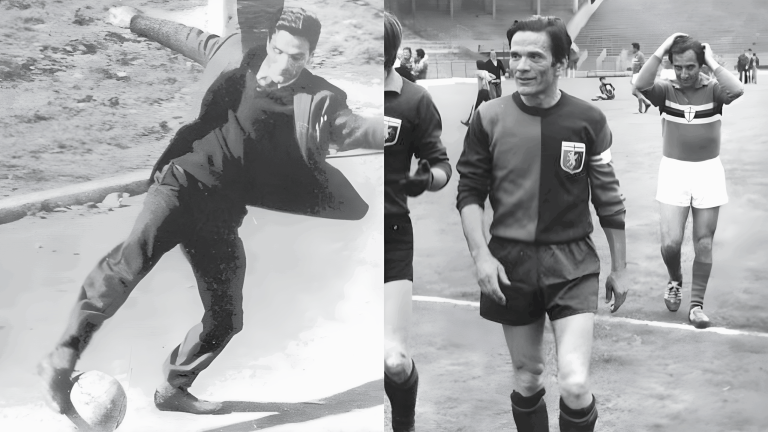
Pier Paolo Pasolini, the renowned Italian poet, writer, and filmmaker, has a famous statement about football. He said: “Football is the last poetic language of the world.” Of course, this statement is not only about football; it also reflects his sharp and avant-garde perspective on art, society, and the nature of modern language — a view expressed half a century before the phenomenon we witness today. He was a visionary of his time.
For Pasolini, many of the archetypes that had historically connected human beings — such as religion, mythology, literature, and poetry — no longer possessed the power they once had, and this connection would continue to weaken over time. But football was the one aspect of life that had replaced myth, religion, and poetry and could still unite millions of people. Because football is a universal language that requires no translation. Understanding its rules is possible for every human being, regardless of intelligence or background. Anyone, in any society, culture, or level of wealth, can engage with it from childhood. Wherever you are in the world, you can find an empty piece of land and a ball — or something resembling a ball — and play football, even barefoot.
Pasolini viewed football as something similar to language: a language that could be either prose or poetry. From the perspective of this modern philosopher, football players are words, and the passes they exchange are sentences. Tactical strategies are the grammar of this language, and the match itself becomes the final text that is created and presented before the eyes of the audience. It is like a book that billions of people across the world can read, feel, and understand. Everyone shares in the joy of victory and the sorrow of defeat in football, and no other event creates such a universal emotional experience. Even wars, storms, and earthquakes do not create the same collective feeling that football does.
Pasolini believed that players who merely execute predetermined tactics are writing prose, while those who create unexpected movements are composing poetry. In his view, European footballers wrote in prose, whereas South American footballers were poets, because their play contained more extraordinary and creative gestures. If Pasolini had not been murdered in 1975 at the age of only 53, he would certainly have called players like Messi or Ronaldo the poets of football.
On the other hand, football can be considered the art form of the twenty-first century. If cinema was the art of the twentieth century, the decline of cinema audiences in the twenty-first century has opened the way for football. While the number of people attending movie theaters decreases every year, thousands still line up to watch their favorite football clubs and continue to go to stadiums every week with passion and excitement to support their teams. During the World Cup, thousands of national team supporters travel from continent to continent and country to country to watch their teams play.
If in ancient Greece and Rome people rushed to watch tragedies and satirical comedies, and this sacred human tradition continued for centuries through theater, and if in the twentieth century people lined up outside cinemas to experience the magic of the seventh art, today football has become the eighth art. Stadiums have replaced theaters and cinemas; the performances are always live. Understanding their stories is neither difficult nor complicated, and the emotional responses are shared. Thousands laugh together, and thousands cry on the other side. Sometimes even rival supporters unite through these shared tears and laughter, reaching a sense of collective unity through their passionate cries.
Perhaps this is why some football moments from its hundred-year history have remained in the collective memory of people around the world like magnificent scenes from great films. Moments such as Maradona’s famous “Hand of God” goal against England at the 1986 World Cup in Mexico; Zinedine Zidane’s headbutt against Italian player Marco Materazzi in the 2006 World Cup final, which led to his dismissal and contributed to France’s defeat and Italy’s victory; the moment Danish midfielder Christian Eriksen suffered cardiac arrest during Euro 2020, when his teammates surrounded him and he was ultimately saved; and the unforgettable scene in the 2022 World Cup final when Argentina defeated France on penalties, followed by the iconic image of Messi falling to the ground in tears.
These scenes are more than sporting moments — they resemble the dramatic climax of a cinematic epic.
It is true that football in recent decades has been stained by dirty money, corruption, and organized interests. But if we look at football from Pasolini’s perspective, every football match is a ninety-minute film — and sometimes even longer — with a hero and an antagonist, a beginning, a climax, and an ending. It has an introduction, a conclusion, and emotional and dramatic weight.
In football, we should not take the final result too seriously. Every match has a winner and a loser, but the true value lies in searching for the “scene” — moments in which a goal, a victory, or a defeat are no longer the essential point, but instead become mythical experiences; moments that transcend sport and find a permanent place in the minds of audiences.
In fact, football becomes art when we forget the result and remember only the image. Like Messi’s tears, Ronaldo’s scream from the sideline, two rivals crying in each other’s arms, or a mother walking onto the football field holding her son. Years from now, we may have forgotten the score of the match — but we will never forget these epic moments.
© 2026. Phoenix Review