



Psychoanalytic Analysis of the Dictator Through the Lens of a Film by Juraj Herz
If we wish to analyze and dissect the figure of the dictator, before anything else we must examine his narcissistic dimension. But who exactly is the narcissist, and to what kind of individuals does this term apply?
To arrive at a comprehensive analysis, we inevitably have to turn to the theories of Melanie Klein, the prominent post-Freudian psychoanalyst.
According to Klein’s theory, when the infant is separated from the mother’s womb, it loses the safe environment that had fulfilled all of its needs and enters an entirely new world. In this new world, the infant still has no conception of the Other; it experiences the mother as an extension of itself and the mother’s breast as part of its own being. As long as the mother’s breast satisfies the infant’s hunger, it is perceived as the “good breast.” But when gratification is delayed, the breast becomes the “bad breast.” This splitting of the breast into good and bad is what Klein calls “splitting.”
For the sake of survival, the infant is compelled to divide the world into safe and unsafe zones, because at this stage it lacks the ability to comprehend delay or frustration in the fulfillment of its needs. There is no separate mother yet; there is only the mother-infant unity.
To explain this process, Klein introduced two psychological positions. The first she termed the “paranoid-schizoid position.”
It is called schizoid because the child is forced to split the world into good and bad; and paranoid because the child must locate evil outside itself. It is far easier to tolerate external badness than internal badness. Thus, in the paranoid-schizoid position, the child cannot perceive the Other as independent. The external object — the mother — is treated merely as an instrument serving the child’s needs, functioning as what Klein calls a “part-object.” The mother matters only insofar as she satisfies the child’s needs. If those needs are fulfilled, she is accepted as the “good mother”; if not, she becomes the “bad mother.” The Other therefore possesses no autonomous identity whatsoever.
If the mother is “good enough,” positive experiences outweigh negative ones, allowing the child’s ego to believe that the idealized object is stronger than the persecutory one. Gradually, the capacity for love develops within the child’s emerging psychic structure, enabling the child to move toward the next developmental stage known as the “depressive position.”
But if the mother is profoundly inadequate — which is the central issue here — the child remains fixated in the paranoid-schizoid position. In such a case, the child sees others only as objects existing to serve its needs, devoid of independent identity, feelings, or subjectivity deserving recognition. Since the psyche is structured on this basis, in adulthood anything that gratifies the narcissist’s desires is experienced as “good,” while anything that frustrates them is perceived as “bad.” Such an individual lacks the capacity to process or interpret the emotions of others and therefore lacks empathy altogether, because this capacity never properly formed in childhood.
Others become merely different part-objects serving the narcissist’s needs. Yet because reality can never fully satisfy such fantasies, the narcissistic individual resorts to secondary means — domination, coercion, violence — to impose their fantasy world onto reality itself. They feed endlessly on those around them in order to compensate for a profound inner deficiency.
If we wanted to describe the narcissist in a single word, perhaps the most accurate word would be “inferior.” Such individuals never had the opportunity to consolidate a stable ego; inwardly they are profoundly devoid of self-worth. That is precisely why they survive through exploiting and feeding upon others.
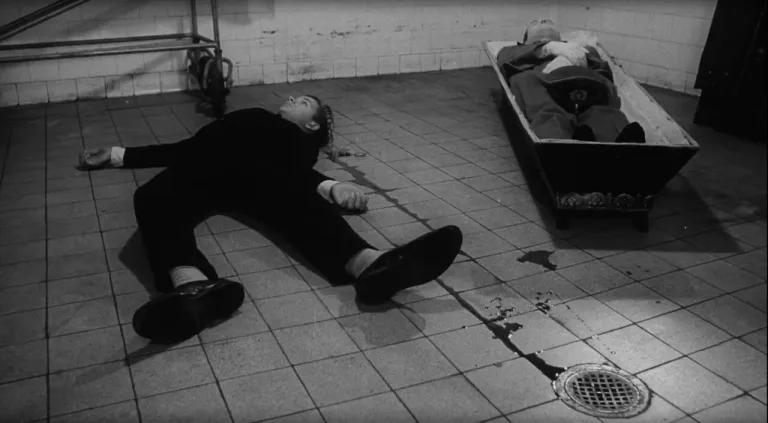
The Cremator (1969) by Juraj Herz
We can continue this discussion through an example from cinema. One of the purest and most striking representations of a psychotic and narcissistic personality in film appears in The Cremator.
The film’s protagonist, Karl Kopfrkingl, appears outwardly to be an ordinary man working in a crematorium. But beneath the surface, we encounter a psychotic fascist who remains deeply devoted to the ideology of the Führer — Adolf Hitler. He even goes a step further by blending Nazi ideology with distorted Buddhist concepts, convincing himself that by cremating human beings he is purifying and redeeming them for a better next life.
He transforms the crematorium into a kind of sacred temple. So absolute is his commitment to ideology that he eventually murders even his own wife and children. Every human being around him functions merely as a tool — a part-object — for the realization of his goals. And those goals themselves exist solely in service of the fascist ideology of the Führer.
To understand the logic behind Karl Kopfrkingl’s actions, we must turn to an important theory proposed by Sigmund Freud.
In Group Psychology and the Analysis of the Ego, Freud presents a remarkably insightful argument: when individuals become part of a group or mass movement, they replace their own superego with the leader of the group. In other words, the ideology, will, and authority of the leader become internalized as the moral law governing each member of the collective.
The superego ordinarily forms through family structures and social laws; it is directly tied to conscience, morality, guilt, and empathy, and emerges precisely because human beings must coexist with others. But if this structure is entirely removed and replaced with the dictates of a psychotic narcissist, one can imagine the catastrophe that may unfold within society.
This is precisely where dictatorship becomes psychologically possible: not merely through fear and violence, but through the surrender of conscience itself.