



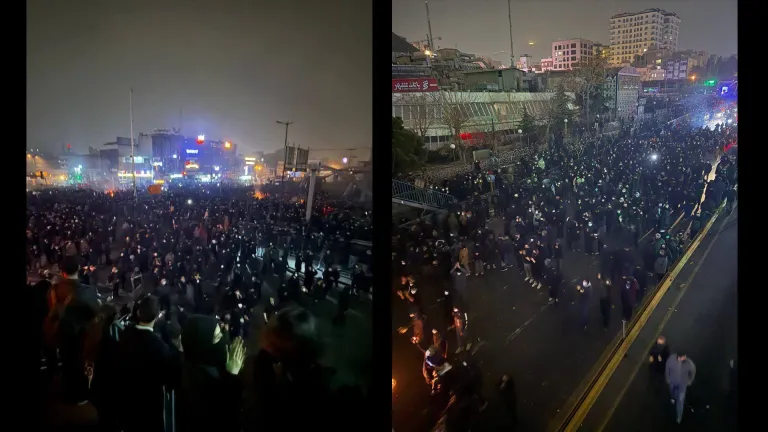
I was turning through the pages of modern history, trying to understand what historical parallels might exist for the massacre of at least thirty-six thousand people during the street protests in Iran on the nights of January 8 and 9, 2026. One of the bloodiest street uprisings to end in mass slaughter was the Tiananmen Square protests in Beijing in the 1980s, where the highest estimates by human rights activists placed the number killed by the Chinese regime at around ten thousand. Even among the ethnic conflicts, civil wars, and genocides of modern history, I could not find another case in which such a horrifying massacre had occurred within the span of only two nights.
In July 1995, during the final days of the war in the former Yugoslavia, Bosnian Serb forces entered the city of Srebrenica and, over the course of roughly two weeks, massacred around eight thousand Muslim men and boys. The world came to recognize the atrocity as genocide, leading NATO forces to bomb Serbia and ultimately bring an end to both the genocide and the war between the Serbs and the Muslims of Bosnia and Herzegovina. Most of the victims were buried in mass graves. Women, children, and the elderly had been sent to safer areas, meaning the massacre specifically targeted Muslim men and boys from Srebrenica. Yet even the death toll of that genocide was far lower than the killing of Iranians by the Islamic Republic over the course of two days.
In the end, I found only one comparable case in the history of the Second World War in terms of the number of victims: the massacre at Babi Yar, on the northwestern outskirts of Kyiv. After Nazi Germany invaded territories of the former Soviet Union that today belong to Ukraine, and after the capture of Kyiv in 1941, notices were distributed throughout the city on September 29 and 30 ordering Jews to gather at Babi Yar so they could supposedly be relocated elsewhere. But after thousands of women, men, children, and elderly people assembled, they were all machine-gunned and buried in the ravines of the valley.
The Nazi army reported the number of victims murdered at Babi Yar over those two nights as 33,771 people. The event came to be known as the “Holocaust by Bullets,” before the period in which millions of Jews would later be sent to death camps, murdered in gas chambers, and ultimately reduced to ashes in crematoria. In the months and years that followed, thousands of Roma people, political dissidents, psychiatric patients, physically and mentally disabled individuals, and Russian and Ukrainian prisoners of war were also executed at the same site and buried in mass graves.
If on the outskirts of Kyiv the Nazi army massacred Russian and Ukrainian Jews, then in the cities and towns of Iran, Iranians have been gunned down in their own country by a minority of mercenaries and beneficiaries of the regime — people who are themselves Iranian. They speak Persian, their supreme leader comes from Khameneh in Azerbaijan and was born in Mashhad, and if one looks at identity papers, murderer and victim emerge from the same religion, the same traditions, the same nation. Yet in the accounts of Babi Yar I found no mention of finishing off the wounded with execution shots, no reports of abducting injured people from hospitals, no stories of organs being removed from the dead, nor of wombs being torn open to determine whether a woman carried a fetus — and if she did, removing that fetus from her corpse. I found no mention of bodies stolen for future purposes, no demands that grieving families pay for the bullets used to kill their loved ones, no extortion for the return of bodies, no forcing of relatives to sign statements claiming that the dead had been Nazis and were killed by terrorists.
The Poem That Shook the World
The “Holocaust by Bullets” gradually entered the collective memory of Europeans and found expression in art, poetry, and literature. Although in the Soviet Union itself, the massacre remained unspoken for years, since Communist leaders had little interest in emphasizing the suffering of Jews. But exactly twenty years after the horror of Babi Yar, Yevgeny Yevtushenko, a poet from Siberia, wrote a poem in protest against the absence of any memorial at the ravine. The poem was titled Babi Yar. Already famous during Khrushchev’s era of reforms, Yevtushenko achieved worldwide recognition through this work — a long poem that became an even louder cry against silence in the face of racial hatred. In this immortal poem, Yevtushenko not only condemns the systematic antisemitism of Nazi Germany, but also criticizes the intellectual stagnation and moral paralysis of his own society. He points to how hatred — and at times the silence of ordinary Europeans themselves — made possible people like Hitler and those who shared his ideology of racial supremacy.
The poem begins with these lines:
“There are no monuments over Babi Yar.
A steep cliff only, like the rudest headstone.”
Throughout the poem, Yevtushenko places himself in different bodies: sometimes in the body of a Jewish child during medieval pogroms, sometimes in the body of a nineteenth-century man, and sometimes in the body of a Russian hated in the streets. In truth, the multitude of victims becomes a single voice within the poem, as though the ground of Babi Yar itself had begun to speak. The poem moves through mourning, rage, and empathy while remaining rooted in the soil of the massacre itself. Babi Yar begins like a public speech, but gradually turns inward into a private monologue. This shift transforms the reader from a mere “spectator of history” into a “witness.”
As one of the great poetic works written about the Holocaust, the poem focuses on the absence of a memorial as a symbol of voicelessness and of history’s refusal to acknowledge the crime. There is little direct depiction of blood or violence in the poem, yet the void and absence are rendered so powerfully that the reader feels their weight even more intensely. Babi Yar transcends historical reporting and enters the living collective memory of humanity. Dmitri Shostakovich later composed his Thirteenth Symphony inspired by the poem.
Throughout every verse, the poet seems to stand above that terrifying ravine, hurling words into the air. The poem ends like this:
“And I myself
Am one massive silent scream
Above the thousand thousand buried here.”
Perhaps this is why all dictatorial and anti-democratic governments fear poets, writers, and artists. Because with the writing of a single poem, a dictator can be exposed; crimes can be dragged from beneath the earth into the light; and the collective memory of a people can be awakened from silence, numbness, and forgetting. Every act of writing and artistic creation about historical events is an act against forgetting, against domination and repression. It is the conscience and living memory of society.
There is little doubt that in the near or distant future, artistic works will emerge that immortalize the “Iranian Holocaust” within the awakened memory of history. Because pens can be broken, but poetry never. A musician’s hands can be severed, but music never. A director can be killed, but cinema never. A stage can be burned, but theater and dance never. The artist’s brain can be shattered, but art never.
I want to end this piece by naming artists whose arrests have recently been reported, while also honoring the countless anonymous artists who were killed, wounded, imprisoned, or disappeared during the January 2026 uprising:
Mostafa Alimohammadi, pianist and piano instructor; Artin Parioush, tar player and jeweler; Abdollah Ajparin, theater actor and director; Shakila Ghasemi, painter; Sarina Rezaei, photographer; Sadegh Mansouri, calligrapher; Iman Nobakhti, singer and composer; Mahyar Aghamohammadbagher, jewelry designer; Hamidreza Akhound Nasiri, writer and director; Mohammad Moein, actor and assistant director; Ali Hamdani, theater actor; and Ali Safari, a theater actor only twenty-three years old, arrested in Karaj on January 8 and charged with moharebeh — “waging war against God” — a charge that could result in his execution.