



When approaching It Was Just an Accident, directed by Jafar Panahi, if we consciously shift the analysis away from the level of political subject matter and toward the film’s formal structure, we arrive at conclusions that differ greatly from the widespread celebratory consensus surrounding it. Here, I feel obliged not to be overwhelmed by the film’s international awards and acclaim, and to examine it not as a political document or a protest statement, but as a set of narrative, visual, and performative relationships. From this perspective, the main issue for me is not what the film says, but how it says it; and it is precisely at this level that the film reveals serious shortcomings.
It Was Just an Accident lacks the meta-cinematic and self-reflexive qualities of Panahi’s earlier works and instead concentrates on a linear narrative centered around rage and revenge. The film’s primary driving force is violence, anger, and the tension between the desire for revenge and the possibility of restraining anger through ethical self-control, as well as the conflict between humanity and animalistic instinct. It is a political and moral thriller oscillating between violence and compassion, and between political critique and black comedy. Yet in my view, It Was Just an Accident is a clear example of the gap between a film’s global prestige and its actual quality on the levels of narrative, characterization, and execution. The film is the product of a political-festivalist gaze dominating an aesthetic one; a film in which thematic and political weight overwhelms formal structure, and where the narrative, instead of emerging organically from the actions and relationships of the characters, serves primarily to reinforce external political implications.
Internationally, It Was Just an Accident has received striking and unusual acclaim, even reaching the level of winning the Palme d’Or. Yet rather than demonstrating a genuinely creative cinematic achievement, the film points to sloppy direction, unstable storytelling, and characters who never achieve convincing dramatic or ethical coherence. More than anything else, it is the filmmaker’s political background, the underground nature of the production, and its taboo-breaking qualities that purchase legitimacy for the film—not the film itself as an independent artistic work.
The film claims to revolve around the themes of violence and revenge, yet the director never clarifies his position toward these themes. He neither takes a decisive stance on violence nor seriously problematizes revenge. The result of this indecisiveness is that the characters—especially Vahid and Shiva—constantly oscillate between vengeance and forgiveness, without this fluctuation ever acquiring psychological logic or dramatic necessity within the structure of the narrative. Decisions change, but not through a tragic process or internal conflict; rather, they shift because of a phone call, a slogan-like line of dialogue, or a sudden moral turn that resembles last-minute narrative doping more than the product of dramatic action and reaction.
The film’s narrative structure is built around an accident—an event meant to function as a classic turning point that activates a chain of dramatic consequences. However, the organization of information and the distribution of cause-and-effect motivations suggest that the accident functions less as a generative core for the plot and more as a thematic device.
The film’s opening sequence—the interrogator Eqbal’s car accident with a dog—is a revealing example. An incident that could easily have served as a compelling dramatic catalyst is reduced to an ineffective scene. The accident provides no new understanding of the interrogator, nor does it produce any meaningful shift in the direction of the narrative. The line spoken by the interrogator’s wife—“It was just an accident,” from which the film takes its title—fails to connect to the plot even on a symbolic level; it remains an idea the body of the film is incapable of supporting.
This structural weakness is also evident in the characterization. The characters generally remain at the level of political types: representatives of victimhood, authority, or protest. Their actions emerge less from the logic of characterization than from the film’s effort to reinforce its ideological stance. Information about the characters is mostly delivered through explanatory dialogue rather than being shown through action and mise-en-scène. We come to know the interrogator not through his behavior in dramatic situations, but through the words of his young daughter. We are told that he is a dogmatic man, that his daughter’s dancing and music in the car irritate him, that he worries about the judgment of neighbors, that he is suspicious of those around him, and that he does not allow his daughter to call them even in times of crisis. These traits resemble a checklist of moral attributes more than the result of dramatic observation.
The interrogator’s own reactions within the situations themselves do not reinforce such a type. In practice, he is a scattered and inconsistent character, and in the final sequence he undergoes a surprisingly abrupt transformation—from a fanatical, ideological man into a pitiful victim humiliated by society and the system.
The interrogator’s pregnant wife also serves a purely instrumental role in the film. Even in the scene involving the accident with the dog, the filmmaker makes no meaningful use of her pregnancy. The woman merely prays that nothing terrible has happened to them. Likewise, leaving a heavily pregnant woman—on the verge of giving birth—alone at home, in an era when childbirth scheduling is hardly an unknown matter, is a narrative convenience with little relation to reality. Vahid and his companions also remain at the level of clichés. Their prior relationship with the interrogator is never given depth or historical weight; everything is reduced to a few passing references and the nickname “Pretty Foot.” Hamid’s behavior is exaggerated and childish. He is angry, hot-tempered, violent, thirsty for revenge, and resentful toward everyone, yet we are never shown what political background or moral legitimacy lies behind this rage. In the film’s climactic moment, he absurdly storms off, separates from his comrades, and simply leaves to mind his own business.
Panahi’s portrayal of contemporary Iranian society in It Was Just an Accident is deeply pessimistic and built upon the assumption of moral collapse; a world in which corruption and bribery are not exceptions but the everyday rule. From the gas station worker to the parking attendants and hospital nurse, everyone is depicted as corrupt and willing to take bribes. By repeatedly staging such situations, the film insists on the idea that the system is so contaminated that no level of social relations has remained untouched by corruption.
From a directorial standpoint as well, the film is a collection of sloppy and uninspired choices. The direction hovers ambiguously between simplicity and a complete lack of design, while the performances are incapable of compensating for the structural weaknesses. The pursuit of the interrogator, kidnapping him in broad daylight in the middle of the city, tying his hands, feet, and eyes, and transporting him to the desert without leaving the slightest trace behind, has no logical justification. A city in which nobody notices anything, and a kidnapping carried out without the smallest obstacle, resembles fantasy far more than the setting of a political thriller. The desert location—which could have added visual and metaphorical depth to the film—is left almost entirely unused in any creative sense. The frames are empty and the camera movements aimless. The grave-digging scene for Eqbal creates neither suspense nor dramatic tension, nor does it serve any meaningful structural purpose beyond symbolic posturing; it seems designed solely to keep the viewer in suspense, even though the film is incapable of generating such suspense in the first place. As a political thriller, the film utterly fails to convey any genuine sense of fear or anxiety.
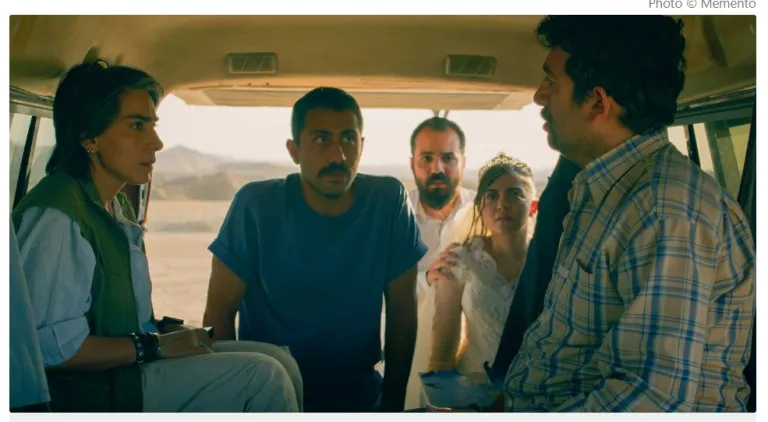
Panahi’s visual style gestures toward deliberate simplicity built on omission. Yet simplicity only acquires formal value when it emerges from a conscious and organized artistic choice. In most scenes involving the extended conversations between Vahid, Shiva, and the bride and groom, there is not a single thoughtfully composed shot. The framing is strikingly ordinary and aesthetically ineffective. In most dialogue scenes, verbal confrontations that could have reached emotional intensity through spatial design and shifts in camera axis are drained of dramatic energy through repetitive shot selection and a complete lack of variation in perspective. Such decisions suggest not a conscious reduction of cinematic elements, but rather the absence of a carefully designed découpage.
In the scene where Hamid argues with his companions in the desert over the interrogator’s fate, the mise-en-scène feels profoundly amateurish. The arrangement of bodies within the space, their movements, and their relation to the frame are guided by no discernible logic, and instead of directing the viewer’s gaze, the camera wanders pointlessly from side to side. This sloppiness recalls neither documentary realism nor anti-formalist style; it resembles, rather, a student filmmaking exercise made without the time or discipline necessary for proper staging and direction.
The film attempts to turn its premise into tragedy, yet its narrative structure often resembles unintentional comedy. The repeated transporting of the interrogator through the city and back into the desert recalls black comedies such as The Trouble with Harry or The Night of the Hunchback—with the crucial difference that in those films, comedy and irony are consciously embedded within the structure, whereas in It Was Just an Accident, the comedy is largely accidental and fundamentally at odds with the film’s self-serious tragic tone.
The hospital sequence is a prime example of this tonal confusion: a situation that could have served as the climax of the moral conflict between revenge and responsibility instead turns into a shallow and exaggerated comedy. The enraged, revenge-driven dissidents suddenly become devoted caretakers of the interrogator’s wife, despite the fact that this ethical transformation and inner shift have never been developed throughout the narrative.
The film constantly delivers anti-violence slogans through characters such as the bride and Shiva, while at the same time violence permeates their own interactions and profanity-filled dialogue. Had this contradiction been consciously explored, it might have pointed to the internal contradictions of the opposition or to the violence accumulated within society itself. In the film, however, it feels more like the awkward juxtaposition of two incompatible tendencies: a civilized, ethical posture tailored for festival consumption, and a lumpen, rage-filled posture meant to create a sense of realism and taboo-breaking authenticity.
The use of vulgar language appears less dramatically motivated than performatively provocative—as though the sole purpose were to demonstrate that opponents of the regime are not necessarily polite or noble individuals, but can also be foul-mouthed and aggressive. The problem is that the film simultaneously refuses to portray them as uncultured or thuggish, and therefore continually attempts to morally purify them. The result is a fractured and confused representation of the regime’s opponents.
The height of this problem appears in the scene where the interrogator’s daughter calls Vahid on the phone. At a moment when everyone is supposedly consumed by rage and the desire for revenge, a single phone call is suddenly enough for the entire group to endanger themselves, keep the interrogator tied up inside the van, and collectively escort his wife to the hospital. The most obvious and rational course of action would simply have been to call emergency services and request an ambulance. This narrative choice emerges less from the logic of the situation than from the filmmaker’s moral agenda, which attempts at the last moment to inject ideas of forgiveness and human responsibility without having properly established the groundwork for them.
The film’s final long take is intended to function as its moral and tragic climax: the moment in which the interrogator, at the height of his captivity, speaks in an arrogant and authoritative tone. First, he denies everything; then he suddenly transforms into a loyal servant of “the System and the Supreme Leader”; and immediately afterward, following a few slaps from Shiva, he turns into a pathetic victim of the system, speaking of coercion, childhood humiliations, and finally collapsing into pleading and remorse. Such drastic shifts in position within such a short span of time, without any preparation, are neither psychologically convincing nor dramatically coherent. The sequence resembles a compressed montage of contradictory clichés about interrogators assembled one after another.
The decision to release an interrogator who now knows everyone’s identities and could easily have them arrested has no realist justification and is entirely implausible. Through the final shot of Vahid from behind and the sound of the interrogator’s footsteps and prosthetic leg, the film pretends to arrive at an open, ambiguous, multilayered ending. Yet this ambiguity is not the result of suspense, but of the film simply refusing to resolve its central problem. Rather than wondering whether the interrogator has returned to apologize or to seek revenge and arrest them, the viewer is left asking why such an elaborate narrative journey was necessary to arrive at such a weak and unfinished resolution.
The film’s structural and situational resemblance to Death and the Maiden is unmistakable: political victims confronting a former interrogator in an enclosed space, the tension between revenge and justice, and the final confession. A published letter by Ariel Dorfman indicates that Panahi had previously contacted Dorfman seeking adaptation rights but received no response and no permission was granted. Even if legally such a matter may be difficult to prove or pursue, ethically the very least expected would have been an acknowledgment in the credits stating that the film was freely inspired by Death and the Maiden. The omission of such acknowledgment, given the obvious similarities, places the film in a morally questionable position and stands in contradiction to its own themes of justice and responsibility.
Another major weakness of It Was Just an Accident lies in the performances, which are often clumsy and amateurish—not in the sense of the controlled naturalism and nonprofessional acting associated with neorealism or certain Iranian independent and art-house films, including some of Panahi’s earlier works such as The Mirror or Crimson Gold, but rather in a rawness and inconsistency that constantly pulls the viewer out of the scene. The actors compensate for weak performances with shouting, profanity, and abrupt, meaningless gestures. The dialogue is artificial and sloganistic, while the actors appear lost within the film’s sloppy and neutral mise-en-scène. As a result, emotional and dramatic relationships between the characters never truly materialize on screen, and the audience struggles to believe in their suffering, anger, or hesitation.
This weakness in acting is intensified by the film’s uneven and bifurcated rhythm. In the first half, the narrative relies largely on longer takes and extended pauses, producing an overall slow tempo. Yet this slowness does not emerge from carefully constructed suspense, but from stretching insignificant actions and filling time with unnecessary comings and goings. In the second half, the rhythm suddenly shifts: shots become shorter, cuts faster, and the film attempts to generate crisis and suspense through superficial acceleration. Because this change in tone and rhythm lacks formal coherence, the film loses all momentum, as though two separate films with incompatible temporal logics had been awkwardly stitched together. This fractured rhythm, combined with the unconvincing performances, destroys the film’s emotional and stylistic unity and prevents the audience from fully inhabiting its narrative world.
It Was Just an Accident is ultimately a mixture of scattered ideas, moralistic slogans, and political-taboo-breaking gestures that function effectively within the current international festival climate—particularly at a moment when Iran is engulfed in political and existential crisis—but in terms of narrative, characterization, and mise-en-scène, it lacks cinematic coherence and creativity, resulting in a film that is profoundly amateurish, superficial, and artistically worthless.