



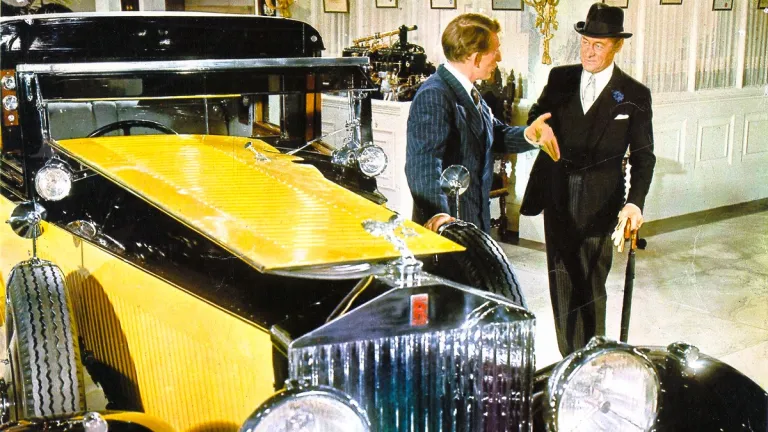
The Yellow Rolls-Royce is a romantic comedy-drama centered on a luxury automobile that becomes the vessel for the formation of short-lived, forbidden yet enduring loves—affairs whose memory endows the Rolls-Royce with a distinctive identity.
Anthony Asquith, the English filmmaker, entered the world of cinema by gaining experience in various fields such as stunt work, assistant directing, screenwriting, and editing. As a result, when he decided to direct, he possessed a comprehensive understanding of the many facets of filmmaking.
He made his first film in 1928 and over the course of 36 years directed more than 40 feature films, many of which received awards and nominations at prestigious international festivals. Among his achievements were winning the Silver Bear at the Berlin International Film Festival for The Browning Version and receiving nominations at Cannes, Venice, and other major festivals.
Asquith’s filmography includes notable works such as The Browning Version (1951) and the documentary A Night with the Royal Ballet (1963), both acclaimed for their awards, recognition, and reception among cinephiles. However, the final film of his career holds a special place due to its ensemble of famous actors, its structure and form, and especially its emphasis on doomed romances—qualities that have made it particularly memorable.
The Yellow Rolls-Royce is based on a screenplay by Terence Rattigan, the celebrated English playwright, who had written numerous plays and screenplays. His works earned nominations for Academy Awards and BAFTAs, and The Browning Version won the Best Screenplay award at the Cannes Film Festival.
The film received BAFTA nominations for Best Cinematography and Best Costume Design. At the Golden Globe Awards, it was nominated for Best Original Score and ultimately won Best Original Song, composed by Riz Ortolani.
The Yellow Rolls-Royce unfolds in three episodes, each devoted to a love story, with the car serving as the connective thread. The Rolls-Royce plays a decisive role in shaping short-term, forbidden romantic relationships that end in failure—yet for various reasons become lasting experiences for these contrasting couples.
Accordingly, the film’s narrative structure can be considered non-classical yet simple and fluid, enabling the formation of a romantic-comedy atmosphere in each episode. The presence of well-known actors in shaping love triangles or relationships born of conflict and prohibition gives the film its enduring appeal and narrative pull.
In all three episodes, the purchase of the yellow Rolls-Royce sparks the beginning or development of a doomed, secret relationship, often marked by intimacy inside the car. Eventually, the car becomes a pretext for its sale—turning into a pleasant memory for one person and a bitter one for another, and serving as the gateway to the next episode.
The film opens with images of a luxury car being transported through the streets of London under a cloth covering. This motif is repeated in various shots, laying the groundwork for a sustained focus on the car’s presence and creating a sense of curiosity about its identity.
This design is further developed in the next scene, when the new Rolls-Royce is unveiled behind a shop window, its yellow color drawing everyone’s attention. Soon after, Marquess Frinton (Rex Harrison), an English aristocrat working at the Foreign Office, decides to buy the car as a gift for his beloved wife, Marchioness Frinton (Jeanne Moreau), on the anniversary of their relationship.
This moment marks the beginning of the first episode. The Marquess becomes fascinated by the car’s features—from the liquor cabinet and window curtains to the telephone and even the height of the rear seat—offering suggestions for improvement, while the salesman insists on describing the car’s performance and engine power.
All these details, particularly the Marquess’s obsessions, function as narrative cues that later acquire dramatic significance—not for the privacy of the Marquess and Marchioness, but for the latter’s secret rendezvous with a Foreign Office clerk, Finn (Edmund Purdom).
Their tryst inside the Rolls-Royce runs parallel to the Gold Cup horse races, which, despite the Marquess’s horse winning, culminate in the exposure of the wife’s infidelity and the collapse of their planned marriage. This ending of the first episode explains the man’s hatred of the car and his decision to return it to the company—an act that initiates the car’s journey from owner to owner and its trip to Genoa, Italy.
In the second episode, the yellow Rolls-Royce is purchased by an American gangster, Paolo Maltese (George C. Scott), for his incompatible fiancée, Mae Jenkins (Shirley MacLaine), for a tour of Italy. In this episode, particular emphasis is placed on the car’s sense of identity, evident in Mae’s first encounter with it, her references to the car’s “spirit” and “personality,” and the repetition of this motif in the middle and end of the episode.
Here too, a forbidden romance develops—this time between Mae and a street photographer, Stefano (Alain Delon)—with the Rolls-Royce providing the setting for their happiness. Though brief, the experience is profound, ultimately compelling Mae to make a rational choice to save her lover’s life: she gives him up, affirming the law of survival and, paradoxically, the nature of passionate love itself.
The transition from the second episode to the third occurs with the end of the Italian journey and the couple’s return to America, along with the prospect of marriage. Naturally, the car loses its function, paving the way for the third and final episode, set in 1941 in the Italian city of Trieste near the Yugoslav border.
The Rolls-Royce is no longer in its luxurious state and sits in a repair shop, with the word “Used” written on its windshield. A wealthy American widow, Gerda Millett (Ingrid Bergman), calls about purchasing it.
This situation marks the beginning of Gerda’s challenging journey to a turbulent Yugoslavia alongside a young patriotic revolutionary, Davich (Omar Sharif), during which she is unwittingly drawn into a partisan operation—and an untimely romance.
As Nazi Germany launches a sudden attack on Yugoslavia, the journey forces this resolute woman to confront the harsh realities of war and to take a personal stand against Germany, despite her country’s declared neutrality. Gerda comes to the aid of the partisans and stands alongside Davich.
It is these diverse and compelling experiences that seem to persuade her—unlike the previous owners in the earlier episodes—to keep the yellow Rolls-Royce. Upon returning to Italy, she asks the hotel manager to have the car shipped to America.
The Yellow Rolls-Royce is a film that, across three episodes framed as romantic comedy-dramas, not only tells distinct love stories rooted in conflict and contrast, but also grants new dimensions to the vehicle itself—effectively turning it into a character endowed with an identity as expansive as the singular love it carries, a love deemed worthy of preservation and remembrance.